A new Aotearoa Jewish identity: justice as our common cause

The Spinoff 211024: a new book argues for a religious space without nationalism.

Marilyn Garson’s guest column in The Spinoff:

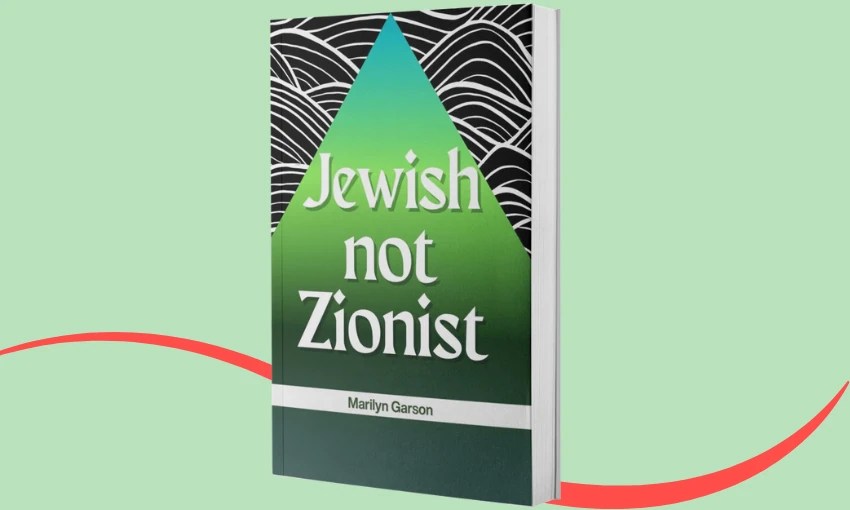
Marilyn Garson, author of Jewish, Not Zionist, outlines how Aotearoa’s Jewish community can live a full Jewish life without Israel. 

Israel’s advocates have tried for years to cram Jewishness into Zionism. It’s time to unpack these terms: we are Jewish, an ethno-religious group. Israel is a state. Zionism is a nationalism, and a large majority of Zionists are Christian. How large? A group of 65 Christian clergy publish as the Coalition of Ministers Supporting Israel in New Zealand. That’s nearly 11 times the number of Jewish synagogues, and 13 times the number of rabbis in the country.


Aotearoa’s media has generally told just two Jewish stories.
Either we are asked to speak as pro- or anti-Zionists; or else
antisemitism is used to justify exceptional licence for Israel. The
licence granted by that narrative now appears to be endless.


Those two well-rehearsed scripts are equally limiting. They
wrongly present broad issues of justice and racism as separate Jewish
matters, centred on Israel. The first reduces Palestine and Palestinians
to being the voiceless objects of Israel’s actions. The second severs
anti-Jewish racism from others’ experience and from our common
anti-racist mahi. 


Those narratives leave no space for a fearless, outward-looking
Jewish identity; one that is not centred on Israel at all. Can we not
live a full Jewish life right here in Aotearoa?


Stories of a revitalised diasporic Jewishness come from New
York, London, Berlin and other major northern cities. Justice-oriented
Jews walk out of the Zionist-Jewish institutions that denigrate their
principles. They explore their Jewish identities in new communities of
values. Flourishing Jewish organisations
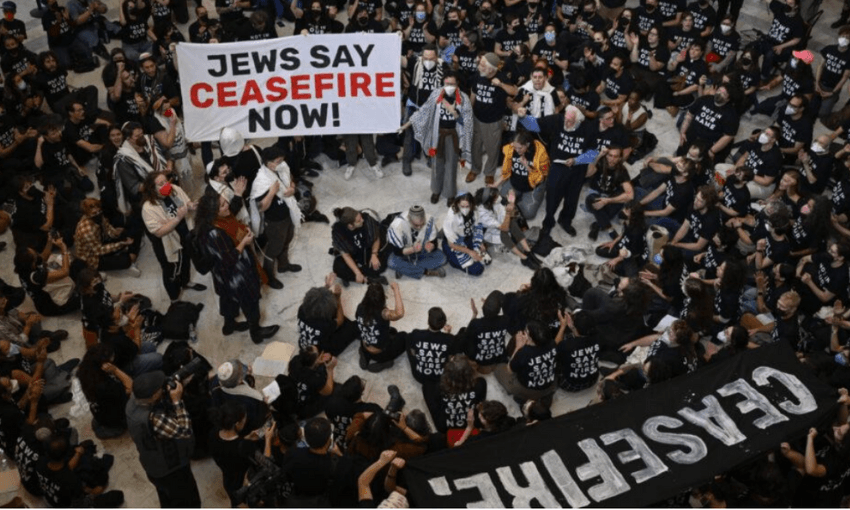
bring ritual into public space, to wrest the symbols of Judaism back from settlers and soldiers. 


Jewish protest surrounding rabbis (wearing prayer shawls) in the Congressional rotunda (Photo: Jewish Voice for Peace)

That’s New York. What happens here? North of the Dunedin Jewish Congregation,
what happens when a Jewish person asks, “What will I believe?
Everything I have been told? Or the world in front of my eyes? If I am
not Zionist, who am I?”


Until very recently, we asked that question at the expense of
our communal lives. The effort of forming a Jewish identity that is
politically alive and principled – and, for some of us, spiritual – was
solitary work. Now we are building organisations to belong to. We have
made a religious space not distorted by nationalism. 


I wrote Jewish, not Zionist to tell one story of Aotearoa’s liberatory Jewish community. Far from feeling threatened by the rights of Palestinians, we regard justice as our common cause. We are tangata Tiriti, committing also to the long
work of justice at home. 


If not through Zionism, Aotearoa’s media presents the Jewish community through the lens of antisemitism. Repeatedly, reports of protest are diverted by claims of antisemitism. The focus of protest is obscured by personal accusations. It is an act of political misdirection to confuse principled protest with racial hatred. It implies that there is no other motive for upholding the
rights of Palestinians.


Furthermore, when the media fails to present the Jewish
community more fully, they reduce Jewish identity to victimhood. That is
a distortion. We – Jewish New Zealanders – are not Aotearoa’s victims.
Here, now, we are not underserved, over-imprisoned, or denied education.
We do not tend to be food-insecure and few of us lack shelter. Many of
us lead privileged lives. And we are not the people whose whānau are
experiencing what the UN’s highest court has called “plausible
genocide”. 


We are not victims but we are targets of antisemitism. Distinct from its political use, real anti-Jewish hatred is alive and well. From the far right and malevolent disinformation networks, hardcore antisemitic voices are vigorously seeking to capitalise on widespread anger at Israel.

They want to spread the lie that Jewishness is the cause of genocide in
Gaza and injustice in Aotearoa – not nationalism or colonialism or
imperial power-seeking, but Jews. 


Overwhelmingly, these networks are also Islamophobic: Jews and Muslims are in this together. Aotearoa’s anti-Zionist Jews work alongside our natural antiracist allies to uphold the rights of Palestinians, Muslims, tangata whenua and Jews. Human and political rights are everyone’s rights, or they are nothing.


Even as we struggle with our outrage at Israel’s slaughter of
civilians and the betrayals of law and politics, we reject the excuse of
racism. We see exploitative structures of power and economy, not
ethnicity. We protest against the crimes of genocide, apartheid,
collective punishment and starvation – not against Jews, Jewishness or
Judaism. Not against Palestinians, Arabs, Muslims or those who are
assumed to be Muslim. 

At this moment, being Jewish in public can feel like standing on a very
narrow bridge. As Rebbe Nachman of Bratslav wrote, when you stand on a
very narrow bridge, the most important thing is not to be afraid. In
that spirit, I have written one story to invite the whole anthology of
our liberatory, spiritually and politically alive Aotearoa Jewishness.


Please tear up the old scripts and make some space.


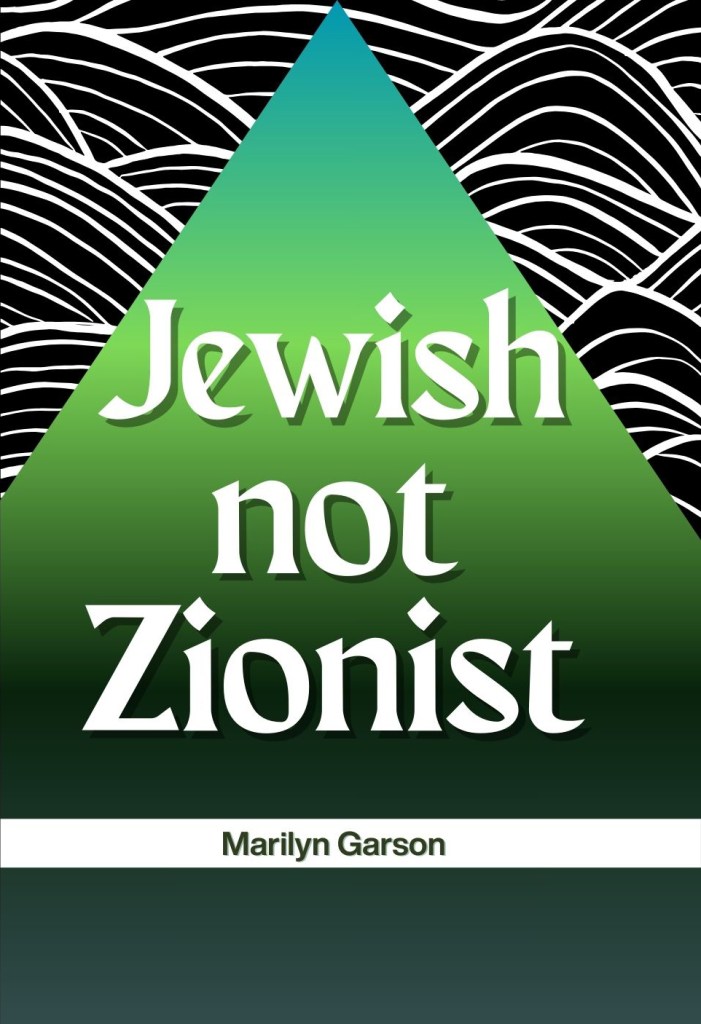
Jewish, not Zionist by Marilyn Garson ($30, Left of the Equator Press) will be launched at Unity Books Wellington on October 22 and at Trades Hall, Auckland on October 27.


How is antisemitism working right now?

A joint statement by leaders of Alternative Jewish Voices, Justice for Palestine and Dayenu: NZ Jews Against Occupation:

We in Aotearoa have been fortunate to work in a rights-based, antiracist partnership for peace–grounded in justice–and self-determination for Palestine. Along that road, we have spoken often about the content of justice. We believe it is now urgent to speak in more depth about the content of antiracism.

Antisemitism has been politicised and weaponised. We have had to repeat what antisemitism is not. Anti-Zionism is not inherently antisemitic. Principled protest against Israel’s genocidal campaign in Gaza, its illegal occupation of Palestinian territories, its apartheid and its regional escalation are not inherently anti-Jewish. ‘Israel’ does not equal ‘Jews’. 

We have used a simple guideline for contrast: antisemitism is the hatred of Jews, the Jewish religion or Jewish identity. That is no longer sufficient. Antisemitism stalks the edges of our work together and we need a better understanding. What work is antisemitism seeking to do right now, around and among us?  

What is antisemitism?

Antisemitism is a shape-shifting racism. For centuries, Jews have been the Other within while Muslims were the Other without. We all carry that legacy in our intergenerational memory and in our social structures. It may be unexamined, or it may have impacted some part of our lives—but it is there in our collective histories, latent and available to people who wish to exploit it.

If we shrug and say that antisemitism is eternal and fated, then we are saying that racism is beyond our control. We do better when we understand and confront the fluid, purposive use of racism, and when we hold racists responsible for their actions.

Antisemitism is a means of oppression. It is a dual-use lever wielded with purpose. Its dual uses help to explain its many manifestations.

A recent book, Safety Through Solidarity, uses the analogy of punching up or punching down. Most racial hatreds punch down. They justify the oppression of some group by portraying them as inferior people. Racist speech essentialises and attributes characteristics to the target group, making their inferior status sound natural. That excuses racist actions which hold the group down.

Conversely, conspiracy theories allow antisemites to claim to be punching up when they target Jewish people. They claim to be saving society from mythical Jewish powers. Inevitably, they are misdirecting others in order to advance their own purpose.

That adaptable dynamic explains why antisemitism emerges in forms that suit a wide range of grievances. Adolf Hitler attributed all of his society’s ills to Jews. He crafted antisemitic language to suit his moment, and held up the Jewish community as an all-purpose object to divert, unify, harness and radicalise Germans’ existing, latent dissatisfactions. He used Jewish people to advance his own purpose.

Benjamin Case, in Safety through Solidarity, explains the malleable use of antisemitism:

…to defeat fascism you must understand how they see the world and in many ways it hinges on antisemitism… Fascism requires a concealed ultimate enemy responsible for making the strong weak. It is the ultimate conspiracy theory, which is why a lot of the most popular conspiracy theories have an antisemitic architecture: the secret cabal behind the scenes running the show, bound by some evil, mystical lineage.

Antisemitism is a method that serves a multitude of political or material purposes. Within any movement, it breaks the unity of those who would resist or oppose that particular purpose. At the moment, it seeks to break the unity of those who protest for our equal human and political rights.

That underlying explanation leads to a working principle of antiracism: 

People who exploit or oppress 

do so for reasons unrelated to their religion or ethnicity. 

Individuals act badly because they seek wealth or power or the protection of their status. A soldier commits an atrocity because they are empowered and hateful. Individuals do not commit crimes because harmful motives are an essential characteristic of their ethnic group. That principle directs us to identify and respond to each actor’s actual motivation. We harm each other, and we miss the chance to respond effectively, if we have been misdirected by racist explanations.

How does antisemitism manifest now?

Classic antisemitism speaks in tropes, conspiracies, or shameless hatred. Often it is expressed by attributing global or disproportionate power to Jews, who are then blamed for one’s grievances or unsatisfactory place in a hierarchy. Jewish people are portrayed as being essentially evil or dangerous.

At the moment, we see these conspiracist inclinations in new forms: Israel’s government or military does X because Jews are Y. Racialised motives replace the secular motives of politicians and armed actors. That kind of statement reduces Jewish people to fictitious negative attributes, and blames all Jewish people for the indefensible, criminal actions of some. That is antisemitic. Look for it on social media, where it is common. The understandable rage against the actions of Israel’s government and military is leading to the language of a more generalised anti-Jewish rage.

Good Jew / bad Jew: This speech embraces some Jewish people as ‘proof’ that the speaker is not antisemitic, then goes on to essentialise and attribute evil to all the others. Having approved of a few, the speaker feels free to condemn the rest in racial terms.

As anti-Zionist Jews, we are a political minority in our own community. We hear some people make us their approved exception. They go on, not to disagree with the others, but to characterise and denigrate them en masse. Similar, categorical speech is also used by Zionist Jews and Christians to vilify the Jews with whom they disagree. 

To avoid antisemitism, speak to the choices, ideologies, or actions of any people rather than essentialising them as a racial category. We are not good and bad racial groups. Just as we have become attuned to the racist implications of blurring ‘Palestinian’ into ‘Hamas’ and then into ‘terrorists’; we need to hear the distinction between profound disagreement and racialised characteristics of any group.

Antisemitism and Israel: Israel’s advocates refer eagerly to ‘the Jewish state’. The Israeli government uses the same language. Legislation openly allocates rights by ethnicity, including the 2018 Basic Law: Israel as the Nation-State of the Jewish People. That is part of apartheid. The government of Israel is wrong (and they have no mandate) to appropriate Jewish identity for their settler-colonial project. 

In the name of upholding Palestinian rights, it’s easy to respond in similar terms. Often it happens in shorthand: Netanyahu’s criminal guilt is called ‘Israel’ while Israel, its soldiers and its settlers become stand-ins for all Jews. No amount of anger makes those racialised generalisations true. Criminal guilt is individual.

The actions of a cabinet minister or a settler are wrong because they enact violent, sometimes genocidal intentions. Their wrongs are not related to identity. Their horrible acts would be wrong for anyone to do to anyone. 

We recognise the care that is needed when Israel’s advocates use misdirecting language. We ask our communities to recognise the harm of adopting their shorthand.

Why is this important?

Antisemitism is purposefully, energetically being normalised by hardcore antisemites and disinformation actors. They see the genocidal violence of the IDF as an opportunity. Some rights-based activists have simply given up, feeling that antisemitism has been politicised beyond comprehension. That lets racism in.

It’s a big ask to pay attention to this while the government of Israel is allowed to starve two million civilians, while settlers draped in the symbols of the Jewish religion are allowed to terrorise and displace Palestinian families without consequences. 

Remember that hate misdirects action. It is not merely good, it is also smart to take the time to distinguish criminal individuals from Jewishness. Poor analysis leads to wrong-headed protest, leaving the real structures of nationalism, militarism, colonialism and racism untouched.

Take an example from BDS. If antisemitism lures a person to think that all Jewish-owned companies are to blame, they will boycott businesses which have absolutely no impact on the financial flows that support Israel’s illegal occupation of Palestine, or its military industries. Effective BDS is specific and evidence-based.

Antiracism in solidarity 
Pointers:

We believe that antiracism is a fundamental principle at the core of organising for Palestinian human rights. For the most part, we focus our energy on opposing racism in all its forms. We know how colonisation, fascism and white supremacy capitalise on division, fear of the Other and scapegoating. However, we also need to be aware that racism against different groups has always had its unique characteristics. We believe the following questions are important to consider in relation to antisemitism:

–   How can we ensure evidence (not race or ethnicity) determines our targeting and campaigns?


The BDS movement has always had clear guidance around targeted campaigning and boycotts. These guidelines ensure that we accurately target structures and services, not individuals. Unfortunately, we have no shortage of evidence of human rights abuses to ground our choices. We use evidence of complicity in Israeli apartheid and genocide, not assumptions, to determine our campaign targets.

–   If words have power, how do we use them to promote antiracism?


Notwithstanding the desire for stronger and stronger language to reflect the escalating horrors we see, we have factual language to describe these horrors. Illegal and genocidal are words used by the ICJ; terms like subhuman are redolent of racism. It’s worth considering how fascists and war criminals often used, and still do, frameworks which divide people into good vs evil along racial lines. Eg in Netanyahu’s words, “We are the children of light, they are the children of darkness.” These frameworks are fascistic.

–   How do we address Israeli impunity without falling into antisemitic conspiracy?


Some generalisations attribute unlikely power or capacity to the Jewish community or to Israel. This feeds conspiracy and incorrect analysis of the role of US empire and its geopolitical interest in the Middle East. It also leads us to misunderstand the real power we have to change these systems. Conspiracy theories disempower and divide us. Our job is to promote an understanding of the very real power structures at play. Informed analysis leads to an informed strategic response.

How do we get it right if we feel unsure?
When it all feels too complicated, remember that it is never antisemitic to speak to the rights, the aspirations and the full humanity of Palestinians. Speech that upholds human rights is not anti-anyone. Affirming what we stand for, rather than just defining ourselves by our opposition is critical to our strategy. 

We embrace the antiracist principle that Palestinians are not defined by that which is done to them, their whānau and their homeland. By the same antiracist principle, Jewish people are not defined by the actions of Israel.

Great sources for reading in depth:

Historical analysis of the emergence of modern antisemitism: Critical Theories of Anti-Semitism, by Jonathan Judaken

Antisemitism within antiracist activism: Safety Through Solidarity

See also PARCEO for excellent curriculum resources on liberatory antiracism

BDS guidelines

Fred Albert and Marilyn Garson, Alternative Jewish Voices

Nadia Abu-Shanab, Kate Stone and Samira Zaitoun, Justice for Palestine

Justine Sachs and Avigail Allan, Dayenu
What makes a liberatory Aotearoa Jewish identity?

launching in Wellington Oct 22, and in Auckland Oct 27

What happens in Aotearoa NZ when a Jew acknowledges Palestinians as her equals? What does anti-Zionist mean? For the first time, Jewish, not Zionist tells a very personal story of Aotearoa’s Jewish solidarity with Palestine.

Marilyn Garson worked in Gaza for four years. In her new book, she recounts her homecoming as a practising Jew seeking her faith community and justice for Palestine. Painfully excluded from her community, she slowly constructed a liberatory Jewish identity—both activist and spiritual. She co-founded Alternative Jewish Voices to call for justice in a pluralist, anti-racist Jewish voice.

In two parts, the book also carefully explores the power of a political definition of antisemitism to shield Israel’s unbearable violence and apartheid. It deconstructs the echo chamber of overlapping entities which purport to speak for the Jewish community. Throughout, the book offers timely analysis of the impact of the International Court of Justice’s July 2024 Advisory Opinion. In particular, Garson reinvigorates human rights as a radical politics for dehumanised Palestine.

Co-founder of Alternative Jewish Voices and a steering committee member of Global Jews for Palestine, Garson writes with the aroha of Gaza and an unwavering resolve learned on the front lines of the international movement for justice.

Advance praise for “Jewish, not Zionist”

One day, Jewish, not Zionist will be riveting testimony to a Jewish solidarity with Palestine that blossomed in our unique context of Aotearoa. Right now, it is an urgent meditation on getting there. Together.

Nadia Abu-Shanab, Palestinian organiser

We are very fortunate to be offered a glimpse into a full life of solidarity and community building, from a writer who treats self-reflection with the utmost care. A brilliant work of solidarity. Garson shines a light, through sharp and honest prose, on an alternative path to identity and religious hope through community building.

Murdoch Stephens, Author of “Doing Our Bit: The campaign to double the refugee quota”

In this extraordinary book, Marilyn Garson grapples with the unbearable pain of her exclusion from her small New Zealand Jewish community in response to her support for Palestinian human rights. Rather than a tale of retreat and recrimination, this is a story of spiritual and political commitment to the principle that Jewish tradition and practice can and must be reclaimed for liberatory purposes.

Dr Sheryl Nestel, Independent Jewish Voices of Canada Steering Committee, 2012 – 2022; Affiliated Scholar at New College, University of Toronto

Marilyn Garson’s compelling book takes readers on a journey of resistance, shedding light on the conflict between Jewish identity and Zionism. It urges us to delve into grassroots Jewish solidarity, its potential and challenges, and the struggle against Zionism’s dominance. This timely contribution is essential in understanding the role of Jewish solidarity in dismantling Israeli colonisation and reclaiming the true essence of Jewish identity. It is particularly relevant in the face of the ongoing genocide in Gaza, providing valuable insights and perspectives on these current events.

Dr. Nijmeh Ali, National Centre for Peace and Conflict Studies, University of Otago

An ancient Chinese proverb says: “When Marilyn Garson speaks, the world ought to listen.” Having benefited from Marilyn’s wisdom and spirit over many years, I wholeheartedly recommend the proverb and her new book.

Norman G. Finkelstein, Author of “Gaza: An Inquest Into Its Martyrdom”

Wellington launch: Unity Books, 6:00 pm, October 22

Auckland launch: Trades Hall, 1:00 pm, Sunday October 27

The world of October 6

AJV remarks to the October 6 Pōneke / Wellington event: Past, Present, Future

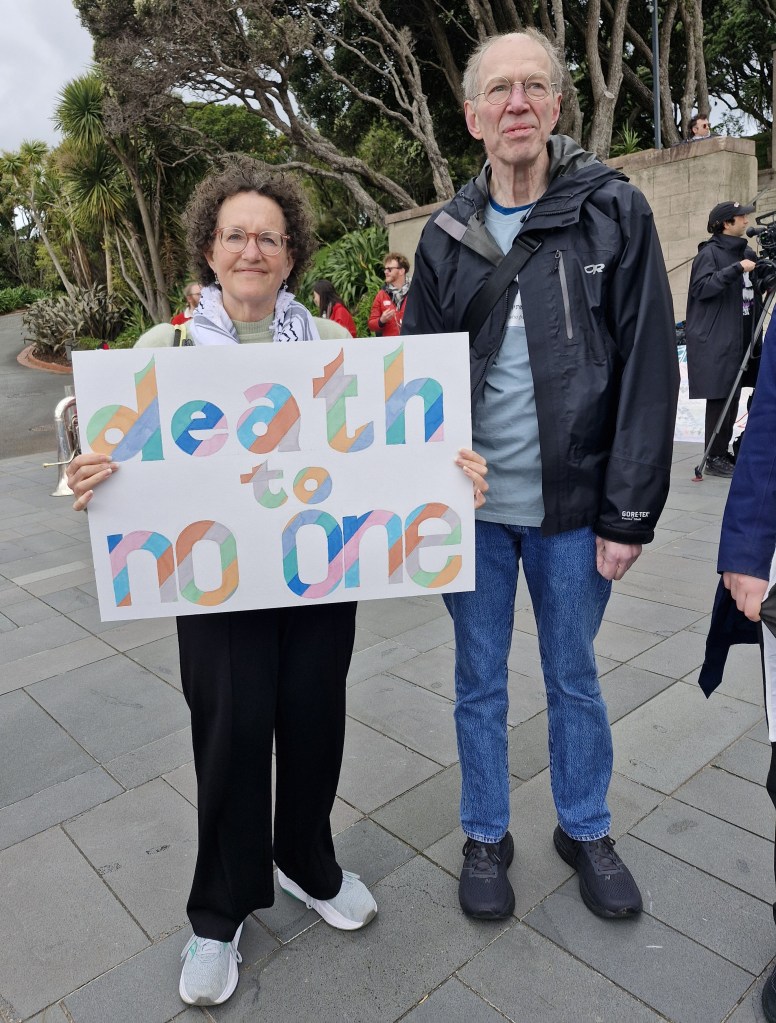
co-founders Fred and Marilyn, October 6 2024

Kia ora koutou,

I whakakaupapa māua ko Fred Albert i te rōpū Alternative Jewish Voices

Ko Marilyn Garson taku ingoa.

A year ago today, four generations of Palestinians had lived under an illegal occupation. The population of Gaza had grown 29 times in the same space. How would Pōneke / Wellington feel with 6.1 million people behind a blockade wall?

Young Jews were still being told that we could live a pioneering Jewish life right next to that wall. As if confining two million Palestinians would bring their humanity into question, rather than ours.

I lived in Gaza through four of its 17 blockaded years. Driving along the back road, I could see that the land on the other side of the wall was irrigated. There were lights at night.

I used to wonder, what happens to children who grow up seeing rubble every day? How do you relate to the world, when every horizon of your world is armed? What do you dream, when an air force bombs from the sky? Who do you reach for when an army has always prevented you from driving one hour to meet your West Bank whānau?

Israeli opinion surveys approved of what they called conflict management. They no longer thought that they had a Gaza problem, but Gaza never stopped having a blockade problem. Diplomacy hadn’t had an idea for decades.

Two years ago, Israel elected a proudly fascist government. Itamar Ben Gvir was no conflict manager. He called for attack and expulsion. We heard his genocidal intentions. In the West Bank pogroms we saw them. One year ago, 2023 was the deadliest year for West Bank Palestinians.

But the world had gone numb. Palestinians knew it; Israel’s Cabinet was counting on it. Genocide always glides past the indifference.

Then the clock struck midnight. The illegal billion-dollar barrier that held the world’s greatest power disparity in place, turned out to be just a fence. The horror and the violence became a shared reality for one day. For 365 days since then, we have seen the genocidal violence of Israel’s government and military. We see the US arming and participating. Today we see them reaching into Lebanon, Syria, Yemen, Iran.

We, AJV, acknowledge the history of Palestine’s pain. We hold people accountable for the illegality. These days we struggle to hold our outrage and our horror, without conceding to hatred and despair. We cling to the vision of a dignified future for all who live between the river and the sea. Our protest is our demand that we must all be loved and safe and self-determining – and free.

The International Court of Justice has instructed us, Palestine must be free.

GLOBAL JEWS FOR PALESTINE SPEAK OUT FOR JUSTICE 

As we approach the Jewish New Year and as we come upon almost a year of Israel’s genocide against the Palestinian people, Global Jews for Palestine–a coalition of organizations from 16 countries across the globe–releases (see link below) a 5.5 minute collective video speaking to the moment we are in as well as a statement attached (Al Het: confession of sins recited during Yom Kippur, the Day of Atonement).


October 1, 2024

“Ashamnu” – We are culpable”

On Yom Kippur, Jews traditionally confess our sins in public. We confess in the plural, and we do so not only for our own sins, but for those of the community we live in and for those of the Jewish people as whole – for even if we did not personally commit each and every sin listed, we are responsible for stopping our fellow Jews, and the Jewish communal institutions that act in our name, from committing these sins. According to the great medieval Sephardic Jewish philosopher and Torah scholar Maimonides, the person in whose power it is to prevent sin and does not undertake to prevent it is ultimately responsible for the sin since it was possible for them to prevent it.

This year as Jews worldwide recite the Al Het (list of sins) and the Vidui (confessional) under the shadow of a genocide being carried out in Gaza in which nearly 50,000 Palestinians have been killed let us consider some of the sins that have been committed in our name by people and institutions claiming to act on our behalf – namely by supporting and defending the oppression, historical erasure, degradation, dispossession, and killing of Palestinians in the name of Jewish self-determination.

Every day during the ten days of repentance, we will post one sin that our community must rectify in the quest for justice and moral accountability- heshbon nefesh.

אָשַֽׁמְנוּ

 “Ashamnu” (we are all culpable for the transgressions of our community). “Jewish communities must make a choice. We cannot continue to deny the injustices committed in our name against Palestinians. We must engage in the work of teshuva (repentance) by facing the truth about Palestinian suffering and by recognizing our complicity and ending our silence. 

בָּגַֽדְנוּ

Bagadnu” (betrayal) We have betrayed Jewish tradition by failing to acknowledge the humanity and rights of the Palestinians and by supporting the state of Israel as it carries out a genocide.

גָּזַֽלְנוּ

Gazalnu” (robbery) We have participated in the theft of Palestinian land by supporting the Jewish National Fund and the ever-expanding Israeli settlement project.

דִּבַּֽרְנוּ דֹּֽפִי

“Dibarnu Dofi” (slander) We have slandered and defamed those with whom we don’t agree including Jews who oppose Israel’s violence and human rights abuse

חָמַֽסְנוּ

“Chamasnu” (acting zealously)

In our zeal to protect Jews and Israel we have distorted, misused and weaponized charges of antisemitism.

טָפַֽלְנוּ שֶֽׁקֶר

“Tafalnu Sheker” (lying) We have distorted and denied the truth about Israeli crimes against humanity and justified policies such as the withholding of water, medicine and basic necessities to the people of Gaza.

פָּשַֽׁעְנוּ

“Pashanu” (perverting justice) We have wrongfully exerted influence on institutions so as to prevent legitimate criticism of Israel’s treatment of Palestinians.

קִשִּֽׁינוּ עֹֽרֶף

Kishinu Oref” (stubbornness) Even when confronted with the deaths of nearly 17,000 children, Israel supporters continue to claim that there are “no innocents in Gaza”.תָּעִֽינו

“Tainu” (straying from a righteous path) We have abandoned the fight for justice by refusing to acknowledge the Nakba – the ongoing Palestinian experience of violence, expulsion and dispossession’

תִּעְתָּֽעְנוּ

Titanu” (causing others to stray from righteousness) We have caused others to stray from righteousness by miseducating our community and our children about Israel’s role in the Nakba and Palestinian suffering alongside the history of Jewish suffering.

•  •  •

May the spirit of justice guide us in the new year so that we may open our ears to truth, open our hearts to the oppressed, and speak our minds courageously in order to begin to stop our community’s complicity in the, oppression, suffering and attempted destruction of the Palestinian people. 

In this season of atonement Jews must take an ethical stand:

*Demand an immediate end to the genocide in Gaza.

*Demand that our religious, educational and cultural institutions acknowledge and speak truthfully about the Palestinian Nakba.

*Demand that Jewish institutions stop attacking, maligning and punishing those who speak their conscience about Israel’s genocidal violence and dispossession of the Palestinian people.

*Demand an end to the malicious vilification of fellow Jews who name and oppose Israel’s violations of Palestinian human rights.

*Demand an end to Jewish communal funding for organizations that promote Islamophobia, anti-Arab and anti-Palestinian racism.

*Demand an end to Jewish communal funding for organizations that support and enable illegal Jewish settlements on occupied Palestinian land and which defend settler violence in the West Bank and East Jerusalem.

Written by Sheryl Nestel, Independent Jewish Voices Canada; Global Jews for Palestine