
I consulted to the office of UNRWA’s Gaza director for 2 ½ years. I arrived a skeptic, but I left convinced that UNRWA is indispensable for now.
Israel’s advocates have long tried to blur civilian Gaza into militant Hamas, as a way of discounting Palestinians’ civilian protections. This campaign extends to UNRWA itself, portraying UNRWA as a Hamas vehicle in order to call for its closure. Returning to Aotearoa at the end of 2015, I was taken aback by the depth of fury that the Israel Institute in particular reserved for UNRWA. So I have written intermittently about UNRWA since then.
Israel’s parliament has passed legislation that will ban UNRWA’s operations in Gaza and the West Bank on January 30. It will also close the headquarters which supports UNRWA’s operations in Jordan, Lebanon and Syria. UNRWA is mandated by the UN General Assembly, not by Israel. Its closure would violate the agreements Israel signed when it became a member of the United Nations. Israel’s action would also set a deadly precedent for other states to deny civilians the essentials of life. Simply put, if Israel bans UNRWA, “more people will die.” States have widely condemned Israel’s legislation as an immediate disaster and a calamitous violation of the UN Charter, the laws of war, Israel’s humanitarian obligations, and orders of the international courts.
Israel’s government is counting on the apathy of states like ours. Israel’s legislation will take effect unless states raise the cost of its implementation, such that Israel steps back. This month, a global campaign calls for civil societies’ intervention.
Israel’s legislation is an attack in three dimensions. It targets the life, unity and spirit of a community in resistance.
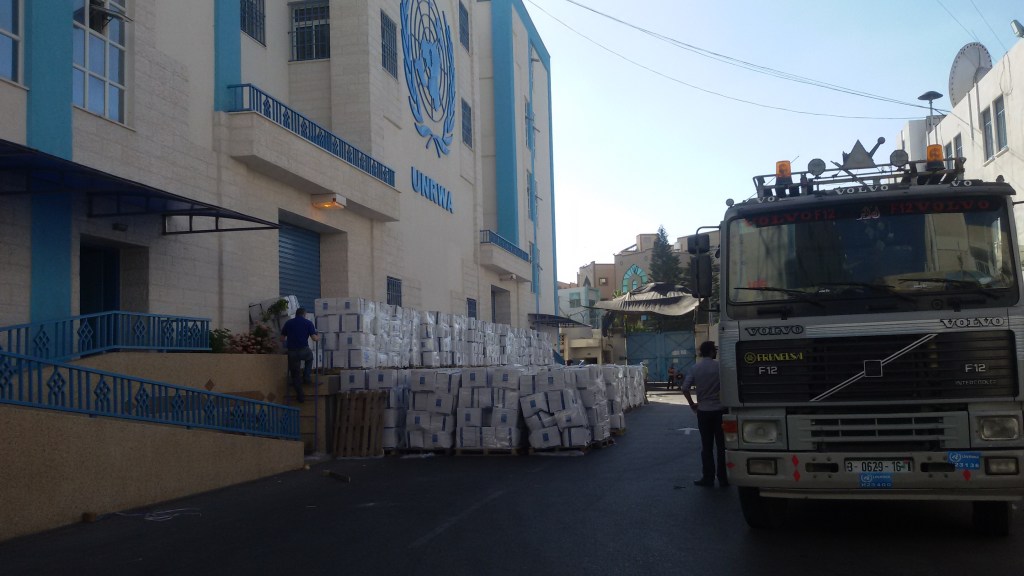
First and most urgently, UNRWA is indispensable to Gaza’s humanitarian assistance. This is not simply because UNRWA owns the largest number of trucks and is the largest employer in Gaza. More than that, UNRWA is the repository of expert knowledge. UNRWA anchors Gaza’s supply chain because it has been built to procure and bring goods through an atrocious blockade which inflicts collective punishment by keeping goods out. From the crossings through warehouses to neighbourhood distribution points, UNRWA’s capacity rests on skilled people from each of Gaza’s neighbourhoods.
Israel’s advocates say dismissively that UNRWA’s trucks can be given to others who have some disaster management experience. They say that it will be a routine matter to contract, hire, procure, deliver, navigate the blockade, warehouse and distribute lifesaving supplies without records or local knowledge. Behind a blockade, the likes of which exists nowhere else on this planet. Under fire, among people who have survived 15 months of unbearable suffering. Israel’s advocates say it will be routine to do all this in conditions of infrastructure, social and environmental collapse; while enduring an assault that the UN’s highest court calls ‘plausibly genocidal’. In 2018 I wrote,
“Gaza has not had a natural disaster… It is a zone of manmade, escalating sacrifice. To cast that as an administrative matter for routine, instant rescue is – and this is the very nicest thing I can write – murderously misleading.”
Israel’s attack on UNRWA is also essentially political. UNRWA is mandated to serve Palestine refugees as members of a single national community, displaced to a number of locations. UNRWA will do that until a durable, just political solution is in place. If Israel can pull UNRWA apart while other states yawn, UNRWA’s kinetic functions will be fragmented into thousands of NGO budget lines. There will be six-month contracts to supply sacks of flour to a given refugee camp, and NGOs will want to hit their quantitative marks in the hope of extending their contracts.
I once asked a group of Gazan IT graduates how they would feel about collecting food within such a system. They were aghast, and tried to put the obvious into words. Gazans are not simply poor. They have been intentionally, politically deprived for four generations. The neighbours who distribute and receive food in Gaza share that history and await a political solution together. To be Gazan is to be held in place. Gazans are the living evidence, and together they persevere. Food distribution enacts all that at neighbourhood scale. To simply line up before strangers without reference to cause or meaning or purpose would feel—the university graduates searched for words—diminished, even a little shameful.
You see, UNRWA is also the proof that donor states have not forgotten. UNRWA’s logo is a two-way bond. Less than two weeks after the cessation of bombing in 2014, people began to gather at UNRWA’s gates to protest donors’ slow response to the enormity of reconstruction. Where else should they go to be heard? UNRWA is the face of UN states’ obligations to Gaza, and its withdrawal would constitute a terrible betrayal at any time. It is unthinkable that Gaza would see us toss our obligations away after these 15 apocalyptic months.
Wouldn’t NGOs try to replicate that mandate?
I worked two years for a well-regarded NGO whose American donor required that documentation exclude words like blockade, occupation and war. Just like that, the hardship of Gazan Palestinians had neither cause nor solution, while Israel had no obligations. Humanitarianism is not about cause. It addresses needs in the present tense.
When I arrived at UNRWA, I asked a colleague which euphemisms I would be required to use. He regarded me as if I’d come straight out of kindergarten and spoke very deliberately, “Around here, we call a blockade a blockade.”
This is part of the reason why donors have kept UNRWA around. UNRWA is evidence of Palestine’s longstanding, unresolved injustice. As UNRWA’s January 30 denouement looms, the UN has made it clear that “the United Nations does not plan to replace the agency in the Palestinian territories, and the Knesset must reverse its decision to ban it.”
The UN is a set of institutions, a collection of member states and a framework of international agreements. The institutional UN will not cooperate while Israel trashes that framework, leaving in its place a compliant remnant of aid for people who are being starved as a war strategy. Now we need to convince our own member-state government to back that up with action.
UNRWA needs not simply preserving but progress, and there is only one direction in which to progress. There’s not enough left in Gaza to imagine reverting to the status quo ante. That is why Philippe Lazzarini, Commissioner-General of UNRWA has said, “UNRWA can be replaced only through a functioning Palestinian state which would address the plight of Palestine refugees.”
Remember that: UNRWA’s mandate can only go to a sovereign state.
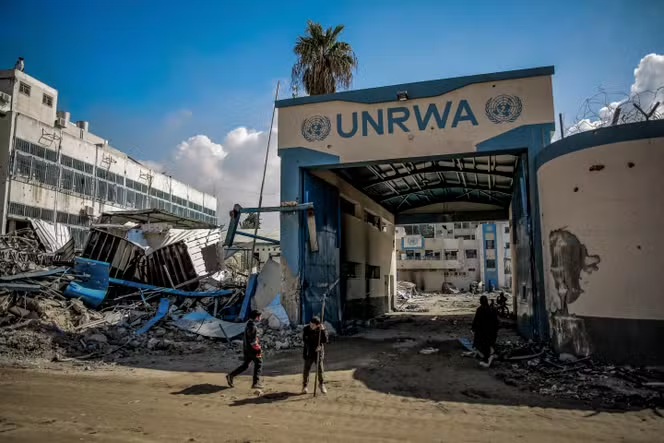
Is it too late? States have done nothing while Israel’s forces damaged or destroyed 70% of UNRWA’s buildings; 95% of them while they were being used as shelters. States have sat and watched while 237 UNRWA staff have been killed – the greatest loss in the history of the United Nations. What does it matter now? It matters because UNRWA continues to provide shelter in the buildings that remain. It still matters because there will be a ceasefire one day. Gazan Palestinians will need every ounce of autonomy and advocacy to decide what happens next. UNRWA will continue to matter for some time yet.
Therefore, in the coming weeks, please join AJV and Justice for Palestine as we push our government to do three things.
- Stand up for UNRWA’s humanitarian operations and its mandate.
- Attach consequences to Israel’s illegal ban. If Israel bans UNRWA, we should suspend diplomatic ties until Israel complies with its legal and humanitarian obligations. Such consequences are entirely within our capacity.
- Immediately recognise the State of Palestine. UNRWA’s mandate can only be handed to an effective Palestinian state, capable of assuming responsibility for its citizens. New Zealand has not even imagined the existence of such a state.
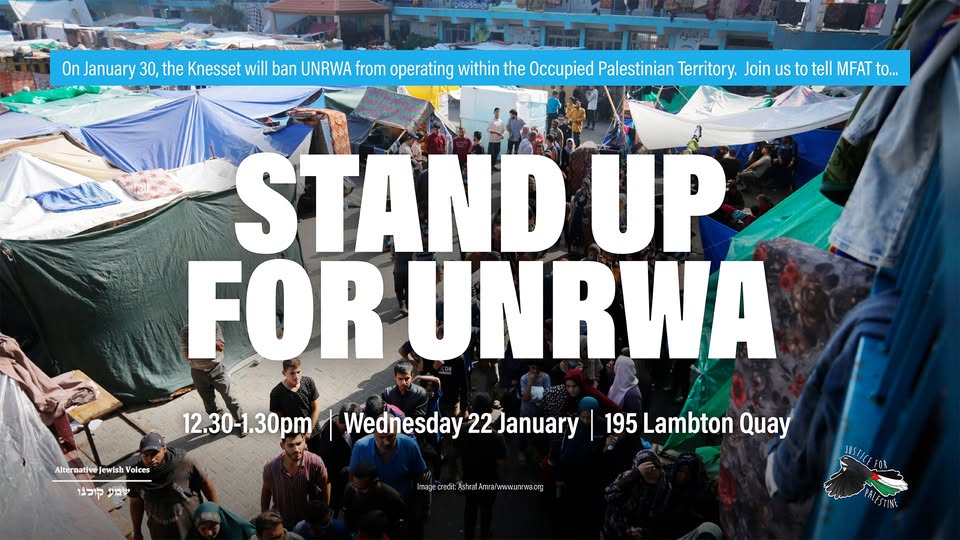
Write to Foreign Minister Winston Peters today. And tomorrow. Join Justice for Palestine and Alternative Jewish Voices in front of MFAT, 195 Lambton Quay in Wellington, 12:30 on January 22. We will tell them again!
Marilyn Garson, for Alternative Jewish Voices
 Sh'ma Koleinu - Alternative Jewish Voices (NZ)