
An open letter to the Prime Minister

An open letter to Prime Minister Christopher Luxon                          

Tēnā koe, Prime Minister,                                                                 Feb 16, 2025

We are Jewish New Zealanders, members of Alternative Jewish Voices and Dayenu: New Zealand Jews Against Occupation. We understand that your office has scheduled a meeting this week with the NZ Jewish Council (NZJC) and additional ministers. We object in the strongest terms. The NZJC is unelected coterie, forever uncritically aligned with Israel. That is not the Jewish community.

We have documented in depth that the NZJC is not representative. They are not elected. Their constitution outlines a regional structure for indirect democracy, but much of that structure does not seem to exist. They are not accountable to the community. Their president has broadcast her intention to ‘disempower as much as possible’ Jews like Alternative Jewish Voices (AJV) members who ‘raise their voices’.

Several of us attended the Wellington Regional Jewish Council’s last community meeting, in 2021. The meeting roundly disavowed the Jewish Council’s tone and their relentless focus on Israel. Indeed, the NZJC’s constitution does not even mention Israel or Zionism. The Wellington Regional Jewish Council dissolved itself after that meeting, acknowledging that they have no community mandate. They haven’t been heard from since. So much for regional representation.

Through public and private channels, members of the Jewish community have repeatedly asked the NZJC to embrace some positive, rights-based vision of the future. Instead, through Israel’s 15-month ‘plausible genocide’ in Gaza, the NZJC’s militarism has only become more overt. Juliet Moses was to share a platform with IDF’s head of infantry doctrine Yaron Simsolo at an Auckland event in March, until Jewish objections drove Simsolo’s session offsite.

This is not solely an issue for the Jewish community. For years, we have protested that the Jewish Council’s related Community Security Group shares politically slanted information about New Zealanders with Israel’s embassy. They interpret objections to Israel’s occupation as a security threat to the New Zealand Jewish community, and they share their views of individual Palestinian, Muslim and other New Zealanders with a regime accused of genocide against Palestinians. This creates particular risk for Palestinian New Zealanders, should they ever travel to Israel or the Occupied Palestinian Territories to visit family and whānau.

Let us say this clearly: there is nothing essentially Jewish about Zionism. Zionism is a project of colonisation, erasure, apartheid, ethnic cleansing—finally, of genocide. Institutions that wrap their nationalism in our Jewishness are shielding the brutality that we witness daily. In this country, the NZJC has been a leading voice in the campaign to confuse Jewish with Zionist, enabling decades of oppression in our names.

The NZJC does not serve, represent or account to the Jewish community. How many Jewish New Zealanders would choose a representative who, like NZJC president Juliet Moses, retweets defenses of Elon Musk’s Nazi salute?

The NZJC is an extremist voice. Their politics are harmful, and their actions jeopardise the good standing of Jews in Aotearoa. We protest in the strongest terms that Israel’s advocates are being given Prime Ministerial access.

It’s not hard to guess what the NZJC will be asking for: some special “antisemitism regime” that uses our Jewish identity to shield Israel from the directives of the International Court of Justice. They will be asking to divorce the Jewish community from our shared mahi of antiracism and our human rights framework. They will be seeking some exceptional status, suppressing principled protest for Palestinian rights and the criminal accountability of Israeli leaders. That conversation should not take place without representation from the Muslim and Palestinian communities. They are the New Zealanders whose voices are being silenced, and frankly they are the communities who have lost the most to racism in recent years.

Prime Minister, any meeting with the NZJC ought to be recorded in the ministerial diaries as a session with Israel’s ambassadors. And damn it, they will be doing it in our name. We are also the New Zealand Jewish community, and we are so tired of being used this way.

We would like to join your meeting with the NZJC, bringing Jewish diversity into the room. If you will not open this meeting to the real breadth of the Jewish community, then we wish to schedule a second meeting which includes Muslim and Palestinian representation. We work closely with the Muslim and Palestinian communities in Aotearoa, modelling the change that we would like to see in the Middle East.

Hear us out before you act.

Alternative Jewish Voices and Dayenu: New Zealand Jews Against Occupation
Trump ended U.S. funds for UNRWA. Israel banned it. The human costs will be astronomical

Anyone who cares about human rights should be able to see these decisions for the travesty they are

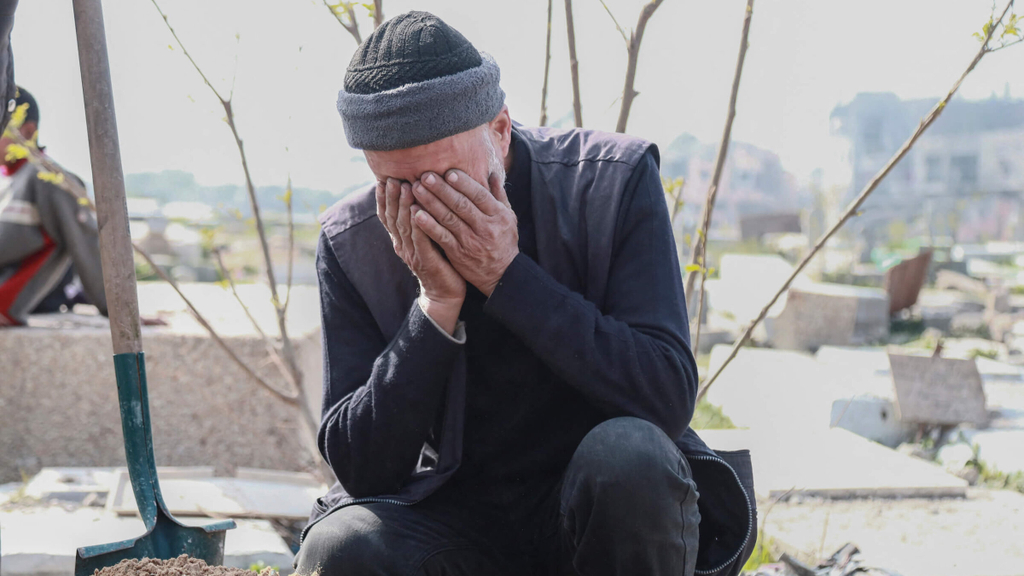
An elderly man covers his face while crying beside a grave in the Fallujah cemetery in the northern Gaza Strip on Feb. 3 Photo by Abood Abusalama / Middle East Images via AFP/Getty Images

Marilyn Garson in The Forward, February 5, 2025

After Israel last week enacted its ban on UNRWA, the United Nations agency that serves Palestinian refugees, from operating in Israeli-controlled territory, President Donald Trump on Tuesday halted all U.S. funds for the agency. I consulted for UNRWA’s Gaza director for two and a half years, including during the 2014 bombardment and the following year of what passes in Gaza for reconstruction. I have seen the work that these actions will disrupt; work that is essential to any real recovery from 15 months of furious violence.

The Knesset’s ban and Trump’s withdrawal cap a long and exceptionally rancorous campaign against both UNRWA and Israel’s obligation, in the context of its military occupation, to provide and facilitate humanitarian assistance to Gaza. Jerusalem’s deputy mayor, Aryeh King, called UNRWA “the enemy in our holy city.” Noga Arbell, formerly a Foreign Ministry official, said flatly in the Knesset that “It will be impossible to win the war if we do not destroy UNRWA.”

The vitriol was on display long before Israel alleged that fewer than 0.01% of UNRWA employees had taken part in attacking Israel on Oct. 7, 2023. UNRWA terminated the employees in question, and Israel has not provided evidence to support any wider charges against the agency — although such sweeping claims have continued to circulate.

While the politics swirl, Trump and Netanyahu’s moves mean, simply, that more civilians in Gaza will die because fewer of their survival needs will be met. The ban also directly contravenes Israel’s obligations in international law.

The International Court of Justice affirmed last summer that Israel is illegally occupying the West Bank and Gaza. In January, 2024, it ordered Israel to improve humanitarian access to Gaza amid the war. Yet 26 NGOs reported last week that “Israel’s authorities failed on all counts to improve humanitarian access over the last year” to Palestinians fleeing the Israeli onslaught.

In 1949, the UN established UNRWA with a mandate to serve Palestinians as members of one dispersed nation, until a durable political solution could be found. That mandate recognizes that Palestinians’ suffering has a political cause, and awaits a national political solution. Recent moves are far from the first time that UNRWA’s detractors have tried to erase that mandate.

UNRWA also records intergenerational refugee rights, which detractors say helps to perpetuate violent resistance against Israel in Gaza and the West Bank. Politically, the millions of people who have protested for Palestinian rights across the globe mock any notion that UNRWA is the cement holding their movement together. And the frequent suggestion that Palestinians’ intergenerational rights are exceptional is factually incorrect: Worldwide, the rights of refugees always transfer to their children.

These arguments distract from what UNRWA needs to do. More than 2 million Palestinians in Gaza need to reestablish a standard of basic livability after the unprecedented destruction of the war. UNRWA is essential to meeting their most fundamental rights.

Even more responsibility for Palestinians’ rights will devolve to Israel in UNRWA’s absence. There is no reason to expect that Israel will take that obligation seriously. Some Israeli leaders, envisioning Gaza’s future, have presented proposals for prospective Israeli settlements and beachfront condos. For-profit security contractors are already at work.

And Trump, leader of Israel’s most powerful ally on the world stage, has in his first weeks back in office repeatedly called for Palestinians to be relocated from Gaza to other Arab countries — despite forced relocation being, under every definition, a war crime.

These actions affirm Israel’s disregard for Palestinians’ rights, and for its own clearly outlined obligations. In Israel’s hands, there will be no meaningful aid for Palestinians in Gaza — only attempts to turn the strip into an asset for Israel.

Gazans’ need is enormous. Amid the war’s violence, life expectancy in Gaza has been cut nearly in half, according to one Lancet study. The UN’s development program estimates that Gaza’s development has been set back by 75 years. Investigators with the research group Forensic Architecture have charted in Gaza the “near-total destruction of civilian life.”

UNRWA is indispensable to any genuine response. Statements of scale — UNRWA delivers more than half of all Gaza’s aid — fail to explain the agency’s real importance. UNRWA is a blockade specialist with decades of deep neighbourhood knowledge.

For a year following the 2014 war, I saw just how essential that specialized knowledge can be. In my reconstruction role, I spent time compiling the needs of bakers, tailors, and self-employed families whose chickens and rabbits had died of fright from the noise of the bombings. Around me, colleagues measured windows and doors to weatherproof more shelters. UNRWA consolidated exceptionally diverse needs for shelter, water, sanitation, food, fuel, cash, education, medication and health services. It produced quantity surveys for buildings to provide those services, all while navigating a longstanding blockade so intricate that it has been known to make it impossible to import the lead in pencils.

UNRWA was designed to pull this together in one coherent appeal, rather than presenting donors with a hundred competing requests.

Within weeks of the cessation of bombing in 2014, civilians in Gaza began to protest at UNRWA’s gates. They felt that the scale of need in Gaza was already receding in importance in the global eye.

Where else could they go to make that statement? Gaza has no Embassy Row. Israel prevents or controls the entry of international journalists, and most Gazan civilians have never been outside the blockaded strip. Then as now, Palestinians in Gaza sent messages to donor states through UNRWA, and UNRWA delivered its assistance in the name of donor countries.

UNRWA is the face of the world’s obligation to Palestinians. Every pallet of aid says that the world has not forgotten. Having survived an unimaginably destructive war, it is intolerable that the civilians of Gaza might now see the General Assembly let UNRWA’s mandate be torn up.

And although Israel’s ban will be deadliest in Gaza, its implications are much wider. If Israel is permitted to push UNRWA from occupied East Jerusalem, doing so will help cement Israel’s illegal annexation of the area and its religious sites. Just how much provocation will the region tolerate?

Marilyn Garson in The Forward