

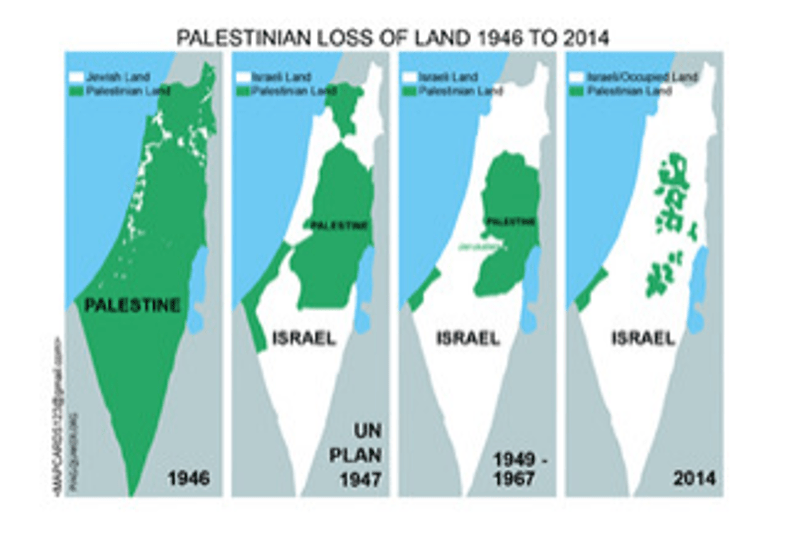
Author’s note – As a Palestinian, I write this not to provoke but to expose the dominant myths that have long shaped public understanding of Zionism and the so-called Israeli Palestinian conflict which continues to shield Israel from rightful scrutiny. This article is a call to recognise Zionism for what it is — a settler-colonial movement — and to encourage honest, informed conversations about justice, history, and the urgent need for a truly democratic future in Palestine. My aim is to raise awareness, especially among Western readers, so they can see through the layers of propaganda and challenge the so called two-state solution and join the growing effort — in Palestine and beyond — to speak clearly and truthfully about what has happened, and continues to happen, in that beautiful land.
There are truths that societies often find difficult to confront, and among the most elusive is the recognition of oneself as a coloniser. Throughout history, colonialism has rarely been perceived as such by those who practiced it. It was cloaked in the language of civilizing missions, divine promises, or national rebirths. Yet the patterns repeat: the arrival of settlers, the displacement of indigenous peoples, the claiming of land under foreign notions of entitlement.
Zionism follows this same historical pattern. It is a political movement that sought to establish a Jewish state in Palestine—a land already inhabited. This is not a theoretical or ancient dispute, but an ongoing reality. From its earliest stages to its present-day manifestations, Zionism has functioned as a settler-colonial project, relying on the displacement of Palestinians to realise its vision.
Prior to the arrival of Zionist settlers, Palestine was a diverse land with Muslim, Christian, and Jewish Palestinians living in established communities. The Zionist project, backed by imperial powers, aimed not to integrate into this existing society, but to replace it. This is not a matter of interpretation—it is a matter of documented historical planning and execution.
Zionism’s and Israel’s founding figures, such as Theodor Herzl and David Ben-Gurion, understood that the establishment of a Jewish state in Palestine would not occur through peaceful coexistence with the native population. Instead, it would necessitate the removal of that population. Israeli New Historians — including Benny Morris, Ilan Pappé, and Avi Shlaim — have documented, using Israeli archival sources, that the expulsion of Palestinians was not an unintended consequence of war. Early Zionist leadership foresaw and accepted the necessity of expulsion.
The State of Israel was established through a planned mass ethnic cleansing campaign during which over 750,000 Palestinians were driven from their homes, more than 500 villages and towns were destroyed, and dozens of massacres committed. This catastrophic event is known as the Nakba.
From that day to this day, Israel’s refusal to allow Palestinian refugees to return, in defiance of UN Resolution 194, further confirms Zionism’s intention to destroy the Palestinians as a distinct group of people. Had peace been the goal, Israel would have allowed return, restitution, and reconstruction. Instead, it has only expanded its colonial project.
Today, this settler-colonial reality continues through settlement expansion, military occupation, home demolitions, and land theft. These are not security measures. They are the modern practice of the same project that began over a century ago: to secure maximum land with minimum Palestinians.
This is not antisemitism, and it does not negate the historical suffering that Jews experienced in Europe, which is often used to justify Israel’s crimes. Instead, it is a necessary step toward an honest reckoning with the past and the present, if Palestinians and Israelis are ever to build a shared future together.
The longer the world continues to avoid speaking honestly and bravely about the nature and essence of the actual settler-colonial relations between Israel and the Palestinians, the longer we continue to be participants in sustaining Israel’s criminal apartheid regime – until it reaches its own final solution stage.
The Western powers’ blessing of the Zionist colonisation of Palestine was cynically branded as partition. Today, the so-called two-state solution continues the same deceit, dressing up a brutal colonial project as a peace offer.
When you hear “two-state solution”, you should hear “partition” and recognise it for what it is: a form and a tool of colonisation.
Partition was proposed in South Africa to create separate homelands for Black South Africans. It was argued by some in the United States after the Civil War to preserve the Confederacy. French settles in Algeria pushed for it. So too did colonial powers in Vietnam, carving the country into north and south.
Whether it was through wars of liberation or internal revolution, the lesson was the same: partition is unjust, unsustainable and must be called out and rejected.
In a world that is increasingly recognising and reckoning with the facts and impacts of colonialism – from the Americas to Africa and the Pacific – it is time to extend this recognition to Palestine.
The only just and lasting way forward is a shared country. There should be one democratic state for both peoples with equal rights, freedoms and responsibilities for all who live on that land, from the river to the sea.
One country that would open its gates and take in the descendants of its sons and daughters who were recently made refugees – who, after nearly 80 years, still dwell in refugee camps around their beloved homeland like orphans, denied their inalienable right of return to the motherland.
by ‘Goliath’
 Sh'ma Koleinu - Alternative Jewish Voices (NZ)