

We have rallied, written and shouted for the restoration of humanitarian assistance to Palestinians in Gaza. We urge our government to help preserve UNRWA, the lynchpin of Gaza’s humanitarian structure. Israel is bent on preventing UNRWA’s humanitarian capacity from being used.
We do not spend much time on the reality of this humanitarian provision. What is it that Israel is seeking to dismantle?
Humanitarianism is an ethic that places the value of human life at the centre of emergency (here, warfare). Assistance is prioritised according to need, and delivered within the principles of humanity, impartiality, neutrality, and independence. In Gaza’s daily desperation for food, we see the abysmal absence of these principles.
As a response to emergency, humanitarian assistance is limited – a bandaid, not a cure. Humanitarians will not give Palestinians a state. Assistance neither prevents nor ends wars. It seeks to limit the harms of war, and it can only operate in the space agreed by all armed parties.
Yet humanitarianism acts on our human dignity in a way that I find enormously valuable. As an aspiration, it is the very best bandaid we’ve got in a world where we cannot prevent armed violence. Personally, the rights-based principles that give rise to humanitarian action also give me a guardrail to hold back the absolutes which make our differences harder to resolve. Absolutes can creep into any movement, sliding from principle to implacable rage that suggests we cannot live together.
It takes a hopeful belief in humanity to say that now, which Scott Anderson shares.
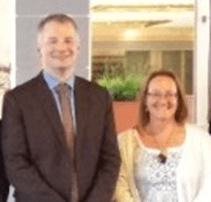
Scott was the deputy director of UNRWA while I was in Gaza. I reported to him operationally for two years. He tolerated my response to United Nations bureaucracy, which involved unplugging my desk phone for, um, a while. Scott thrived in emergency, and led the UNRWA emergency operations room through the 2014 onslaught. I saw his physical bravery when we visited shelters together.
In November 2023, Scott went back. He was UNRWA’s director in Gaza through January 2025. This week we spoke about those 15 months, and only very briefly about Israel’s resumption of bombing after March 2025.
The 2014 war had been, Scott said, a high water mark of Israel’s willingness to coordinate with the UN on matters like humanitarian pauses (agreed cessations of fire which allow people to move and be supplied with food safely). Israel’s choices were now driven by anger, and some were “indefensible. It’s just a very difficult time right now and there doesn’t seem to be anywhere to find safety for people who are innocent in Gaza.”
UNRWA has long been Gaza’s largest provider of safe shelter but this time, “most, if not all, UNRWA shelters have been hit … I think that when it was announced that UNRWA staff were part of October 7th, it took on a new dimension. I personally think it’s a way to put psychological pressure on the [Palestinian] community that UNRWA isn’t safe anymore. One of the [Israeli government’s] stated goals, besides eradicating Hamas, is to get rid of UNRWA.”
While Scott was there, “well over two hundred” of his UNRWA staff were killed “that we knew of. I’m sure there are some that are in the rubble, that we just aren’t aware of … And it wasn’t just us. [The IDF aerial strike which killed seven staff members of] World Central Kitchen was a kind of inflection point.”
After staff of other agencies were shot at while trying to retrieve bodies, “We did stuff we didn’t have to do before. We collected remains of people. It’s something I felt was important – first, for our own humanity but also for our Palestinian colleagues. Whatever we do in this life, we deserve a dignified burial at the end of it, right?”
I asked how (for lack of a better phrase) he hadn’t gotten himself killed. “It was dangerous. There were probably three or four times when I wasn’t sure we were going to make it out.”
We talked about the strangeness of Gaza’s once-familiar landscape. I have seen what remains of our offices. Mine is a shambles with no ceiling or front walls. My former apartment building is dust. Seeing those places is like driving through Shuja’iyya after 2014. I couldn’t even count the streets to locate myself, because there were no streets to discern.
“You’re right,” he said. “I went to Gaza City and the driver said, ‘Look, there’s Beirut Tower.’ I didn’t know where I was. There’s so much damage in the frame of reference. It’s just gone.”
To me, the daily horror stories from Gaza have sounded as if the whole notion of de-confliction – coordination intended to keep routes or places safe for the delivery of aid – has broken down. “No,” Scott shook his head, “I don’t believe that. I think that it didn’t work particularly well, and it really didn’t work particularly well with certain units of the IDF … You could see, they were scared … I don’t believe anybody’s out to hurt humanitarians, because it helps in most conflicts.”
So how did he cope, as the leader of people who needed to move through that environment? “It’s a pretty fine line between being pragmatic and principled, right? The only real leverage the UN has is saying that we’ll stop, but we won’t, and we all knew we wouldn’t.”
Is Israel’s flagrant disregard of humanitarian space and entitlements an aberration or a precedent? “I hope it’s an aberration, but I think that the way the humanitarian community functions needs to be re-examined as well. I do believe that. I don’t think the model still works [in] the more violent places where we’re working … The war has become so much more asymmetrical that it’s much harder now to protect sites and people.” When superpowers bomb a confined community, the very idea of reciprocal need falls away. The humanitarian risk and need are as one-sided as the weaponry.
I asked about the extent of Palestinian hardship during Scott’s time. Mutual assistance has always been integral to Gaza, but there are also networks and clans which profit from scarcity. “I do think that there was a sense of helping each other, but there was also opportunistic profiteering – which is the reality in most war zones… And frankly I remain shocked that there hasn’t been a pandemic or something. I think it’s because people are very intelligent, and very resilient. But it’s really pretty remarkable.”
Through it all, I have struggled to understand intention. Israel’s cabinet is brazen and fascist, and we have all read horrifying individual statements of genocidal intent from others in and out of office. We respond to that, because those speakers are culpable, and because we are also doing politics. But how should we speak beyond that? We have seen the harm done when all of Gaza is blurred into a single, militarised object; willfully denying Palestinians’ civilian protections. What is the converse of that?
Scott negotiated and interacted for years with Israel’s occupation institutions and military leaders. When I spoke about Israel’s plans for Gaza, he looked dubious. “I don’t know if it’s a plan. I often feel they’re a little schizophrenic when it comes to Palestinians and Gaza. They want them to leave, but they also don’t want to let them leave.”
So, for 19 months, two million people have been driven north and south, north and south. Presently they are forced south, pushed into smaller and smaller spaces and drawn desperately by the magnet of food. And now there is Trump and apparently, the most malicious in Israel’s government have carte blanche. Of the Israel / US-backed Gaza Humanitarian Foundation (GHF), Scott says, “It’s clear that this is an attempt to sidestep the humanitarian principles, which doesn’t seem to have worked very well. The consulting group and head of the GHF have both withdrawn. This is a litmus test, certainly, and other countries – Russia for example – are watching.”

Scott lived nine years and seven months in Gaza, across several senior roles. Israel has refused to grant him entry in another UN capacity within Israel, because “they didn’t want it to look like UNRWA was sneaking back in.”
Of his decade, he says, “I think we all came and did what we could.”
One of the great privileges of my own years in Gaza was the ability to cross boundaries and listen again. It does not diffuse my outrage. After all, there will be people sitting in cafes in Tel Aviv while Gaza starves. But crossing boundaries complicates what I understand of this as a human deed.
Scott leaves believing that, “From a distance, everything looks pretty black and white, but up close, it’s all shades of grey … You have to really dig into it to understand. If you’re a friend of Palestine, you should visit Israel and try to understand. And if you’re a friend of Israel, you should visit Palestine and try to understand. You have to have empathy and understanding, that’s what I would say [although] the scales are different.”
Scott has not said the word ‘genocide’. Organisations play different roles and speak within different constraints. Regarding the world court case against Israel for crimes of genocide, “The work UNRWA did in compiling statistics was used by South Africa in raising the case to the court. [UNRWA’s] primary role was documentation and advocacy.”
UNRWA’s tireless, principled advocacy is ongoing, based on the rights of Palestinians and on ground truth. This week’s statement by UNRWA’s Commissioner-General was sent under the title “aid distribution has become a death trap”.
Marilyn Garson
 Sh'ma Koleinu - Alternative Jewish Voices (NZ)