A few simple facts to distinguish between the Israeli government’s claim that it is ‘bombing Hamas’ and the actual bombs that are landing on the Gaza Strip.
The Israeli armed forces are not dropping bombs on Hamas, because Hamas is not a place. They are dropping bombs on Gaza, which is one of the most densely populated places on this earth. The language of ‘bombing Hamas’ gives us the soothing impression that the bombs land in a distinct, guilty, non-civilian Hamas-place. No such location exists in Gaza.
Israeli space also densely mingles the civilian with the military. The headquarters of the Israeli Ministry of Defense stands in the commercial centre of Tel Aviv. Uniformed and / or armed Israelis can be seen on every sidewalk of Israel’s cities and towns. The government of Israel has long justified its aggressive force-protection stance by labelling its army as civilians in uniform. Yet Israel demands its full share of civilian protections.
Israel places police stations in every neighbourhood, yet it just blew up ‘dozens’ of Gaza’s police stations as ‘Hamas targets.’
I heartily wish that every combatant would stand at a distance from every non-combatant in this world, truly I do. Until that happens, we must not allow anyone to discount the safety of Gaza’s civilian space as it is being discounted in this bombardment.
I have grappled with my dislike of Hamas in print and through four years of living under Hamas’s rule. I am no defender of theirs. I consider Hamas to be an unfortunate product of Israel’s occupation.
However, in Israel’s official speech, “Hamas” becomes a deadly strategic convenience that confuses our understanding of civilian Gaza. So, a few simple facts.
Hamas is the governing authority in the Gaza Strip. It employs teachers, rubbish collectors and countless other non-combatant civil servants. Those people are civilians. The homes of combatant and non-combatant Hamas employees hold families. Those families are civilians. The family members of Hamas combatants have not forfeited their civilian protections. The children of Hamas combatants have the same protected status as any other child.
Human Rights Watch studied Israel’s targeting of Hamas persons in their family homes across Gaza in 2014. Its findings are titled: “Unlawful Israeli Airstrikes Kill Civilians: Bombings of Civilian Structures Suggest Illegal Policy.”
Hamas rockets did not start this. Nakba started this. Blockade. Repeated bombardments and deprivation. Now Sheikh Jarrah has triggered an uprising that Hamas joined with its rockets. History books don’t begin their explanations with today’s events, and neither should our media.
Rockets do not let Israel off the hook for its bombs. No number of rockets can relieve Israel of its legal obligations regarding Gazan civilians – not for one instant – because Israel’s obligations are not to Hamas. In the laws of war and occupation, belligerents are not responsible to each other. Each belligerent is independently responsible and accountable for its actions. One violation does not release anyone else from their legal obligations.
Israel fires at will and has time to make its choices. It chooses to bomb overwhelmingly at night, exacerbating the fear and depriving everyone of sleep. Israeli planes and drones and tanks and gunships could fire just as well in daylight because Gaza has no defensive weapons.
We must hold Israel accountable for its choices. To understand what that means, here’s a good enquiry into military accountability for the deaths they call collateral.
I do not celebrate the rockets, because I hate weapons of war – but I do not equate the weapons of the powerful and the powerless. Rockets make a hole in the ground. Bombs blow up apartment buildings and essential infrastructure. Common sense would never confuse them, and neither should our government in its official statements.
I am aghast when I see the wreckage, the shattered bodies and the now-homeless survivors, the petrified children and the grieving parents who will have this horror imprinted on their minds forever. When an unvaccinated, trapped populace flees before one of the world’s most powerful (vaccinated) military machines, I am speechless at the notion of Israel’s restraint – let alone its claim to victimhood.
Just look, and you will see who is the aggressor and who in need of defense.
When I speak about Gaza, people sometimes tell me that they hesitate to stand up because they’re afraid that they might disrespect the Holocaust.
Standing up to protect our fellow human beings does not disrespect anyone. Indifference disrespects the memory of every person who ever needed us to act.
We honour history by living with moral courage. A trapped community is under assault by one of the most powerful militaries on earth. Stand up for it.
Help Gaza. Do you understand – we end this. We own the laws of protection. Israel always, only stops when it is told to stop by other states. Israel’s Office of the Comptroller assessed that the 2014 war was fought without a meaningful strategy. They bombed until the world stopped them. Now they are doing it again.
May 15, at Wellington’s Nakba Day gathering, we joined Palestinians and many others in outrage and (in the words of another speaker) radical hope. These remarks will be Alternative Jewish Voices’ Nakba Day statement.
Kia Ora,
Thank you – shukran – for inviting me.
The protests in NZ are furthest from Palestine, so, from the ends of the earth we are with you, seeking your protection, your freedom and all of our futures – because I will only be free when we are all free and safe.
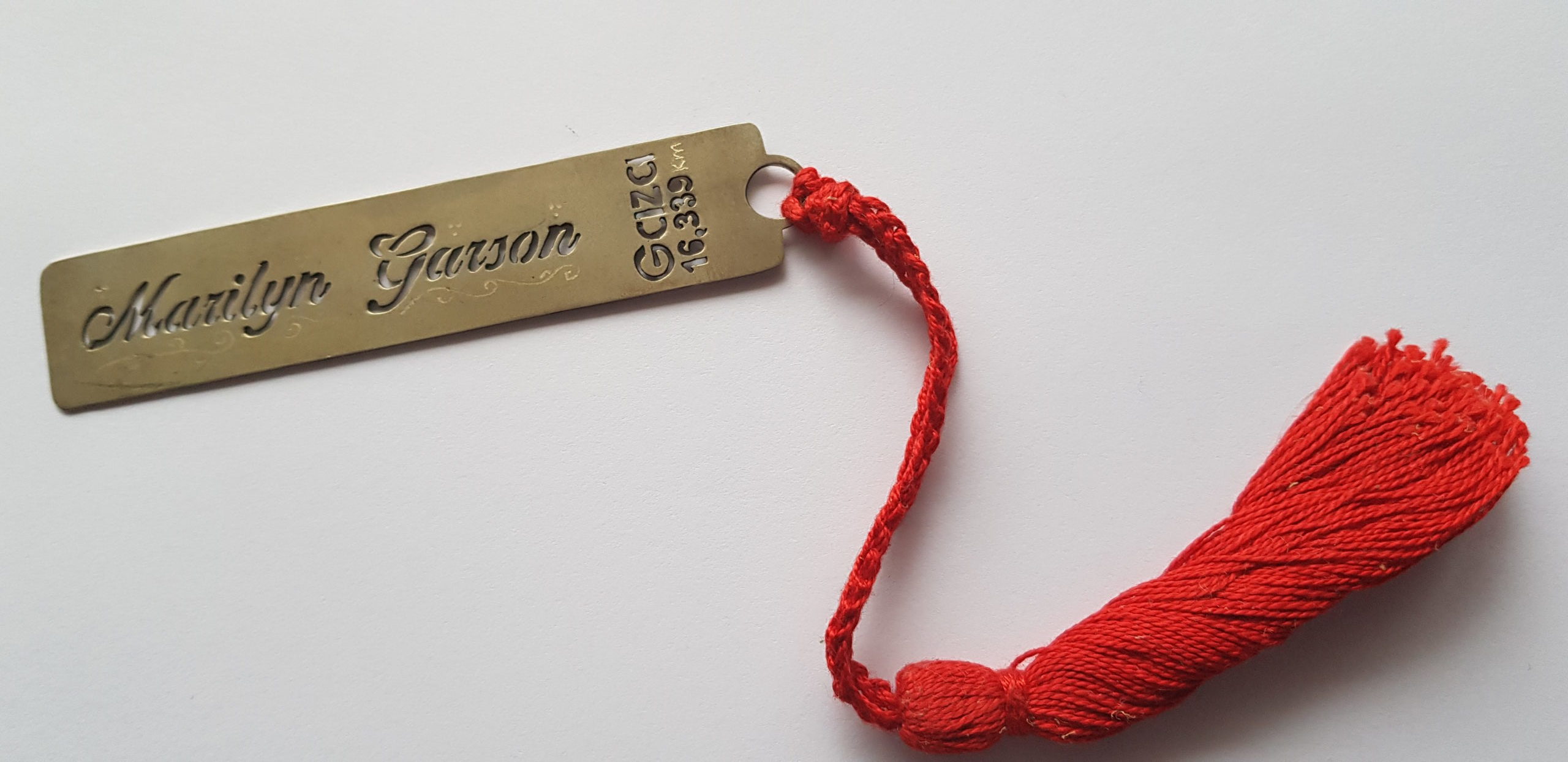
My name is Marilyn Garson, and I am a co-founder of Alternative Jewish Voices. I’m here with my co-founder Fred Albert. We are with friends and we bring messages of support from more Jewish friends up and down the Island. We are with you, in sadness and in solidarity. To each of the Palestinians here today, we wish safety and justice for your families.
Nakba Day and Sheikh Jarrah are both about family homes. A few generations ago, our antecedents, seeking shelter, took the homes of others. They drove Palestinians out their homes and built a militarized regime of occupation and apartheid. Until we resolve it on that level, the Nakba will continue to be an event in the present tense. Israeli settlers are still trying to force Palestinian families out of their homes in the West Bank, in Sheikh Jarrah. The settlers have ethnic laws and overwhelming force on their side, but their impunity has abruptly ended.
There is no way back to their status quo, because their status quo caused the absolute horror that we see unfolding.
Let me say that I dread violence, I dread anyone’s violence. But I do not equate the actions of the powerful and the powerless. I hate the weapons of war but I see the cause, the power disparities and the proportions of harm. The Israeli human rights organisation, B’Tselem tracks the casualties of this Israeli regime. Through the past 20 years, the casualties have been 88% Palestinian – and those have been grossly, disproportionately Gazan.
As a Jew, I do not know how it has felt to be Palestinian through those years. I do not narrate the experience of those years. I listen while you tell me what those years have meant.
But I do know how it feels to sit beneath the bombs in Gaza. I worked in Gaza through the last war. I sat beneath four years of bombs, and my body will remember them forever. The bombs that Israeli forces are dropping in Gaza are larger by an order of magnitude than the rockets. Nowhere on this earth are the power disparities greater than in the repeated bombardments of Gaza. They are not bombing Hamas, because Hamas is not a tidy, separate, non-civilian place. No, they are bombing Gaza. One of the most powerful militaries on earth is bombing in overwhelmingly civilian cities, where a million children are trapped behind a wall. Gazans are fighting to claim their most basic human rights, to walk free and drink clean water. When buildings are falling around them, when unvaccinated civilians flee from a vaccinated army, when we all know there is no safe place behind that wall – you tell me, who is the aggressor, and who is in need of self-defense?
I plead with our government to act. Jacinda Ardern, Nanaia Mahuta, where are you? Gaza is in great danger – we need you to stand up and help them. Occupied people are legally protected people and we need you to enforce the laws of protection.
To our fellow Jews we say, surely this is not the Israel you had in mind. So please join us. Standing here, together, you can see the future. This madness will end when we admit what we have done, when we listen, restore, return – then we can begin to transform this mess together. We who hold the power, we start by saying: “Our lives have equal value. Jewish supremacy is not our Judaism. I will not have it done in my name.”
Occupation is not our Judaism – not in my name. Apartheid is not our Judaism – not in my name. Bomb a million children behind blockade walls – never, never in my name. That is not our Judaism.
Again but differently, that terrifying open-ended escalation.
In 2014, Israel’s final, gratuitous act in Gaza was its bombing of two residential apartment buildings. In 2021, it is their opening gambit. They have picked up where they left off – but it’s different this time. UNRWA which sheltered 293,000 displaced people in 2014 has been gutted by Trump while Gaza’s health, water and other essential infrastructures have been hollowed out by Israel through the years. Where will people go for shelter?
This time, there is Covid on one side. Israel has vaccinated its military and systematically refused to meet its legal obligations to vaccinate the Palestinians whose land it occupies. Gazans in distress, in relatives’ homes, in hospitals, will be unable to socially distance.
It is different within Israel, too. Rockets are reaching further and causing casualties. There is an uprising in Lod. I dread the violence, everyone’s violence. I am afraid for my family, I am worried and sad for everyone.
Still, I cannot understand this unless I distinguish between the equal rights of civilians to safety, and the grossly unequal Israeli regime that has placed them all in such danger. With that distinction, I know there is no way back to the status quo ante, because the status quo caused this.
Generations of settler-colonial occupation, racially differentiated laws and life prospects, forced expulsion and violence with impunity – that was the status quo. Palestinians have abruptly overturned it. Rejecting the forced expulsion of families from Sheikh Jarrah and incensed by the paramilitary violation of their sacred space, 80,000 Palestinians faced down the soldiers and prayed at Al Aqsa Mosque. With that, the status quo was over. There is no way back.
So I sit with my fears, I dream about a post-racial society that has dealt with its crimes, and I send my best to clear-eyed strangers.
But I will not sit still while Gaza is under bombardment. That is different. The wall makes that different.
Two million people are trapped within an illegal blockade, crowded together in a pandemic, lacking reliable supplies of clean water or electricity. Most of all, they lack any way to move to safety. You cannot protect civilians behind a wall. I know this. I was part of the UNRWA emergency response team that could not keep displaced Palestinians safe enough from Israel’s bombardment in 2014.
My heart is racing today as it used to race then.
Gaza is so small that the bombs have names on them. First the sound smacks into your chest and the earth shudders, and a moment later the curtains flap inward from the rushing air. You turn to each new pillar of smoke and dust and flame, and you ask, “Who do I know there – which of my friends lives there? Who have I lost?” And even if you don’t know anyone in that neighbourhood, the density of Gaza means that the bomb had someone’s name on it. Someone has lost.
No matter how many bombs fall, you do that every time. You peer into every pillar of smoke and strain to know who is gone. The number of explosions does not blunt a single one of them.
And then neighbours race toward the rubble and the fires. Neighbours come to dig with a shovel or with their bare hands, to search for survivors or to carry the remains of their friends and families for burial. When the other sounds abate, you hear the screams of relatives who are tormented by their wait.
The wall, the blockade makes Gaza different.
Occupied people are legally protected people. The law makes their protection our responsibility, and the people of Gaza need us to live up to our responsibility right now.
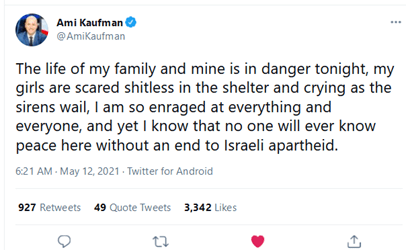
I woke up to the news and fear cut into me for my family in Israel. Where are they right now? I felt one moment of the fear that Palestinians live with.
No false equivalence: nothing about this is equal.
In video, Israeli police are heavily armed and armoured, backed by courts of ethnic law. Palestinians stand their ground wearing T-shirts. An armed charge into an unarmed crowd is not a ‘clash,’ it is an assault.
Israeli soldiers have been vaccinated and most Palestinians have not. To hell with Israel’s legal responsibility. They knew that no state would hold them to it, and no state has.
But look – Palestinians are changing the script before our eyes. They are taking authorship.
On May 8, 80,000 Palestinians came to Al Aqsa Mosque. Israeli police had violated their holy place and they came to reclaim it. They overwhelmed the roadblocks and the paramilitary police and faced them down with their bodies and their prayers.
Palestinians protested in Ramallah and Jaffa, in Gaza and in Haifa. They are unstitching the Green Line. Palestinians and their allies are protesting around the world.
Thousands of Israelis have been filmed dancing this morning, delirious at the sight of fire in the Al Aqsa Mosque. In 2014, Israelis sat on the hillsides of Sderot to watch the bombardment of Gaza. I think their desensitized madness has spread; the soullessness that comes from wielding overwhelming violence with impunity.
Wait, look again. In Gaza there is danger of a different magnitude.
Gazan fighters fired rockets to join the uprising, to protest the forced expulsion of Palestinian families from their homes in Sheikh Jarrah. I am not fond of rockets, but having seen both rockets and bombs in action, I would prefer to stand near a rocket than a one-ton bomb. A rocket makes a hole in the ground, while the airborne bombs of the IDF make the earth tremble.
“Israel conducted airstrikes in Gaza on Monday evening, following rocket fire from Gaza that caused damage to one Israeli vehicle, and “lightly injured” one Israeli civilian, according to an Israeli army statement.”
Israeli bombs killed 20 Gazans overnight. They killed nine children, and injured scores of people. Let that attest to the relative value placed on one Israeli vehicle and twenty Gazan lives.
International governments condemned the rockets and elided the rest.
Israel, still drunk on its Trump license, may believe it can bomb Gaza with impunity. Gazans, with clarity and unfathomable endurance, with Covid rampant behind a blockade wall, may feel they have less and less to lose.
This is a formula for catastrophe. We must not let it play out again. Gazans are not symbols to be held up as proof after the fact. They are human beings under assault right now, and they need our protection.
Do not tut-tut them all to step back equally, because the inequality of the status quo ante was the cause: a regime of dispossession, apartheid, blockade, ethnically determined lives and life prospects.
We need to respond to the cause and the crimes. We need to demand that our governments uphold the laws they sign in our names to clear the way forward – not back. Intervene, protect, invoke the law, end the Nakba.
Saturday may be Nakba Day, but Nakba is an event in the present tense until we – yes we, calling on law and justice with every means available – bring it to an end.
When a person holding a stone confronts soldiers who are armed with rifles, ask yourself why they are willing to do that.
On May 8, 80,000 Palestinians came to stand in front of rifles and pray at the Al Aqsa Mosque. They overwhelmed the rifles with their numbers and spirit. We stand with them.
We deplore Israel’s violation of sacred space during the Muslim holy month of Ramadan. We are horrified by the mob violence and the paramilitary police who enable it. This is not a ‘clash’ between two opinions, this is occupation and apartheid at work.
We reject Israel’s campaign to dispossess the Palestinians, including current efforts to evict families from Sheikh Jarrah. The New York Times notes, “A spokesman for the United Nations High Commissioner for Human Rights, Rupert Colville, said Friday that the evictions ‘would violate Israel’s obligations under international law’ prohibiting the forced transfer of residents from occupied territory…. [Aryeh] King, the deputy mayor, said ‘of course’ [the evictions] are part of a wider strategy of installing ‘layers of Jews’ throughout East Jerusalem.”
We say, stop the evictions, and get the Israeli settlers out of occupied East Jerusalem. This is ethnic cleansing.
Israel’s refusal to vaccinate the Palestinians whose land it occupies in Gaza and the West Bank has been condemned by UN Rapporteurs as “discriminatory and unlawful.” Covid is rampant and we plead with our governments to provide the lifesaving assistance that Israel is withholding.
We call for an end to Israel’s impunity. These are crimes. We must begin to respond to them as crimes.
We hold the Palestinian protestors in our thoughts.
— International Jewish Collective for Justice in Palestine
Alternative Jewish Voices makes this statement as a member of the IJCJP.
To our fellow NZ Jews we ask, is this the Israel you had in mind?
If not, where is your protest? Why are you silent??
Alternative Jewish Voices is a non-Zionist collective of New Zealand Jews. We have written this brief to give readers some insight into the task of recognising antisemitism and adopting a definition for policy and public understanding. You are welcome to download the brief, and please share it widely.
Worldwide, the understanding of antisemitism has become controversial. In 2016, proponents of the International Holocaust Remembrance Alliance Working Definition of Antisemitism (IHRA-WDA) called on civil society and governments to define and respond to antisemitism separately from other forms of racism. Because the IHRA-WDA conflated antisemitism and protest against Israel’s occupation of Palestine, it enabled many often-baseless charges of antisemitism to be made in Aotearoa-NZ and overseas. Those who advocate for Palestinian rights have been called Jew-haters.
This does nothing to protect the Jewish community from racism, and the confusion impedes our collective task of opposing racism in all of its forms.
In March 2021, the Jerusalem Declaration on Antisemitism (JDA) 2021 was published to clarify what has become a hostile issue. The JDA situates antisemitism among all the forms of racism which require our combined action, and it offers guidance to distinguish between hatred and political disagreement.
The two definitions thus differ in their style and intent. We believe that the JDA, while not without its problems, is a more considered document than the IHRA-WDA and we will argue that it offers more nuanced guidance to help decide whether a particular action is antisemitic.[1]
We welcome the Jerusalem Declaration, and we ask you to give it your attention.
We ask government, institutions and authorities to consider both definitions side by side if they are lobbied to adopt the IHRA-WDA as a new definition of antisemitism. If a new definition is needed at all, then ask what each of the two definitions protects. Ask how they each preserve our right to engage in vigorous political speech without becoming the target of inflammatory accusations.
We urge authorities, media and all of New Zealand to recognise that the Zionist agenda of the IHRA-WDA does not represent the position of the whole Jewish community.
We ask our partners and our neighbours to use the JDA, to reflect on their speech and continue to act in pursuit of justice and equality.
We ask that the name-calling end, so that the real work of making positive change can continue.
Why do we need the Jerusalem Declaration on Antisemitism now?
Regardless of the intent of its writers, the IHRA-WDA has primarily been used against Palestinians and their allies, academics and Jews who criticize Israel. Even in Aotearoa-NZ, where the IHRA-WDA has no official standing, we have become accustomed to reading routine, sweeping accusations of antisemitism. The accusers blithely write off political protest as Jew-hatred, while overlooking the white supremacist and violent racism of the far right. Palestinians who simply tell their lived stories, or those who call for the application of human rights law in the occupied territories quickly find themselves labelled as people who hate Jews. Social media circulates these stigmatising charges widely, and the individuals have no way to clear their names. These unaccountable accusations distort the public understanding of antisemitism. When disagreement is confused with racism, the Jewish community’s understanding of the prevalence of genuine antisemitism is also distorted.
We have objected. Zionism is not the same as Judaism. Zionism is Jewish nationalism, embodied in the state of Israel. It is subject to the same political scrutiny as any other ideology or military project. Judaism is a religion, and it belongs in the protected sphere of belief. The Jewish community is not protected from racism by foreclosing on protest or silencing Palestinian voices. The IHRA-WDA advocates claim to act on behalf of the whole Jewish community, while seeking to discredit massive numbers of Jews as antisemites. Something is very wrong.
The Jerusalem Declaration on Antisemitism (JDA) pulls the emergency brake and resets the issues.
Comparing the definitions
Jerusalem Declaration on Antisemitism
IHRA-WDA Working Definition
Antisemitism is discrimination, prejudice, hostility or violence against Jews as Jews (or Jewish institutions as Jewish).
Antisemitism is a certain perception of Jews, which may be expressed as hatred toward Jews. Rhetorical and physical manifestations of antisemitism are directed toward Jewish or non-Jewish individuals and/or their property, toward Jewish community institutions and religious facilities.
Both documents agree that it is antisemitic to use or invoke the classical tropes of Jew-hatred, to essentialise Jews or deny the facts of the Holocaust. The IHRA-WDA added eleven examples of speech that it considers antisemitic. Seven of the example deal with Zionism and Israel. This itself is a point of strong contention, since it places the ideology of Zionism in the protected space of religion. The two definitions begin to diverge in the extent of political speech they would permit. See our Appendix for a table of comparisons.
Beyond its text, the IHRA-WDA’s examples have been interpreted in an absolute way. The expansive application of the IHRA-WDA created the need for the JDA’s intervention. Therefore, the JDA goes on to cite five examples which counter the creeping presumption that anti-Zionist protest is inherently antisemitic. The Jerusalem Declaration does not find these forms of speech to be, prima facie, hateful:
Supporting the Palestinian demand for justice and the full grant of their political, national, civil and human rights, as encapsulated in international law.
Criticizing or opposing Zionism as a form of nationalism, or arguing for a variety of constitutional arrangements for Jews and Palestinians … to support arrangements that accord full equality to all inhabitants
Evidence-based criticism of Israel as a state. This includes its institutions and founding principles. It also includes its policies and practices, domestic and abroad, such as the conduct of Israel in the West Bank and Gaza … It is not antisemitic to point out systematic racial discrimination.
Boycott, divestment and sanctions are commonplace, non-violent forms of political protest against states. In the Israeli case they are not, in and of themselves, antisemitic.
Political speech does not have to be measured, proportional, tempered, or reasonable to be protected under Article 19 of the Universal Declaration of Human Rights or Article 10 of the European Convention on Human Rights and other human rights instruments. Criticism that some may see as excessive or contentious, or as reflecting a “double standard,” is not, in and of itself, antisemitic. In general, the line between antisemitic and non-antisemitic speech is different from the line between unreasonable and reasonable speech.
We reproduce the relevant section of the Jerusalem Declaration on Antisemitism in full in the Appendix.
Other points of difference
Compare the drafting of the two definitions. The IHRA-WDA was a working document, intended to aid data collection. It has no academic or legal imprimatur. Two hundred eminent scholars worked for a year to draft the JDA with legal and constitutional advice. Their gravitas gives us a serious work, purpose-built and grounded in principles of free speech and opposition to racism.
The IHRA-WDA has been pilloried for its vagueness and contradictions: it fails on its own terms as a definition. Even the authors of the IHRA-WDA have protested the use to which their working document has been put. Advocates have sought to harness the machinery of government to shield Israel’s occupation from challenge, in the name of the whole Jewish community. Particular reputational harm has been done to Palestinians and their allies, to academics, and to dissenting Jews. The climate of healthy political debate has been chilled. The public understanding of antisemitism has been distorted, in order to shield Israel’s actions from political opposition.
Importantly, the Jerusalem Declaration does not replicate the IHRA-WDA’s activist strategy. The JDA is not a rival manifesto but a reset. It takes no position on Zionism; it takes a position on preserving political debate and opposing racism.
Some activists have expressed thoughtful reservations, although most have still welcomed the JDA on balance. They recognise that the alternative is not an imagined ideal definition. The alternative to the JDA is the perpetuation of the IHRA-WDA’s reputational and political harm.
The Jewish community of Aotearoa-NZ is not protected by protecting Israel’s occupation of Palestine, and the IHRA-WDA is not “what the Jewish community wants.” Government, media and our neighbours must understand that there is no single Jewish position on Jewish nationalism. We wholeheartedly believe and work to uphold the equal rights and standing of the Palestinians who are dispossessed and harmed by Israel’s actions. Occupation is not our Judaism.
Our Hebrew name is Sh’ma Koleinu. That means, hear our voice. On these matters, please hear all of our voices.
In sum, the Jerusalem Declaration is a definition, an instrument, not a conclusion. No definition will do the work of opposing racism or advancing justice. The JDA is an emergency brake to stop the reputational harm of sweeping accusations of antisemitism, and let us get on with the work of justice and equity. We ask you to embrace it and use it as a guide to end the name-calling, and protect the space for fearless, vigorous debate.
Both definitions consider it antisemitic to use or invoke the tropes of classical Jew-hatred. When their attention turns to speech involving Israel, they begin to diverge. This table is comprised of direct quotes, taken out of sequence to enable comparison.
Jerusalem Declaration considers these antisemitic
IHRA-WDA considers all of these to be antisemitic
Accusing the Jews as a people, or Israel as a state, of inventing or exaggerating the Holocaust.
Assuming that non-Israeli Jews, simply because they are Jews, are necessarily more loyal to Israel than to their own countries. Holding Jews collectively responsible for Israel’s conduct or treating Jews, simply because they are Jewish, as agents of Israel.
Accusing Jewish citizens of being more loyal to Israel, or to the alleged priorities of Jews worldwide, than to the interests of their own nations.
Denying the right of Jews in the State of Israel to exist and flourish, collectively and individually, as Jews, in accordance with the principle of equality.
Denying the Jewish people their right to self-determination, e.g., by claiming that the existence of a State of Israel is a racist endeavour.
Applying double standards by requiring of it a behaviour not expected or demanded of any other democratic nation.
Drawing comparisons of contemporary Israeli policy to that of the Nazis.
Requiring people, because they are Jewish, publicly to condemn Israel or Zionism (for example, at a political meeting).
Holding Jews collectively responsible for actions of the state of Israel.
In its Section C, the Jerusalem Declaration counters the IHRA-WDA’s history in practice. Proponents have used the IHRA-WDA to issue sweeping condemnations of protest as antisemitic. We reproduce the section in full, in the hope that can help us to protect valid protest, and recognise real racism:
C. Israel and Palestine: examples that, on the face of it, are not antisemitic
(whether or not one approves of the view or action)
Supporting the Palestinian demand for justice and the full grant of their political, national, civil and human rights, as encapsulated in international law.
Criticizing or opposing Zionism as a form of nationalism, or arguing for a variety of constitutional arrangements for Jews and Palestinians in the area between the Jordan River and the Mediterranean. It is not antisemitic to support arrangements that accord full equality to all inhabitants “between the river and the sea,” whether in two states, a binational state, unitary democratic state, federal state, or in whatever form.
Evidence-based criticism of Israel as a state. This includes its institutions and founding principles. It also includes its policies and practices, domestic and abroad, such as the conduct of Israel in the West Bank and Gaza, the role Israel plays in the region, or any other way in which, as a state, it influences events in the world. It is not antisemitic to point out systematic racial discrimination. In general, the same norms of debate that apply to other states and to other conflicts over national self-determination apply in the case of Israel and Palestine. Thus, even if contentious, it is not antisemitic, in and of itself, to compare Israel with other historical cases, including settler-colonialism or apartheid.
Boycott, divestment and sanctions are commonplace, non-violent forms of political protest against states. In the Israeli case they are not, in and of themselves, antisemitic.
Political speech does not have to be measured, proportional, tempered, or reasonable to be protected under Article 19 of the Universal Declaration of Human Rights or Article 10 of the European Convention on Human Rights and other human rights instruments. Criticism that some may see as excessive or contentious, or as reflecting a “double standard,” is not, in and of itself, antisemitic. In general, the line between antisemitic and non-antisemitic speech is different from the line between unreasonable and reasonable speech.
Sh’ma Koleinu – Alternative Jewish Voices is proud to sign this international Progressive Jewish Response to the Jerusalem Declaration. Definitions find their value when they are used. Let us return to the real work of opposing racism in all its forms.
We believe in a world where we are all safe and cherished—a world without racism, without antisemitism, and without Islamophobia. As fascist, racist, and authoritarian governments and political parties increasingly amass power around the world, we are more committed than ever to the work of building a world where justice, equality, and dignity are accorded to all people without exception.
We write this statement with urgent concern about the ongoing attempts of the Israeli government to evade accountability for its human rights abuses and violations of international law by levying accusations of antisemitism at Palestinians and those who advocate for Palestinian rights. Not only does this silence Palestinians and their advocates, but it also jeopardizes Jewish safety and the struggle to dismantle antisemitism.
The most prominent example of this dangerous campaign is the attempt to impose the flawed and widely discredited International Holocaust Remembrance Alliance (IHRA) working definition of antisemitism on governments, public institutions, universities, and civil society. The IHRA definition is not designed to protect Jewish communities from the rising bigotry and racist attacks we face, predominantly carried out by white supremacists. Instead, it has been employed in many countries as a bludgeon to suppress advocacy and academic freedom. Scores of Palestinian, Israeli, civil society, and human rights organizations from across the globe, as well as academics, writers, and activists—including one of the IHRA’s original authors—have condemned its anti-democratic and repressive impact.
In this context, we welcome the Jerusalem Declaration on Antisemitism (JDA) as a useful corrective to the dangerously flawed IHRA definition. If an institution believes it needs a definition, the Jerusalem Declaration is a vastly improved replacement for the IHRA. Drafted and endorsed by many of the world’s most preeminent Jewish studies scholars, it opens space for debate, champions freedom of speech, and refutes the most misleading aspects of the IHRA definition. However, in attempting to remedy the deceptive claims of the IHRA definition, the JDA falls into the trap of situating Israel-Palestine at the centre of conversations about antisemitism. If the drafters required this special scrutiny to respond fully to IHRA, then they should have included representative Palestinian perspectives and analyses in shaping the document, without which the JDA remains incomplete. This disproportionate focus risks contributing to the intense policing of discourse on Israel-Palestine, and distracting from the real dangers we face as Jews today from white supremacists and the far-right.
Most importantly, we are acutely aware that defining antisemitism does not actually do the work of dismantling antisemitism. Legislating a static definition for any particular form of bigotry weakens our society’s efforts to combat discrimination across different contexts and over time. Instead of trying to codify definitions of antisemitism, we call on progressives around the world to commit to dismantling it alongside all forms of oppression and bigotry. To create safety and freedom for all people, including Jewish people, we offer these principles and practical steps:
Do not isolate antisemitism from other forms of oppression. Situate your work to dismantle antisemitism within the broader struggle against all forms of racism and oppression. Antisemitism is embedded in white supremacy, and is part of the machinery of division and fear used to keep us isolated and vulnerable—the same machinery that is used to target Black people and other people of color, people who are Muslim, immigrants, Indigenous communities, and others. Isolating antisemitism ignores the central threats faced by these communities under white supremacy, erases the lived experiences of Black Jews and other Jews of color, and atomizes a struggle that must be united to succeed. Act from the principles that oppression is intersectional and that justice is indivisible.
Challenge political ideologies that foment racism, hate, and fear. Refuse and challenge fascist, white nationalist, and far-right ideologies leading to murderous violence. These conspiratorial and dangerous beliefs are wielded to divide and sow fear across communities, and to reinforce and maintain white supremacy. Cede no ground to the leaders, institutions, and politicians who promote these ideologies and gain power by breeding violent antisemitism, racism, Islamophobia, and xenophobia.
Create environments that affirm and celebrate all expressions of cultural and religious life. Institute policies and practices that actively embrace, not just tolerate, cultural and religious diversity. White Christian hegemony structures many of our societies, lives, relationships, and institutions. By framing all communities that are not white and Christian as the “other,” this feeds exploitation, hatred, and discrimination. Push back on this harmful reality by assessing your community or organization’s policies and building affirming, inclusive spaces where Jewish, Muslim, Sikh, Hindu, Buddhist and all other faith communities can thrive and belong.
Make undoing all forms of racism and bigotry both policy and daily practice. Establish racial justice, religious inclusion, and social equity as central pillars for setting policy and making decisions—in organizations, institutions, and legislation. Until our entire society is transformed to the point where racism and antisemitism are truly eradicated, it is up to all of us to create open spaces, rooted in the fabric of daily practice, for anti-racist educational initiatives, curriculums, and frameworks. If we do not make undoing white supremacy, including anti-Black racism, antisemitism and islamophobia, a part of our daily lives, we will never achieve the just future we want.
Practice safety through solidarity, not law enforcement. Resist calls to respond to violence against Jewish people by increasing police presence. Increased policing will harm some of the most vulnerable members of our communities, including Jewish people of color. Instead, invest in strategies, practices, and plans that build protection and safety for all our communities, without increasing the power and presence of increasingly militarized law enforcement. Our history shows that freedom and safety for any of us depends on freedom and safety for all of us.
Signed by:
Jewish Voice for Peace (US) Independent Jewish Voices (Canada) Manchester Jewish Action for Palestine (UK) Jewish Liberation Theology Institute (Canada) Sh’ma Koleinu – Alternative Jewish Voices (New Zealand) Boycott from Within (Israeli citizens for BDS) Jewish Voice for a Just Peace in the Middle East (Germany) Jews against the Occupation (Australia) French Jewish Peace Union (Union Juive Française pour la Paix) (France) Jews Say No! (USA) Collectif Judéo Arabe et Citoyen pour la Palestine (France) International Jewish Anti-Zionist Network Een Andere Joodse Stem – Another Jewish Voice (Flanders, Belgium) Scottish Jews Against Zionism (Scotland) As the Spirit Moves Us (a Jewish Justice organization) Tikkun Olam Chavurah
We embrace the Jerusalem Declaration on antisemitism as an authoritative statement to bring to our work.
“Antisemitism is discrimination, prejudice, hostility or violence against Jews as Jews (or Jewish institutions as Jewish).”
The Jerusalem Declaration on Antisemitism was published today, with the definition above. Its signatories are 200 eminent scholars of Jewish and interreligious studies, law and government, arts and philosophy. They laboured for more than a year to write a document that can authoritatively guide us away from the morass of the IHRA working definition (IHRA). By enabling broad, often baseless accusations of antisemitism, the IHRA has been used to chill political speech and harm many reputations.
Read the full text of the Jerusalem Declaration, and see the list of signatories. Their combined standing cannot be dismissed. Read some additional articles and resources here.
The Jerusalem Declaration is built upon the foundations of free political speech and the need to combat racial hatred including antisemitism. Rather than imagining that antisemitism will benefit from isolation, the Declaration’s preamble writes that “while antisemitism has certain distinctive features, the fight against it is inseparable from the overall fight against all forms of racial, ethnic, cultural, religious, and gender discrimination.”
Following its preamble and its one-line definition, the Jerusalem Declaration describes the speech that is and is not prima facie antisemitic, addressing the “widely-felt need for clarity on the limits of legitimate political speech and action concerning Zionism, Israel, and Palestine.”
Its examples counter the IHRA’s overreach. Recall that the IHRA was only a working document, widely critiqued for its contradictions and vagueness. It was not written with any special religious or academic imprimateur. Its primary author has protested that it was never intended for the governmental uses to which it has been put. Notwithstanding that, it been wielded in an absolute, intimidating way. It has been used to render Palestinian stories and anti-occupation protest preemptively antisemitic. Absurdly, in the name of protecting Jews, masses of dissenting Jews have been accused of Jew-hatred.
Even here in New Zealand, where the IHRA definition has no official standing, we have become accustomed to hearing routine and unaccountable accusations of antisemitism. In addition to reputational harm, the name-calling has distracted us from issues – even as it has made those issues harder and more dangerous to discuss.
Something is clearly and profoundly wrong. Antisemitism is real but not every disagreement, not every protest is rooted in the hatred of Jews. We are losing the language to distinguish between debate and racism.
The Jerusalem Declaration intervenes, just when we need an emergency brake. It represents an extraordinary, senior scholarly agreement. It is purpose-built, intended to be easily understood and used. It enables constructive speech and action.
The Declaration’s gravitas is especially valuable to Aotearoa-NZ right now. Efforts have been made to convince our governing authorities to adopt the IHRA definition of antisemitism. IHRA advocates have urged our government to believe that the IHRA definition is needed to protect our Jewish community. Now there is a alternative definition to place on the table. Let’s put them side by side and ask which is protecting what.
The Hebrew name of Alternative Jewish Voices is Sh’ma Koleinu – hear our voice. When they are lobbied ‘on behalf of the Jewish community,’ government needs to realize how diverse and how divided the Jewish community is on the matter of Zionism. We reject it as an ethnic nationalism. Government needs to hear our voice, and the voices of others.
—
We are grateful for the Jerusalem Declaration’s authoritative, concrete intervention. We will use it. We urge others to read it, to reflect on their own speech and continue speaking firmly and constructively against racism and injustice.
We want to set realistic expectations. The Jerusalem Declaration is not an activist manifesto or a silver bullet. It is not – indeed, no document could be – the end of the debate. It can end an ugly moment, and return us all to the work at hand: ending the injustice in Palestine / Israel, and combating all forms of racism with allies.
The critique written by the Palestinian BDS National Committee supports the Jerusalem Declaration, but includes some worthy reservations. There will also be others for whom it also does not go far enough.
We acknowledge those limitations. Still we think that the Declaration’s considered, mainstream language is broadly beneficial. It is a document that we can use now. Our advocacy has suffered from the lack of such an instrument in the past. We have been able to refuse the IHRA, but until now, we had nothing better to bring to the table.
We embrace the Jerusalem Declaration as a powerful instrument to bring to our unfinished work for justice in Palestine / Israel, and our work against racism.
Passover, the Jewish festival of liberation begins this weekend. It reminds us that we will only be free when we are all free. What good is my freedom when so many around me are still in chains?
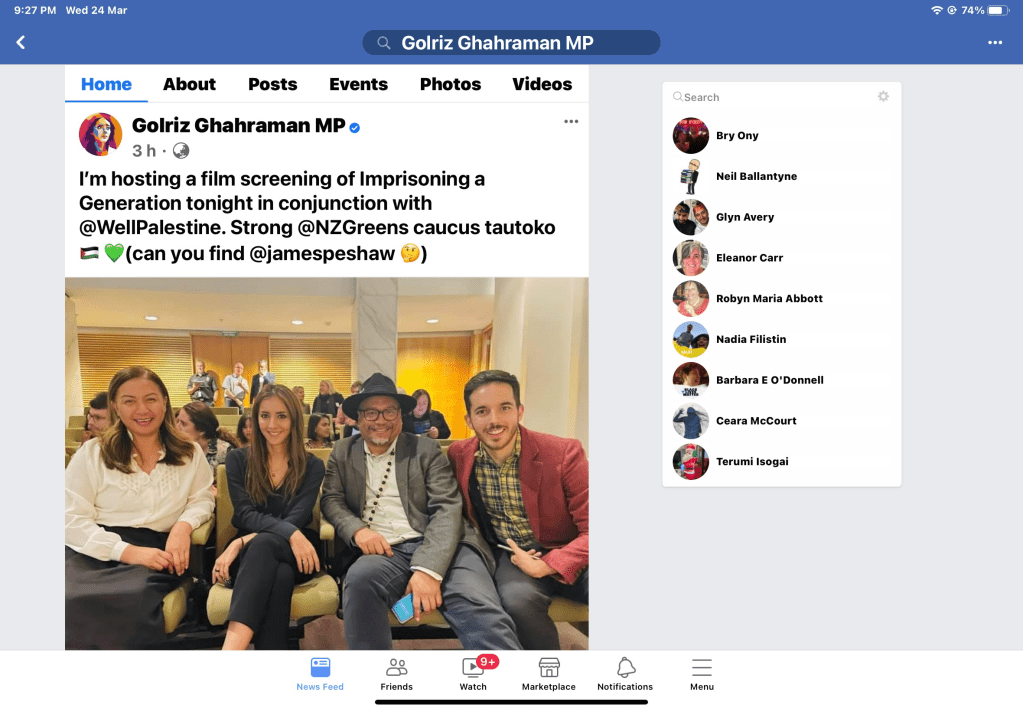
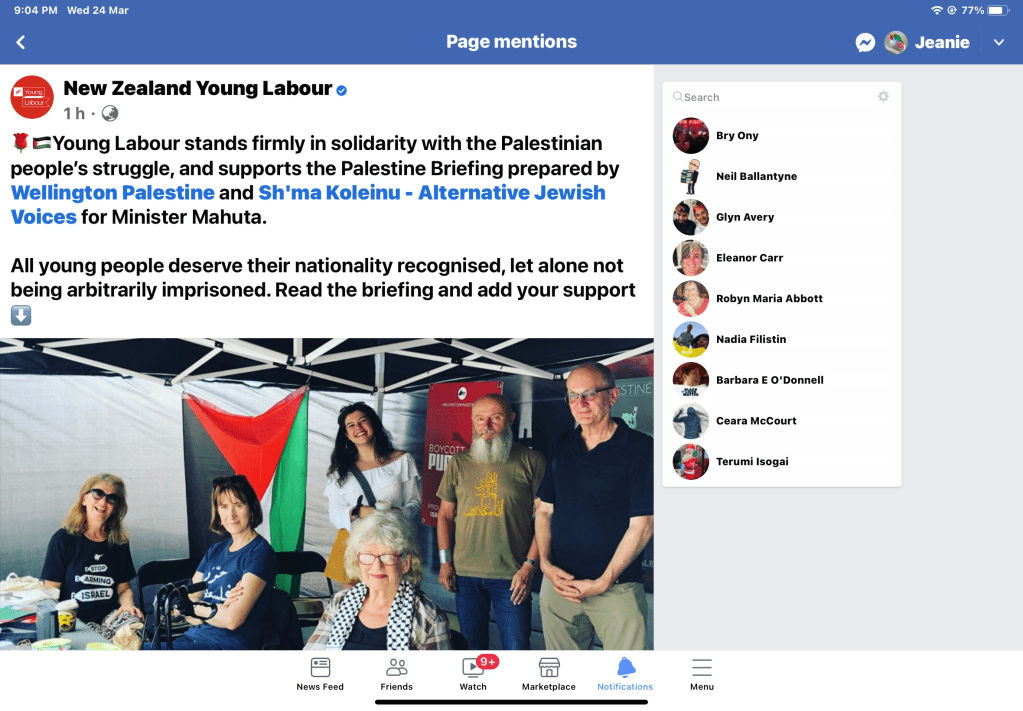
A big thanks to Justice for Palestine for inviting Alternative Jewish Voices to share the platform last night at Parliament. Green MP Golriz Ghahraman hosted the event, protesting the detention of Palestinian children. Ten MPs from Green and Labour (including both Green Co-Leaders) attended.
Shortly after, we were thrilled to read NZ Young Labour’s strong support for the Palestine Briefing that we and Justice for Palestine jointly submitted to the then-incoming Foreign Minister Nanaia Mahuta.
So, as Young Labour suggests, add your support! You can read the brief here. Here is our additional statement on the value of recognising the State of Palestine, and normalizing the equal standing of the Palestinian people:
What would change, if we recognised the State of Palestine?
138 of the UN’s 193 member states recognise the State of Palestine, consisting of the West Bank, East Jerusalem, and the Gaza Strip. Whatever diplomatic outcome they envision, 138 states believe that a solution starts by recognising the parties involved. Recognition implies that, like powerful and powerless parties to a lawsuit, Israel and Palestine approach the court with equal rights.
Aotearoa-NZ is in the minority. We do not recognise Palestine. We let the power disparities stand. We do nothing to acknowledge Palestinians’ national voice, as if that mythical court case should somehow decide about them, without them.
Recognition of Palestine would re-frame the issue.
As an occupied people subsisting under a violent military regime, Palestinians have a right to our legal protection. As the State of Palestine, they have a land and they own its natural resources. Recognition unifies the State of Palestine, which the occupation seeks to divide by policy and force. The unified State of Palestine lives under a single occupation, although it is differently enacted within Israel, in the areas where Israel is the occupying power, and with respect to refugees elsewhere.
As citizens of a state in a world where states remain the defining political actors, Palestinians would have access to the institutions, agreements, interactions, enforcement and responsibilities that we all take for granted. They would have access to the websites that we use, to the banking transactions and passports and mail and myriad other systems that are enabled by state agreements. They would map their own geographies, rather than being administered by military documents that aim to chart the loss of their land and their autonomy. When settlers occupy, or when Israel openly vows to take, additional land from the State of Palestine; the illegality of those acts would be clear – none of this ‘annexation’ obfuscation.
These benefits are so normal that we really must re-phrase our question: why has Aotearoa-NZ withheld all this from Palestinians for so long? Why should a child be denied all that normalcy, by virtue of being born Palestinian?
Rights and law and diplomatic acts like recognition will not end the occupation. Rather, they describe the internationally agreed minimum standards by which we all live. When they are upheld, they restore Palestinian lives to those minimum standards. That sets the stage for two national groups to negotiate in a forum of international law. We will not be the negotiators, but it is our responsibility to establish fair conditions for that political project. We uphold the laws. We drag this occupation into a forum of law for a resolution based on justice, not brute power.
Why do Palestinians live so far beneath those minimum standards now? The law of occupation, the Geneva Conventions, all those UN resolutions – where are they? It’s mystifying, we agree. The tools are all waiting for us to pick them up and use them. We call on our Prime Minister to uphold the laws and conventions that NZ governments have signed in all of our names – and to bring the State of Palestine fully into the same systems by means of recognition.
We are impatient, because the passage of time is not neutral. It never was, and Covid has doubled the urgency. Palestinian living standards, their environment and life prospects are deteriorating sharply: doing nothing is not a cost-free alternative.
We call on our government to recognise Palestine now.
Withholding recognition is a willful refusal to see a nation of five million people, to insist on their equality and inclusion. The occupation is exclusive, denying Palestinianhood, downgrading and ultimately erasing it. Recognising Palestine is an inclusive act. Recognition affirms Palestinians’ full right to exist in a space that will need to be shared. We in NZ know that states may colonise blindly, but they must learn to see and listen and speak new languages. Recognition sees the indigenous people of Palestine. That is the right side of history for NZ to take.
Recognition will also help to correct a conversation that has become toxic.
Too often, protest is merely anti-occupation or merely anti-Zionist; a protest against Israel’s failure to observe law and uphold Palestinians’ rights. Recognition reframes the issue by centering Palestinians, and normalising their full, equal human and political rights. With that established as our baseline, we can protest the deficit, the rights withheld. Recognition will strengthen Palestinians’ platform to speak and act on their own aspirations.
Too often, this occupation has been about exceptionalism (Israeli and Trumpian). We spend too much time on the justifications of the powerful. Recognition rejects all that. It brings the occupation back into unexceptional focus: one state occupies the land of another. Occupation is a military act, governed and limited by law.
We should be working to invoke that law. As a first step, let us join the majority, the 138 members of the UN who recognise the State of Palestine.
Signed by these Alternative Jewish Voices and Friends,
The politics of name-calling, or, down the rabbit hole we go.
A statement by Jewish Voice for Peace is recirculated by Green MP Golriz Ghahraman, protesting Israel’s refusal to vaccinate Palestinians in the occupied Gaza Strip and West Bank. The New Zealand Jewish Council calls Ghahraman an antisemite.
The International Criminal Court will investigate potential war crimes by Israeli and Palestinian armed forces. Israeli PM Netanyahu calls that ‘the essence of antisemitism,’ and the Israel Institute calls it “a kangaroo court only against Israel.”
The NZ Superfund declines to invest in five Israeli banks which fund illegal settlements on occupied Palestinian land. Nicola Willis, National List MP says this is “potentially aligning New Zealand with an antisemitic movement.” The Israel Institute circulates the report and tweets, “NZ embraces BDS.”
What else must you believe, if you consider these acts antisemitic?
Jewish Voice for Peace (JVP’s) position signifies the profound disagreement within the Jewish community. There is no single Jewish stance on Israel or its occupation. JVP staunchly opposes Israel’s policy, but disagreement is not hatred. To find JVP antisemitic, you need to believe that they act out of hatred for Jewishness because that is what antisemitism means. You would need to believe that JVP’s 200,000+ supporters, members of their 70+ chapters, their rabbinic, academic and artists’ councils; and New Zealand Jews like ourselves all want Palestinians to be vaccinated because we hate Jews.
In fact, JVP’s (and our) position is anchored in the human right to health and the occupier’s obligation to proactively intervene when an occupied community is threatened by an epidemic. The Geneva Conventions and International Human Rights Law codify those rights and obligations. The UN Special Rapporteurs have detailed why Israel’s vaccination policy is “discriminatory and unlawful.”
To find all this antisemtic, you must believe that we are all motivated by hatred rather than by the universal principles of equity and protection. All of us.
The International Criminal Court will investigate potential war crimes committed by armed forces in Palestine / Israel, particularly in the Gaza Strip since 2014. All armed forces will be held to the universal standard of the laws of war. Those laws represent nations’ aspiration to minimize the harm that war inflicts upon civilians and combatants. The laws refer to people, to flesh and blood human beings – not to religions. The laws make armed force accountable. They don’t mention Jewishness or treat Israel differently from anyone else.
To find that antisemitic, you need to find a hatred of Jews concealed within the universal laws and principles of civilian protection.
NZ Superfund has excluded five Israeli banks which fund Israeli settlements in occupied Palestinian territory. Their decision document explains:
“The UN General Assembly has consistently reaffirmed the illegality of Israeli settlements in the Occupied Palestinian Territories (OPT) … In resolution 2334 (co-sponsored by New Zealand), the UN Security Council reaffirmed that the establishment by Israel of settlements in the OPT had no legal validity and constituted a flagrant violation under international law.”
The Superfund’s decision was governed by its Responsible Investment Framework, which is in turn “guided by the UN’s Principles for Responsible Investment, domestic and international law and policy positions of the New Zealand Government.” (links to both documents are here)
The UN Special Rapporteur has explained the obligations of states to uphold the law.
To find the Superfund’s act of compliance antisemitic, you must believe that the Geneva Conventions, every NZ and other government that has voted for UN resolutions for half a century, have been motivated by a hatred of Jews rather than by a legal objection to taking other people’s land by military force.
Much of the world is thus implicated in these three acts. Do you believe that we all act out of hatred for Jewishness – really, all of us? None of us acts because we consider Palestinian rights, health, dignity, aspirations to be equal to our own?
This politics by name-calling has dug itself into one deep rabbit hole.
Two things happen when criticism of Israel is instantly condemned as antisemitism. They happen so fast that we need to stop and take note.
First, name-calling distracts us from the real issues of occupation and injustice. Suddenly, we’re talking only about Israel. Palestinian voices have been pre-emptively silenced. Of course Palestinians protest, because they experience the violence of occupation. However, when protest is rendered necessarily antisemitic, Palestinian protest can be ignored. We reject that. Palestinians have their own stories, and Palestinian rights are not about Israel.
Second, when anti-Zionism is rendered antisemitic, Zionism is elevated into the protected sphere of our Jewish beliefs. Suddenly, Jewish nationalism has appropriated our Jewish religion. We reject that, because occupation is not our religion. Suddenly it sounds as if hatred is the only basis for anyone’s opposition to Zionism, and we reject that. We are not Zionists because we value human lives equally, and that principle is a part of the Jewishness that we love.
We need anchors to understand current events, not slogans. Each of the actions above is anchored in enduring principles: law, human rights and dignity, the accountability of power. Those ideals secure us all because they respond universally to racism (including antisemitism) and oppression.
By contrast, politics by name-calling divides us, and seeds suspicion between us. It blurs political disagreement into imagined racial hatred. Social media companies have become obscenely rich by separating us into echo chambers where we don’t need to hear anything that challenges our confirmation bias.
As long as we are conducting politics in this cheap way, we are also giving the real hatred a free pass. When someone who claims to be liberal expresses antisemitism, of course we need to call them out. They have betrayed their stated principles. Far more systematically and far more dangerously, none of this name-calling touches the far right, where antisemitism is an organising principle.
We urge our neighbours and our government not to be enlisted in this politics of name-calling. It is not antisemitic – it is not anti-anyone – to protest violations of international law and uphold our equal human rights.
Signed by these Alternative Jewish Voices and Friends,




 Sh'ma Koleinu - Alternative Jewish Voices (NZ)