Joint Statement on Proposed Amendments to the Terrorism Suppression Act 2002
Date: 1st September 2025
Issued by: Islamic Council of New Zealand (ICONZ), Alternative Jews Voices (AJV), Palestine Forum of New Zealand (PFNZ), New Zealand Buddhist Council (NZBC), Aotearoa Alliance of Progressive Indians (AAPI), The Council of Christians and Muslims (CCM).
Aotearoa New Zealand — We, the undersigned organizations and individuals, express our deep concern regarding the New Zealand Government’s proposed amendments to the Terrorism Suppression Act 2002. These changes seek to broaden the definition of terrorist activity and expand law enforcement powers, including warrantless searches and the criminalisation of planning or preparing for acts deemed as terrorism.
While we recognize the importance of safeguarding national security, we urge the government to ensure that any legislative changes are made with full transparency, meaningful public consultation, and in strict alignment with New Zealand’s domestic and international human rights obligations.
Global precedents demonstrate the dangers of vaguely defined counter-terrorism laws. Such laws have been misused to suppress legitimate dissent, advocacy, and humanitarian work. We highlight the following examples:
United Kingdom: The proscription of the nonviolent protest group Palestine Action under terrorism legislation has led to over 700 arrests, many for peaceful actions such as holding placards. The UN High Commissioner for Human Rights condemned this move, warning of its chilling effect on freedom of expression and assembly.
UN Global Study: Led by Special Rapporteur Fionnuala Ní Aoláin, the study found systematic abuse of counter-terrorism measures across all regions, disproportionately targeting civil society actors, especially women, minorities, and human rights defenders.
Gaza: Human rights defenders and humanitarian advocates have been targeted under vague terrorism laws, facing surveillance, smear campaigns, and even lethal attacks for documenting war crimes and advocating for relief.
In Aotearoa New Zealand, the Royal Commission of Inquiry into the 15 March 2019 terrorist attack found that an “inappropriate” level of intelligence and security resources had been directed at the Muslim community prior to the attack. This underscores the risk of discriminatory enforcement and the need for safeguards.
We emphasize that Indigenous peoples, racial, ethnic, and religious minorities are particularly vulnerable to being over-targeted by counter-terrorism strategies. Ensuring non-discrimination is essential to maintaining trust and justice in our society.
We call on the New Zealand Government to:
Conduct a thorough and inclusive consultation process with civil society, legal experts, and affected communities.
Ensure precise and narrow definitions of terrorism-related offences to prevent arbitrary enforcement.
Include explicit protections for freedom of speech, human rights advocacy, and peaceful protest.
Establish independent oversight mechanisms to monitor the application of the law and prevent abuse.
New Zealand has a proud tradition of upholding human rights and democratic values. We must not allow fear to erode the freedoms that define our society.
We stand united in urging the government to approach this process with fairness, transparency, and a firm commitment to protecting civil liberties.
Our next UK import: The Terrorism Protest Speech Suppression Act
On Sunday August 24, both the Guardian and the New York Times carried articles worrying that the far Right was increasingly bold and secure, and articles detailing starvation and genocide in Gaza. At the same time, both UK and US governments have legislated or decided by edict to treat peaceful democratic protest as a national security threat. Their special target: the protest which draws attention to starvation and genocide in Gaza.
Aotearoa, always taking pride in our independent-minded foreign policy, are rushing to adopt something like the UK’s legislation. If we do, it will be our second such import this season. The divisive Harmony Accord is also a UK product that this government will use to reward its friends and sideline the community.
The government seeks to reform our Terrorism Suppression Act. The revisions would hasten the designation of terror while greatly broadening the idea of public support to terror. That breadth seems to include designating peaceful protest as a security threat. In an article entitled “slippery slope to authoritarianism”, Newsroom’s Sam Sachdeva summarises the “limited consultation currently taking place behind closed doors with a handpicked selection of groups and experts.”
Guess who’s in and who’s out?
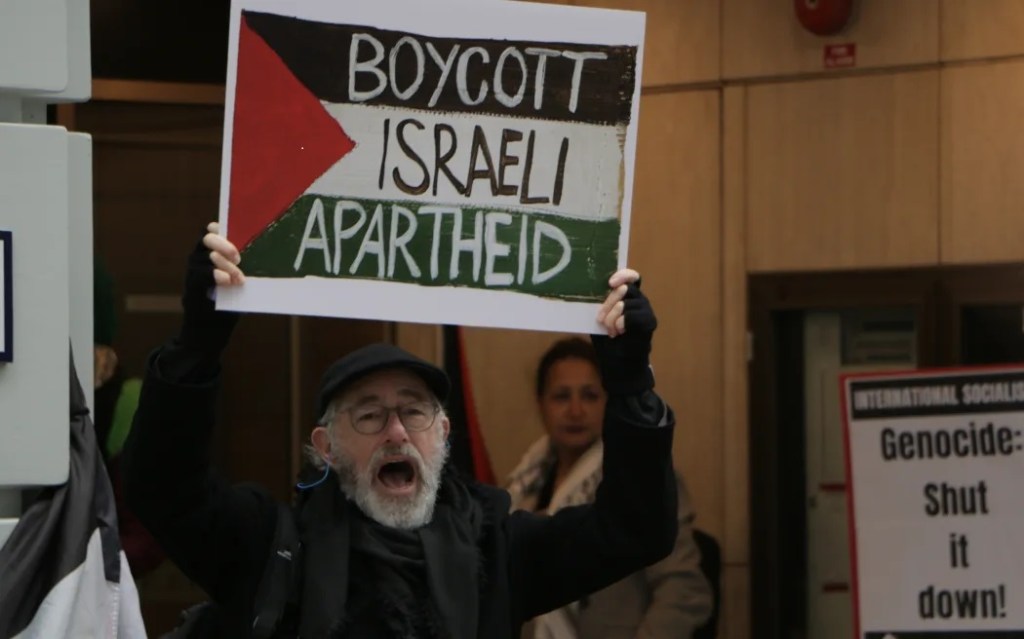
In the UK, it is now legal to arm Israel but it is terrorism to object. We have yet to see a single arrest for inciting or endorsing crimes against humanity. Instead, octogenarian clerics fill the cells for silently holding signs that oppose genocide. People have been arrested for satirising this, so presumably mocking the government’s asinine actions now constitutes a national security threat.
The UK legislation misuses the language of security to shut down peaceful protest. Terrorism arrests bypass normal, open judicial processes where those charged can be heard stating their case. While the legislation’s application has disproportionately targeted protest against Israel’s genocide in Gaza, the issues are wider.
Our government is in a rush to award itself the same tools. If Luxon acts as the UK government has, he will undermine democracy in the guise of security, suppress protest and the right to a fair, open judicial process. He is acting without public consultation, and there is a character issue whenever a government schemes behind closed doors to suppress public challenge. Finally, there is the opportunity to misuse legislation in a way that sidelines real threats in favour of the us-and-them selective use of power.
This government habitually listens to friends and former lobbyists, as it has done with guns, alcohol, smoking and forestry, disregarding the community and placing people at risk. This action is true to habit. Luxon is legislating for friends at the expense of democracy – and immediately for Gaza.
We cannot separate this from genocide in Gaza, the focus of so much protest that this government would like to ignore. Palestine is already an issue on which protest speech has been confused with security threat in Aotearoa. The Community Security Group (CSG) has for years monitored individual New Zealanders’ social media and speech, and declared legal speech to be a threat to the Jewish community. The CSG has shared this information with our security forces and the embassy of Israel. The CSG is funded partly by government, including a recent new CSG staff position. They enjoy special access as a member of Mark Mitchell’s so-called harmony accord.
Already, anyone who speaks to the rights of Palestine and condemns Israel’s genocide knows they will be called a supporter of Hamas and an antisemite in Zionist performative politics. We who demand human rights face various underhanded tactics, but not arrest. For how much longer?
We regard this legislative act as a mechanism to draw the cord evermore tightly around government’s friends and enshrine new ways to target government’s critics. We regard it as a self-inflicted democratic injury, the act of an authoritarian seeking to intimidate and blunt protest.
We regard it as a misdirection. While this government is busy suppressing protest as terroristic, they are also robbing us of the language to grasp the real threats to our society which emerge from the far Right and disinformation networks.
Finally and foremost, we regard it as an intentional distraction from the desperate work of ending genocide in Gaza. This act would call it terrorism to draw attention to the state terror before our eyes. This act cuts us off from those to whom we have obligations.
Count on this: we will oppose this action in every way possible. Taking our lead from friends in the UK, we will fill the public squares with sign proclaiming our disgust at genocide and our government indifference to it. We are confident that we will be in fine company, in numbers too large to intimidate or arrest or disregard. Sometimes, personal impact brings forth the numbers that governments cannot resist. It happened with Viet Nam, when the draft brought the war home. Watching the policy absurdity unfolding in the UK, we think perhaps this legislation might tip the scales.
At each step of its genocidal campaign, Israel’s leaders have accurately assessed the world’s indifference, played on it and nudged it further. Over a period of decades, they eased the world from a settler-colonial theory that implied Palestine’s erasure, to a blockade that ensured Gaza’s strangulation. Now, over a period of months they have been enacting Gaza’s death by genocide in plain sight.
Today Israel’s elected government acknowledges that Israel will, again, still, once and for all, fulfil its fantasy of Greater Israel by stealing Gaza. They already occupy it, as courts have repeatedly affirmed. Now they judge that they can snatch it, displace Gaza’s population and get away with it. They judge that we have given up.
We say no. We say, get out. Get out, stay out, and begin the accounting. Gaza must live, and Gaza is Palestine. Two million human beings must be fed and protected, their bodies restored insofar as is possible after this torture. We concede nothing.
‘Intensifying criticism’? Every diplomatic shuffle distracts from the hourly deterioration of conditions in Gaza. Ever complicit, our governments buy time with their talk while the slaughter continues.
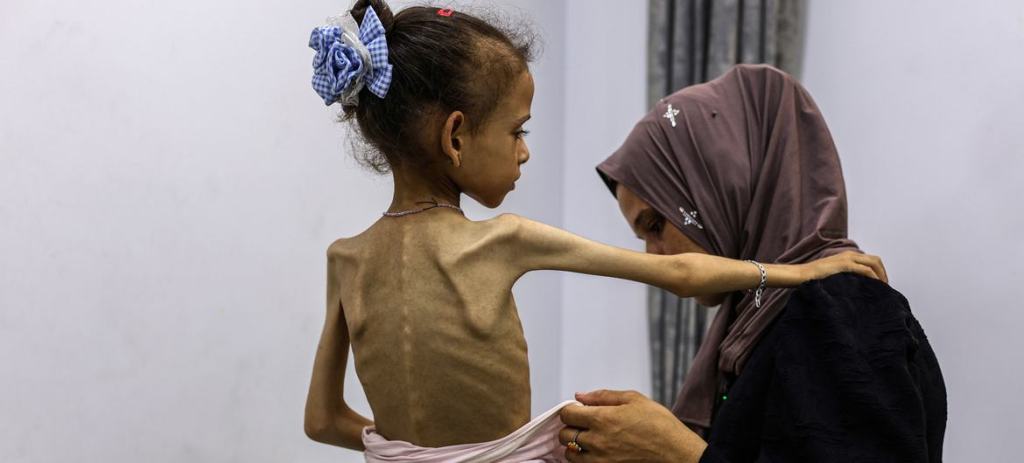
‘Widespread condemnation’ – so what? Not one child can eat these words, and neither can starving children digest the wholly inappropriate foods being distributed by the GHF. States are not taking the slightest meaningful action, although they are watching Israel deprive the children of Gaza of the nutrients they need if they are to have any chance to assert their right to life.
Even as they say, ‘We can no longer remain quiet,’ Jewish leaders are refusing to contemplate meaningful change. Spokespeople for the Zionist NZ Jewish Council still dare to outline the conditions that Palestinians must meet, in order to qualify for their fundamental human entitlements. It is not the task of Palestinians to satisfy the genocidaires of anything. Nonsense. The Jewish Council is trying to distance itself from the present crimes while preserving the core condition of October 6: a Jewish supremacist regime.
We study the indifference of states to the rise of Nazism. We’re past that. We talk about international indifference to the Holocaust. We’re beyond that. The only parallel now can be with the liberation of concentration camps. In those starving Jewish bodies, people glimpsed and felt overwhelmed by the scale and the inhumanity of Nazi crimes. That’s where we are. We see Israel’s inhumanity toward defenceless Palestinian children.
There is no avoidance but willful avoidance now. The problem is not Netanyahu. The problem is baked into Zionism and it cannot be redeemed.
Those children living in the most grotesque pain, those canyons of destruction, those deranged elected officials leading genocide; those are real, actual Zionism. Zionism is the system that produced Netanyahu, not the other way around.
We say, get out. Get Israel out of Gaza, get Zionism out of our institutions.
Feed Gaza – right now, this day. Start the engines, drive the trucks in.
Mark Mitchell’s Ministry of Ethnic Communities has persuaded a small number of Muslim and Jewish organisations to sign a ‘harmony accord’. AJV was invited, took part in a number of discussions, and declined the offer. We have released a joint statement with the Islamic Council of New Zealand of our shared reasons.
The case for being in that room has been stated in detail. We accept that participants assessed risks and benefits and used their best judgement. We write not to undermine them, but to state the Jewish case for applying pressure on this government and its initiative from outside the accord.
In our view, this accord offers government access and resources at the cost of validating the narrative of power, placing human rights on the back burner, and excluding Palestinians. That does not accord with our values.
Of what value is selective access – is it not the role of government to listen to the community rather than the converse? We have pleaded with this government to intervene in grotesque crimes for nearly two years. During that time, we have watched the government try to dismantle Te Tiriti, undermine labour rights; and the list goes on. We want to change this government, not be cordial to it.
The harmony accord proceeds from the problem statement that genocide and government indifference can cause social disharmony in Aotearoa. That is true – but the disharmony has never been between the Jewish and Muslim religions. There is disharmony between the street and the backrooms of power; between society and the far Right and disinformation networks that seek to undermine society; between the great majority of New Zealanders and the White Christian nationalist use of religion to intimidate and incite.
An accord between some Jews and Muslims is not the way to address any of those. New Zealand has multiple interfaith initiatives including a faith leaders’ forum. Those are better placed to carry out faith-based advocacy. Those should be resourced and tasked, rather than funding or rewarding one more council to start from scratch. With starvation stalking Gaza, how can it possibly be anyone’s priority to negotiate the operations of a new council?
—
The Jewish community is represented in this accord by the exclusively Zionist NZ Jewish Council, the Holocaust Centre (which denies that another genocide is taking place in Gaza), the Community Security Group and Dayenu.
This accord revives the flagging Jewish Council, an unelected group chosen by Zionist institutions. We have for years protested their hollow claims of representation. These days, the Jewish Council struggles for language to say that they regret Netanyahu’s extremes but wish to perpetuate Jewish supremacy. Such rearguard Zionist apologetics endanger Jewish safety by continuing to blur Jewish identity with Israel. The NZ Jewish Council cannot bring themselves to envision a future grounded the findings of international courts and our inalienable equality.
At no time in our discussions of this accord did we ever hear that the Community Security Group would be a signatory. Had we known, we would have walked out upon hearing.
The Community Security Group politicises the work of protecting Jewish places. AJV has for years objected to their reporting of individual Kiwis’ social media and other speech to the embassy of Israel in the guise of “anti-Zionist antisemitism”. Their inclusion gives Israel a seat at the table, nothing less.
—
AJV took part in initial discussions of the accord, and had a hand in drafting V1 of the accord. Unlike that V1, the final accord documents do not recognise human rights, nor the role of international courts as the basis for finding peace with justice. The accord’s rationale began with Gaza, but it now contains no vision for advocacy, bringing war criminals to account, and supporting Palestinians’ work for a just co-existence. Participants in the accord are not required to embrace our global agreement of human equality.
As we informed the Ministry of Ethnic Communities and others within the accord, when we realised how the accord had changed, AJV declined to sign.
Should we sit around a table with those who disagree? Sure. However, human rights and international law are not opinions. They are our global norms. They are where discussion begins. No one should have to enter a room, especially a room under government auspices, knowing that they will have to ask for that to which every human being is entitled.
There is no direct Palestinian representation in this accord. By framing discord as a religious matter; by including the Jewish Council who deny Palestinian rights, and the Community Security Group who report on individual New Zealanders to the Israeli embassy; perhaps the council came to feel hostile or unproductive.
—
In these ways, AJV believes that this accord has validated the worst of the status quo. We must do more than ask for the marginal reform of the status quo.
Minister Mark Mitchell says he hopes this signing will be a precedent. Perhaps he hopes for a series of signings to take up the year before the next election.
AJV will work ceaselessly for justice in Palestine, in partnership with Palestinians, Tangata Whenua, and our global movement. We will work with local and international partners who believe that we need new Jewish community – community that will not replicate the harms we are witnessing in Palestine. We will change this government in partnership with all those whose interests and rights have been undermined. None of those are back room functions requiring government funds or recognition.
The real coalition is the one we will build in the street.
Feed Gaza. End Israel’s illegal occupation. Feed Gaza. Implement the decisions of international courts, including the arrest warrants for Israel’s leaders. Feed Gaza. Let justice take root.
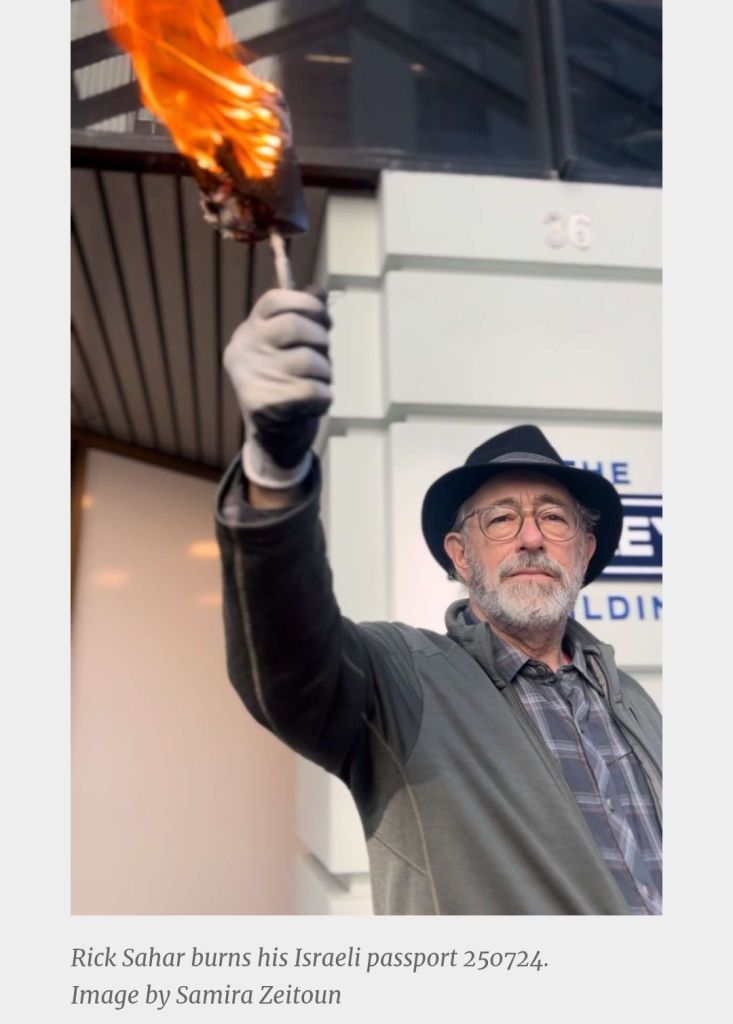
Here are two very different paths from Zionism to last week’s (very successful!) fundraiser at the Olive Branch in Carterton. First, Rick Sahar’s story:
Growing up in Detroit as the son of two Holocaust survivors, my parents never spoke about their lives, before or during the Holocaust, so I knew very little about them while growing up. I will explain more about this later…
When I was sixteen years old, I had enough of the tensions I felt at home. I was also fed-up with high school, and for political and social justice reasons, I did not see a future for myself in the USA. My ideal at the time was to work in agriculture, to become a farmer. With that in mind, I convinced my parents to allow me to travel to Israel for the summer of 1971, not telling my parents that if it worked out for me, I was not planning to return for my last year of high school…
I arrived in Israel naive and uninformed. We never discussed Israel at home, I never discussed Israel with my friends. I ended up living there for 10 years. By the end of that time, I had witnessed the apartheid system in action and knew that I really couldn’t live in Israel anymore and had to leave…
Yes, and during that time, I was conscripted into the Israeli army in January 1974 and was trained as a tank gunner. Conscious objectors were treated like criminals at that time, and they still are. I did not go to the army happily as it got in the way of my work and my relationship. And I never held a gun in my hands before. Armed combat was beyond my understanding. I had no glorified view in the least of me being in the Israeli army… and fortunately, I never saw “live action” during any of my time in the Israeli army.
A few short months after the 1973 October “Yom Kippur” war, I was trained and stationed for 1.5 years in the Sinai Peninsula facing the Suez Canal just in case another war would break out, which it didn’t. I was just wanting to do my time, my three years, and get out and go back to my life on the kibbutz, thinking I will be living there for the rest of my life…
When finally back on the kibbutz, I realized that my personal relationships with Palestinian Arabs I had befriended caused issues for some of my comrades living there. They questioned me as to why I would invite “them” to the kibbutz… that baffled me at the time, still not knowing much of the history, how the Zionists drove Palestinians off their land or, or for that matter, how the Zionists had made a pact with Mussolini’s fascist party. The Zionists didn’t hesitate in killing Arab, British and Jews alike if they got in the way of their plans to create a “Jewish” state.
I joined a kibbutz-led left-wing peace movement that was light on policy and offered little solution to the situation, not yet called in Israel an “occupation”. In 1980, during what turned out to be my last reserve duty, I was stationed in the West Bank and called into my commander’s office; he ordered me to go with two other soldiers to arrest a suspected PLO operative at his home and bring him in. Without a moment’s pause, I flatly refused the order, saying that I was there to guard not to arrest on suspicion… I gladly accepted the commander’s punishment knowing that at least I would not be responsible for ruining someone’s life; I was sent to guard the ammunition bunker, around the clock, for the next three weeks. In those weeks, I came to the conclusion that I must never again serve in this army which meant that my time was up in Israel. So I took a year’s leave from the kibbutz and joined my Kiwi girlfriend on her trip back home to visit her mother in Wellington.
What was it like for me to come to Aotearoa/NZ at the end of 1981? It was like finding Paradise. I learned it was soon after a most divisive time in recent history, the Springbok tour and protests… Arriving in Auckland, the next day we went to Aotea Square, I was amazed… no sign of soldiers, armed with rifles, in sight. Instead we saw kappa haka groups and women singing and swinging poi… I actually cried tears of relief to find myself in such a peaceful environment compared to where I had been living, in a fully militarized state.
Both my partner and I took an interest in Buddhism. I chose to study Tibetan Buddhism as it weirdly reminded me of some Jewish orthodox rituals I went to growing up. Through meeting several Tibetan teachers who told me about China’s occupation, their monasteries being destroyed and their own dramatic escapes, I eventually became involved in the advocacy group “Friends of Tibet”… In time, I became the local chairperson, organizing rallies and vigils, mainly in front of the Chinese embassy. There was a Parliamentary lobby group that somewhat supported our demands for a free Tibet. Knowing that the Chinese president was to arrive for a state visit in 1999, we organized a rally outside the Hotel he was to stay at on Grey St. What happened there, in short, was that the NZ police unlawfully broke up our demonstration, forcing us away from the hotel protest site. We got legal advice from Barrister Tony Ellis who supported us in filing a complaint against the police for interfering in our legal right to protest. There was a Parliamentary inquiry that found in our favour, the Pro-Tibet demonstrators. The police then became keen for us to drop our complaint, end the court proceedings, so they offered a public apology and compensation to all who were illegally detained, which the group accepted. When I was asked by one of the local newspapers, why did we decide to file court proceedings against the NZ Police, my answer was “to preserve the legal right of protest in NZ from now, and into the future”. I’m glad I was part of that action as I believe it has secured our right to demonstrate in support of Palestine, on the streets of Wellington, including in front of the Israeli embassy.
What I realized just a few short years after that experience was how I have been avoiding looking into my own family’s history of oppression suffered under Nazism. I was finally ready to find out about my parents’ Holocaust experience that they never spoken about, and started researching it myself. I was unprepared for some of the facts I found out, yet it went on to influence me in ways I did not expect…
I became obsessed; I searched through thousands of pages on the internet and pieced together the chronological life events of both my parents, how they were forced out of their homes to move into ghettos, later into concentration camps, members of their families murdered, just for being Jewish… sound familiar? I also learned about the events that led to them surviving and to arriving to Detroit and meeting there and getting married. A new start for two traumatized people… I realized that they might never have left Poland, with the happy lives they had there, if not for the Nazis’ cruel plan to rid themselves, and the world, of Jews…”Never again” should mean never again for all people.
I joined the Holocaust Centre of NZ (HCNZ) to continue my research and share my findings with other members of the Jewish community and the wider public. I started by presenting my Parents’ survival story first at HCNZ followed by presentations at several high schools/colleges around the country. I even became a board member. Zionists on the HCNZ board started focusing their support on Israel and justifying its military actions instead of fulfilling HCNZ’s mission statement to call out human rights’ violations as they happen. I resigned from the board disenchanted with the breakdown of process and procedure. HCNZ today does not acknowledge that a genocide is being perpetrated against the people of Gaza… For me, a son of Holocaust survivors, it is incredulous that the HCNZ does not acknowledge that a genocide is being perpetrated against the people of Gaza, even though it is recognized by the world’s leading genocide and Holocaust experts/academics and that a genocide is found by the world’s highest courts to be most likely being committed in Gaza.
So with my family history, my growing personal awareness towards human rights and justice for all, learning the historical facts and that Zionism is a fascist movement, it became apparent to me what to do next… to commit my support for Palestinian Rights and Self-determination and do what I can to at least help raise public awareness about this Genocide in addition to Israel’s land theft and illegal occupation from also before 1948. There are still people in Wellington, and around this country and the world, who believe that Hamas started this genocide on Oct 7. Every leaflet I manage to hand out, on the streets of Wellington, I see as a small victory, in assisting to overcome ignorance that will help lead to a free Palestinian state.
Israel has always made false claims they are being threatened by another state in order to attack them… Israel cannot claim the right of self-defense as an occupying force when attacked by an armed group within a territory they illegally occupy. Their claims have no legal standing in international law…
I firmly believe that ending this Genocide and establishing Palestinian statehood are the most significant human rights actions of our time. Many people living in New Zealand took a stand against the Springbok Tour and the apartheid in South Africa. The whole world should be rising up against Israel as they are the present-day Nazis. I don’t say that lightly knowing the huge amount of suffering perpetrated by the Nazis, yet I’m convinced that to be true. If you agree with me, even in part, then this is the moment to dedicate more of your time and effort to raise awareness of the Genocide in Gaza through whatever means you can – attending rallies, sharing your views with friends and family, writing to the government to sanction Israel and expel the ambassador, boycotting all goods manufactured in Israel and also those companies that support the Genocide. We can all become better informed so that we can understand more deeply the significance for us all the way over here in NZ for being much more involved in supporting Palestinian statehood. Every experience I have had in my life has led me to that realization.
I’ve tried to create a picture of how I overcame my lack of knowledge to become involved in Palestinian rights and in supporting a free Palestine… There is real truth behind the words, “nobody is free until Palestine is free”. If only Israelis thought the same, they too would finally become free.
I see this time we are sharing as significant – we all live entitled lives with the ability of some self-determination, to a greater or lesser extent. With understanding that, it is our responsibility to act.
By Rick Sahar
October 6, 2024, Image Teirangi Klever
And a very different path, by Marilyn Garson
Kia ora koutou, kia ora i te whānau.
Thank you so much for this lovely reason to get out of the city on a beautiful weekend morning.
Ten years ago, I spent my bright weekend mornings reclining on the terrace of the Al Deirah Hotel in Gaza City with my closest Palestinians colleagues and some of their small children. We had breakfast together, overlooking the beach, on each of the last weekends of my four years in Gaza.
Those were quintessential Gaza mornings. Everyone moved more slowly in the mornings. Scorching salt air; fishing boats put-putting into the lagoon. Table covered with plates of food to share. Now and then, like a magnet our eyes would be drawn to the stretch of beach where an Israeli soldier had killed those four skinny boys while they played, one year earlier. July 16, 2014. That beach reminded us that Gaza lived in the pause between wars, and each hour brought the next war nearer. So we talked more slowly, because our rambling talk suspended the time. Gaza was all those things at once.
Israel’s occupation forces destroyed the Al Deirah Hotel in January, 2024. And now Israel’s forces say they will kill anyone who ventures into that cool, spacious water.
My friends who sat around that table have left Gaza now. They say that a part of them is dying from the news. Their children drag them forward. The baby who napped at our table recently told me that she reads chapter books in English in her new Zealand school.
My colleague Scott returned to Gaza in November, 2023. He was UNRWA’s director for the first 15 months of this nightmare. He saw Israel strike every one of UNRWA’s protected shelters at least once, and kill over 200 of our UNRWA colleagues. Scott has gone grey. We caught up after he left, and we talked about the dislocation of Gaza’s once-familiar landscape. The eye looks for landmarks as if the past could comfort the present. The building where we both worked is now a tangle of concrete and rebar. I have tried to locate my apartment building in video of the wreckage of Al Rashid Road but there aren’t enough streets left to count. Sand has begun to smooth over the rubble.
Little Gaza is the most heavily bombed place on this earth. The obliteration of so much of Gaza’s built environment scarcely hints at the wounds to its society. There is a pervasive sense of absence in the images, where there had been such lively bustle. Because Gazans had been crowded so closely together, Gaza’s city streets felt as intimate as village squares. We drove with a particular rhythm, forever tapping the brakes to nod at someone’s relatives, former neighbours, the parents of children’s school friends. As densely woven as Gaza’s connections had been, that thick is the web of Palestinians’ losses now.
I have not gotten used to it. Waking up each dawn, Gaza is still there until I open my eyes.
Here is something else that I learned and brought home from Gaza: steadfastness is relational. Every night when the electricity was cut, the first sound I heard was the cheering from the street. That defiance overpowered and elevated my frustration.
The foundations of resistance take shape in the space between us, where you encourage me and I am there for you. Since Israel set about shattering Gaza’s soul, since Gaza cracked and split this world, you and I have been fortifying those steadfast foundations.
Let me say clearly, I hate that illegal wall around Gaza because I am a Jew. I don’t give a damn who built the wall. That wall is an insult to the value of life, and I care for the lives being lived behind it. There is no question on which side of that wall a Jew belongs. We know about ghetto walls and we belong with those who rise up and fight to survive within them.
Campaigning for UNRWA
Since I left Gaza, I have worked for a just future for both Palestinians and Jews. Zionism is not allowed to steal Jewishness from the rest of us. It has been my privilege to be, among many others, working at the foundations of a new, liberatory, solidarist Jewishness; be it spiritual or secular. We recognise that the old structure has failed, failed utterly. Jewish institutions that claim to act in our name have twisted themselves into pretzels to invent exceptions to their principles and their mercy and the ethics of our teachings.
Does that sound familiar? I regard the Wairarapa flag-waving as the same kind of foundational act – living allyship steadily, together, keeping it visible and resolute. Enacting solidarity with one eye on the institutions that claim to represent us. Our national institutions have twisted themselves into pretzels to make exceptions to the treaties they have signed in our names. They have made Gaza into a jagged little hole in mercy and humanitarian law and the simple value of human life.
Each time we gather the streets or in front of this indifferent parliament of ours, we are working at the foundations of something better. We work for a world in which fairness and feeding children are not radical beliefs.
We work at these foundations, knowing that others around the world are doing the same thing. We are finding new communities of values.
In the same month that we formed AJV, February 2020, we were invited to join Global Jews for Palestine – GJP. Anti-Zionist Jewish groups from a dozen countries realised that Israel’s imperial project was rolling over us because we were each reacting in isolation. We were each scrambling to invent the wheel in our dozen countries. We worked on the foundations of global Jewish solidarity together for four and a half years online. Then we finally met last year in London. They all told me that I’m shorter in person than I look on Zoom. Now we have member groups in 21 countries, on six continents.
I want to be careful, because I would never say that we found opportunity in disaster. I would never reduce Palestinians’ suffering to our opportunity. Instead, I would say that Gaza broke the way that I understand our world. Now I place that suffering at the heart of my vision of the world we need, and my definition of my task as a friend and ally to Gaza.
Any ally jams her body, mind, speech and privilege like a spanner into the workings of race and violence. She refuses to normalise what should not be normal. She does not let others ignore what the structure is designed to hide.
Jewish solidarity also means embracing some discomfort because we are implicated in the systems that oppress Palestinians. It means listening while Palestinians explain what those systems have meant. As my friend Rick so clearly shows, it means being the walking proof that Jews are not threatened by others’ equal claims in this world. On the contrary, we are all threatened by a world in which genocidal violence can be met with silence and complicity.
But we must do more than protest. It is essential that anti-Zionist Judaism also lays the foundations of new Jewish community; community that does not replicate the harms we are witnessing in Palestine. So many institutions of the Jewish religion have handed themselves over to nationalism. Our future does not lie in asking for the marginal reform of any institution that defends one genocide in the name of another. Global Jews for Palestine has mapped our vision of an ethical and inclusive Jewish community in our global manifesto for collective liberation. It’s online, please sign in support.
The quality and durability of any building relies on its foundations. We are all working at the impatient foundations of a global movement now. Palestine will be free.
So much is needed between now and then, and so many days like today. I want to add my thanks to the organisers of this event, to our hosts and to everyone who is contributing toward the desperate, hourly needs of Gazan Palestinians.
And for everyone who waves those flags week after week? I wish sunshine and gentle breezes for you. For as long as fairness and dignity are radical, I belong with the flag-wavers.
By Marilyn Garson
Rick and Marilyn both want to thank the hosts, organisers, speakers and very generous participants at the Olive Branch in Carterton. Close to $3000 was raised!
Government faith initiative misaligned, say groups who declined to join
On Tuesday July 22, a government-sponsored ‘harmony initiative’ will be signed by some Muslim and Jewish groups. The initiative originated with government recognition that the consequences of Israel’s actions in Gaza are impacting Jewish and Muslim communities in Aotearoa, as well as the wider community.
While agreeing with that statement of purpose, other Muslim and Jewish groups have chosen to decline the invitation. They believe that the council, as formulated, is misaligned with its aims.
“Gaza is not a religious issue, and this has never been a conflict between our faiths,” Dr. Abdul Monem, a co-founder of ICONZ explains. “In Gaza we see a massive violation of international law with horrifying humanitarian consequences. We place Israel’s annihilating campaign against Gaza, the complicity of states and economies at the centre of our understanding—not religion. The first action to address the suffering in Gaza and ameliorate its effects here in Aotearoa must be government action. Our government needs to comply with international courts and act on this humanitarian calamity. That does not require a new council.”
The impetus for this initiative clearly linked international events with their local impacts, but the document does not mention Gaza among the council’s priorities. Signatories are not required to acknowledge universal human rights, nor the courts which have ruled so decisively and created obligations for the New Zealand government. Social distress is disconnected from its immediate cause.
The council is therefore open to parties who do not recognise the role of international humanitarian law in Palestine, nor the full human and political rights of their fellow New Zealanders.
Marilyn Garson, co-founder of Alternative Jewish Voices elaborates, “It has broad implications to overlook our rights and international humanitarian law. As currently formulated, the council includes no direct Palestinian representation. That’s not good enough. How can there be credible discussion of Aotearoa’s ethnic safety—let alone advocacy for international action—without Palestinians?
“Law, human rights and the dignity of every person’s life are not opinions. They are human entitlements and global agreements to which Aotearoa has bound itself. No person in Aotearoa should have to enter a room—especially a council created under government auspices—knowing that their fundamental rights will not be upheld. No one should have to begin by asking for that which is theirs.”
The groups outside this new council wholeheartedly wish to live in a harmonious society, but for them it is unclear why a new council of Jews and Muslims should represent the path to harmony.
“Advocacy that comes from faith can be a powerful force. We already work with numerous interfaith community initiatives, some formed at government initiative and waiting to really find their purpose,” says Dr Muhammad Sajjad Naqvi, President of ICONZ. “Those existing channels include more of the parties needed to address local threats, including Christian nationalism like that of Destiny Church. Perhaps government should resource those rather than starting something new.”
The groups who declined to join the council have warm and enduring relationships with FIANZ and Dayenu, who will take seats at this council table. All of the groups share common goals, but not this path.
—
More information about the organisations:
ICONZ is a National Umbrella Organization for Kiwi Shia Muslims for their unified voice. It is an organisation that unites all Muslims who are living in New Zealand and follow the school of the Ahlulbayt (PBUT) under ONE umbrella. ICONZ was established by Kiwi Muslims who have been born in New Zealand or born to migrants who chose New Zealand to be their home. For more, see www.iconz.org
Alternative Jewish Voices is a collective of Aotearoa Jews. It works for Jewish pluralism and anti-racism, and supports the work of Palestinians who seek liberation grounded in law and our equal human rights. For more, see www.ajv.org.nz
—
Joint Statement on the Harmony Accord Initiative
As community leaders and concerned citizens, we acknowledge the intent behind the Ministry for Ethnic Communities’ Harmony Accord initiative. However, after careful consideration, we have chosen not to participate in the current framework of the Accord for the following reasons:
No Need for a Separate Council Framing Muslim-Jewish Relations We do not see the necessity of establishing a specific council to foster peace and harmony between Muslim and Jewish communities in Aotearoa New Zealand. Our communities have long coexisted peacefully and framing our relationship as one in need of repair risks misrepresenting the reality on the ground.
Gaza: A Human Rights Issue, Not a Religious Conflict The ongoing crisis in Gaza is fundamentally a matter of human rights and international law. Reducing it to a religious dispute undermines the gravity of the humanitarian situation and distracts from the urgent need for justice and accountability.
Lack of Meaningful Consultation We are concerned that the Harmony Accord was developed without sufficient consultation with a broad and representative range of community voices. Genuine partnership requires inclusive dialogue and shared decision-making from the outset.
Call for Broader Faith-Based Inclusion For any government initiative to truly promote religious harmony, it must be inclusive of all faith communities. A more expansive and representative approach would send a stronger message of unity—especially in light of the rising hate speech and divisive rhetoric from groups such as Destiny Church.
Acknowledging the Humanitarian Crisis in Gaza We stand in solidarity with all innocent civilians affected by the humanitarian crisis in Gaza. We urge the New Zealand government to take a principled stance in support of international humanitarian law and the protection of human life.
Our Commitment to Social Cohesion and Safety We remain steadfast in our commitment to social cohesion, interfaith understanding, and the safety and dignity of all people in Aotearoa. We will continue to work collaboratively across communities to uphold these values and ensure New Zealand remains a safe and inclusive home for everyone.
We welcome future opportunities for genuine engagement and inclusive dialogue that reflect the diversity and shared values of our nation.
In the last two stories I’ve seen on the Jewish community, Stuff has twice re-posted a harmful image of antisemitism and elicited the same sad tale of Judaism: fear and Israel. Second time, they used my name to let a spokesperson of the NZ Jewish Council position that group in the comfy middle of the spectrum.
First time, I wrote a letter to the editor. Second time, I wrote twice to the journalist, Philip Matthews, asking for space in which they or I could explain the content of Jewishness in a more holistic and meaningful way. I also noted that it is harmful to re-circulate racist images. After two weeks, Stuff declined to print my response. So here it is.
Dear Stuff,
In his interview of Ben Kepes, who is a regular contributor to Stuff as well as a spokesperson for the NZ Jewish Council (NZJC), Philip Matthews proposed this:
How can we describe the range of Jewish opinion in New Zealand? Can we say there is pro-Palestinian Marilyn Garson, author of Jewish, Not Zionist, at one end, and Zionism at the other?
Not quite, Kepes says.
“You have Marilyn Garson at one end, but you don’t have Zionism at the other because I would say the absolute vast majority of Jews in New Zealand are Zionists, as in they believe the state of Israel has a right to exist as a homeland for the Jews. At the other end you probably have ultra right-wing Jews.”
Mr Matthews, I write ceaselessly about our equal human rights in this world, and the decisions of international law, and the dignity of every life. You have effectively placed the Universal Declaration of Human Rights at the far end of the Jewish spectrum. Can that really be the way you understand the Jewish community of Aotearoa?
I never use the word pro-Palestinian, because it imagines a false dichotomy. It overlooks the simple fact that two peoples will or will not find a way to live in justice. Neither people will vanquish the other and thrive alone. As I wrote to you, I reject identity-based politics and I pursue a future grounded in law and human rights; justice for two peoples.
Where shall we place the New Zealand Jewish Council (NZJC) on this spectrum? The NZJC calls for Aotearoa to defund universities which disagree with their definition of protest and “antisemitism”. They want to import Trump’s strategy to create a moral panic about protest; target Palestinians, dissenting Jews and friends; and override civil rights. To call for such anti-democratic politics in the name of the Jewish community is damaging and far from the middle of any spectrum.
The NZJC is unelected and has never sought to represent the whole of the community of which their constitution speaks. Last time the Regional Wellington Jewish Council met, it was roundly disavowed by the community and dissolved itself. Our media have never challenged this body. As they reveal their place in the Trumposphere, it becomes imperative that they not be allowed to drag the Jewish community into disrepute.
The media play into the Zionist framing of Jewishness each time they repeat that Jewish identity can be understood on a one-dimensional spectrum: pro- or anti-Zionist. That spectrum still pretends that being Jewish consists of one’s attitude toward Israel. That framing is a gift to Zionism, and it is an affront to the rich, plural inheritance of Jewishness.
Please oh please oh please, would any one of our media take note and stop reducing us to this flat, political existence?
II
Over and over, Stuff and others report on the Jewish community through antisemitism—or, more often, the “antisemitism” which labels anti-Zionism as a hatred of Jews. Those scare quotes refer to the blurring of protest into racism.
“The ordinary, reasonable listener would understand that not all Jews are Zionists or support the actions of Israel in Gaza and that disparagement of Zionism constitutes disparagement of a philosophy or ideology and not a race or ethnic group…
“Political criticism of Israel, however inflammatory or adversarial, is not by its nature criticism of Jews in general or based on Jewish racial or ethnic identity… The conclusion that it is not antisemitic to criticise Israel is the corollary of the conclusion that to blame Jews for the actions of Israel is antisemitic; the one flows from the other.”
It’s not that hard to remember that Zionism is an ideology while Jewish people are an ethno-religious community. It is critical to make that distinction, while Israel’s leaders stand charged with crimes against humanity and its military carries out plausible genocide, starvation, displacement and unspeakable cruelties.
Israel’s crimes make it the object of anger. Alternative Jewish Voices and our Palestinian partners work hard to remind everyone that effective protest targets the structures which prop up Israel’s illegal occupation and imperial violence. Structures—not labels, not Jews or Muslims or Palestinians—are the proper object of protest. Yet we see the spillover of anger against Palestinians, Jews, Muslims and those assumed to be Muslim. That spillover is actively baited by the far Right and disinformation networks.
If we want others to understand Jewishness, to respect and protect my faith among all the faiths, we need the media to do better. These uncritical Jewish Council stories serve neither Judaism nor safety.
What is Jewishness? There is a fine new identity flowering around the Jewish world. We are politically alive, spiritual or secular or cultural. Our Jewishness is not afraid to inhabit this world with all of its hard questions. Our identity is unrelated to Israel; our sources are far older. Our Jewish identity is often the source of our principles, and right now our principles break our hearts and bring into the street.
Don’t call us anti; call us liberatory. Don’t call us tragic; call us Tangata Te Tiriti. Don’t call us fringe because we are the future.
Alternative Jewish Voices is an original member of Global Jews for Palestine. Read and sign to support our vision for ethical, inclusive Jewish community in our Global Jewish Manifesto for Collective Liberation.
A Global Jewish Manifesto for Collective Liberation
July 3, 2025
Introduction
Founded in 2019, Global Jews for Palestine is a coalition of 25 Jewish groups in 19 countries that are part of the rapidly growing Jewish movement for Palestinian rights. Our condemnation of Israel’s apartheid regime and its genocidal war on Gaza is unconditional. We stand in full and unequivocal solidarity with the Palestinian people and their struggle for self-determination. Our position is a vital counterweight to the full-throated support for Israel voiced by legacy Jewish organizations worldwide. As Jews, we feel a unique responsibility to challenge Jewish organizations whose alliances and actions seek to crush the struggle for Palestinian human and national rights, promote Jewish exceptionalism, and undermine deeply-rooted Jewish social justice traditions.
The vision of a viable and ethical Jewish alternative to the regressive, racist, and undemocratic forces that have controlled Jewish life for decades is within sight. We believe that now is the time to aggregate the voices and actions of Jews who dissent from the Zionist consensus, so that we may fight together for a viable and just future for all.
Israel’s destruction of Gazan lives, communities, schools, universities and centres of culture, and the accompanying campaign to defeat the global movement for Palestinian freedom, have changed our world. The response to these atrocities has been extraordinary. Millions have marched weekly to condemn the genocide and to end Israel’s illegal occupation of Palestinian lands. Jews around the world have joined these protests and swelled the ranks of dissident Jewish organizations in unprecedented numbers.
As the death toll in Gaza and the West Bank skyrockets, we are sickened by expressions of anti-Palestinian and anti-Arab racism and Islamophobia which flow unceasingly from pro-Israel Jewish institutions. Legacy Jewish groups continually launch vexatious lawfare attacks against activists, and unabashedly collaborate with McCarthyite efforts to silence pro-Palestinian voices on campuses and in civil society. Dissident Jews, many of whom are deeply involved in Jewish life, are not exempt from these assaults and have endured public harassment, expulsion from Jewish institutions, and personal attacks.
In too many Jewish institutions, a craven loyalty to the Jewish state has displaced both Jewish religious practice and the Jewish ethical tradition as the only test of who is an “authentic” Jew. As a result, many Jews who are horrified by Israel’s decimation of Gaza remain silent for fear of being labelled as antisemitic or as traitors to their community. Notably, this silence has been broken by many (mostly young) Jews who oppose the political project of a state dedicated to Jewish supremacy. Dissenting Jews are uniting to denounce the organizations and all those offering unconditional material and ideological support to Israel as it annihilates Palestinian life.
For many of us, our Jewish identity is the wellspring of our progressive politics. We cannot cede the future to those Jewish institutions that embrace violence, hatred, and genocide as core Jewish values. Now is the time to build inclusive, ethical Jewish institutions and to nurture alliances with oppressed, colonized and marginalized peoples.
Global Jews for Palestine offers this manifesto in that spirit.
Dissent from the institutional Jewish community’s uncritical pro-Israel stance is an ethical and fundamentally Jewish response to Israel’s violations of international law and its abrogation of Jewish values. There is no possible justification for the genocide being perpetrated against the Palestinian people in Gaza, and the ethnic cleansing being carried out in the West Bank and East Jerusalem.
We affirm and honour the historical and contemporary variants of Jewish life, some of which flourished even under the shadow of annihilation. Jewish dispersion has been central to Jewish intellectual, cultural, and spiritual development and to multidirectional flows of knowledge in every sphere. This dynamic is tragically diminished when the State of lsrael claims dominion over Jewish political, emotional, and intellectual life.
Ideologically and materially in thrall to Israel, an elite donor class in some countries and state-funded bodies in other countries, dominate Jewish life and narrow the political and cultural borders of Jewish life worldwide. In the absence of democratic communal structures, no Jewish institution can credibly claim to speak for all Jews. While democracy and inclusion should be foundational precepts for Jewish communal institutions, the opposite is the case. Legacy Jewish and Zionist organizations are unlikely to cede power by embracing inclusive structures and justice-based politics. Therefore, we welcome and encourage the creation of new communal formations that centre justice-oriented Judaism, Jewish social and ideological diversity, collective liberation and solidarity with Palestine. We need to ensure financial support for a wide spectrum of Jewish initiatives, including schools, camps, and other cultural, spiritual and political institutions that offer alternatives to an Israel-centred Jewish life.
Jews and our institutions worldwide need to learn, acknowledge, and teach their communities about the Palestinian Nakba (catastrophe) – the displacement, dispossession, and dispersion of much of the Indigenous Palestinian population as a result of the founding of the Jewish state in 1948. Jewish history includes similar atrocities. Understanding the parallels between these histories can help us gain moral clarity in the present. Jews need to come to terms with the ways we are implicated in this history through our willful ignorance, material support, and an appalling and uncritical endorsement of Israel’s actions. Reckoning with this history is key to achieving justice for the Palestinian people and creating justice-oriented Jewish communities.
The near-total domination of Jewish communal life by a wealthy donor class has diminished our capacity for critical thinking. We must listen to the voices of Palestinian, Jewish and other scholars and communal leaders who are sounding the alarm about the ethical failures and deadly consequences of Zionism and Jewish supremacism. We must acknowledge the intense debates currently raging among Jewish studies, Holocaust, and genocide scholars about issues such as Holocaust commemoration, Zionism, antisemitism, and Jewish identity.
Antisemitism is rising around the world. We disagree with those who view antisemitism as an exceptional form of hatred, separate and distinct from other forms of racism. The foregrounding of antisemitism as the paradigmatic form of racism, and of the Holocaust as an exceptional form of genocide, undermines the possibility of Jewish solidarity and co-resistance with the struggles of Palestinians and other marginalized, colonized and racialized groups. Antisemitism must be opposed on general anti-racist principles, in solidarity with other antiracist struggles and in concert with the principles of human rights and equality for all people. Jewish safety will only be achieved through solidarity among those who face injustice.
Register here for our webinar, presented by Haymarket Books. Speakers from four continents will discuss this vision, and we are thrilled that Gabor Maté will join us! In Aotearoa, the webinar will take place on Friday, July 25 at 7:00 am.
Alternative Jewish Voices is an original member of Global Jews for Palestine.
Please note that the time in Aotearoa will beJuly 25, 7:00 am.
Please join us for a discussion with Global Jews for Palestine, a coalition of anti-Zionist Jewish groups from 20 countries across the globe. Speakers will discuss our collective responsibility as anti-Zionist Jews at this urgent moment. We are also thrilled Gabor Mate is joining us.
Marilyn Garson (Aotearoa / New Zealand – Sh’ma Koleinu – Alternative Jewish Voices, ajv.org.nz) lived in Gaza four years. She is the author of “Still Lives – A Memoir Of Gaza” and “Jewish, Not Zionist”. Sheryl Nestel (Canada Independent Jewish Voices Canada ) is a sociologist and long-time Palestine solidarity activist. Wieland Hoban (Germany Jüdische Stimme für gerechten Frieden in Nahost) is a composer, translator and author of “German Apartheid Politics”. Iván Zeta (Argentina Judíes x Palestina) is a left-wing activist who works on digital communications.
Closing: @Gabor Maté, a Hungarian-Canadian physician and best-selling author, is renowned for his work on addiction, trauma, and childhood development and is a passionate spokesperson in support of justice for the Palestinian people.
A study published through the Harvard Dataverse uses location mapping and data to assert that nearly one-fifth of the population is missing from the Gaza Strip. Of Gaza’s 2023 population of 2.227 million, 377,000 people no longer appear. They are absent. Gaza’s population appears to be 1.85 million.
Those of us with Gazan friends have struggled to reconcile the scale of our friends’ losses with the official counts of Gaza’s death toll. For the numbers to make sense, our friends’ families would have to have been disproportionately targeted – or the number of deaths would have to be far greater than those counted by Gaza’s health ministry.
This measure of missing population makes a great deal more sense. It also lets us include those who have been forced to leave, taking on crippling debt for the sake of their children’s safety. How many, we do not know – but Harvard’s measure embraces their absence. Anyone who has been physically to places waking up from genocide knows that a pervasive, silent sense of absence precedes meaningful numbers. Spacial mapping captures that. Israel is emptying Gaza of its people.
Yet again, Alternative Jewish Voices implores our government to stand up and act on what we know of Israel’s illegal occupation and genocide. It is no excuse for our government to say that we cannot end the genocide alone. For two thousand years a Jewish adage has reminded us that we are obliged to undertake even the work we cannot complete.
It matters to state who we are and attach ourselves to morality, international humanitarian law and human dignity. It matters to every one of our battered souls that we do what can be done to stop the genocide taking place on our watch.




 Sh'ma Koleinu - Alternative Jewish Voices (NZ)