For 20 months, Israel’s government and occupation forces have pursued a campaign of genocide in Gaza, interspersed with destruction and land grabs in the West Bank, Lebanon and Syria. Now Israel has indulged its long-held desire to attack Iran, a nation of 92 million people.
Israel claims that this was a pre-emptive attack, a necessary act of self-defence to prevent Iran from developing nuclear weapons. US State Department intelligence findings flatly contradict that claim. While it calls Iran a nuclear threat, Israel is the only Middle Eastern state with nuclear weapons – undeclared, uninspected, and therefore all the more dangerous.
We, Jewish groups in 19 countries, believe that Israel’s Prime Minister Netanyahu acted to divert attention from Israel’s ongoing genocide in Gaza and its daily attacks and land seizures in the West Bank, and to extend Israel’s imperial domination over more of the Middle East. He further seeks to extend his own rule (and evade jail). Netanyahu has long wanted to lure the US directly into war against Iran. Ultimately, he seeks to bring down the Iranian government, in denial of the right of the Iranian people to chart their own way forward.
Shortly before it attacked Iran, the IDF virtually cut Gaza’s last communications and imposed a complete siege on the West Bank. Hourly, it pursues genocide in darkness. On June 20, Al Jazeera counted over 170 Palestinians killed in Gaza this week, while they were trying to obtain the food that they have a right to obtain.
It is too easy to condemn only Netanyahu, who is already on trial domestically and wanted internationally for crimes of genocide. The problem is wider. This regional war-crime spree is inherent in the logic of Zionism. Since 1947, the Zionist project has systematically expelled and murdered Palestinians. It has pursued territorial expansion and regional domination inspired by Western imperialism, while claiming victimhood as a persecuted Jewish collective.
Israel’s role remains dependent on the full support – diplomatic, military and economic – of Western powers. Donald Trump, ever ready to claim destruction as his own, openly refers to Israel’s attack as an action ‘we’ undertook. The German Chancellor says that Israel is ‘doing dirty work for all of us.’
Global Jews for Palestine rejects Israel’s atrocities and its racist narrative. This widening suffering and chaos will continue until all countries make it end. Governments must cease arming and justifying Israel’s crimes, and instead they must impose effective sanctions on Israel. As the world’s highest court has advised, we call on our governments to stop normalising and start bringing this disaster to its only credible end: ceasefire, accountability, and justice which realises the right of the Palestinian people to self-determination.
We, Jews from around the world urge all governments to abandon the racist, reckless project of Zionism and start the urgent work of justice. We pledge to continue and intensify our efforts to end occupation, genocide and the wider military adventures which threaten to engulf us all.
—
MORE ABOUT GLOBAL JEWS FOR PALESTINE
We are Jews from many countries, who are members of local, national and international networks and organizations. We are multi-ethnic and multigenerational and our members embrace a broad range of viewpoints on Jewish religious and ethical traditions. We are connected by our involvement in the struggle for Palestinian rights, and by our determination to work for justice. We oppose Zionism and all forms of racism and colonialism.
We believe that it is our particular responsibility to challenge Jewish organizations whose alliances and actions undermine Palestinian human and national rights, promote Jewish exceptionalism, and overturn Jewish social justice traditions. At the heart of our work is the fight for Palestinian liberation and the struggle for a world free of racial and ethnic hierarchy, colonial domination, and unbridled militarism.
For 100 days Israel has starved the people of Gaza openly, in plain sight.
This 100th day is a Tuesday morning, and already this is a week of bitter pills to swallow. Gazan Palestinians continue to be pressed into ever smaller spaces. They continue to be driven toward the faint prospect of food. To save their children from starvation, they make themselves vulnerable to the deadly force that surrounds the GHF choke points. What should they do, starve or be shot?
The Guardian and others report that the UK and France have backpedalled and will not recognise the State of Palestine at the upcoming conference. Instead, they will talk about the concessions and steps that Palestinians should take to assure Israel, such that Israel will not want to obstruct their political rights.
Mike Huckabee, Trump’s ambassador to Israel, has announced that the US will no longer pursue a Palestinian state in the land of Palestine. Any Palestinian state will be carved out of ‘a Muslim country’.
Aotearoa joined other countries in sanctioning two Israeli ministers this morning. Good, thank you, but even this bloodless tweak must be accompanied by assurances to the Israeli people.
Who will assure the Palestinian people this week? Who will comfort the children of Gaza this week? Gazan Palestinians are starving and being killed with impunity – on their own land, which is called Palestine and is recognised as such by ¾ of the member states of the United Nations.
Alternative Jewish Voices regards this ongoing genocide, this political farce with horror and heartbreak for our Palestinian whānau. This week forces us to understand a little more about being Palestinian, because these cycles of hope and cowardly abandonment are not new for Palestinians.
We send our deepest compassion to each Palestinian who is struggling alongside their Gazan family, and suffering these bitter setbacks. We will be with you for as long as it takes.
We urge every friend of Palestine to think sustainably about solidarity. That is what these setbacks demand. We cannot only bank the fiery rage that burns itself out. If we are to stand beside Palestinians through the long work of realising their rights and national aspirations, we need to act with the care, the comfort, the creativity and consistency that will endure.
We have rallied, written and shouted for the restoration of humanitarian assistance to Palestinians in Gaza. We urge our government to help preserve UNRWA, the lynchpin of Gaza’s humanitarian structure. Israel is bent on preventing UNRWA’s humanitarian capacity from being used.
We do not spend much time on the reality of this humanitarian provision. What is it that Israel is seeking to dismantle?
Humanitarianism is an ethic that places the value of human life at the centre of emergency (here, warfare). Assistance is prioritised according to need, and delivered within the principles of humanity, impartiality, neutrality, and independence. In Gaza’s daily desperation for food, we see the abysmal absence of these principles.
As a response to emergency, humanitarian assistance is limited – a bandaid, not a cure. Humanitarians will not give Palestinians a state. Assistance neither prevents nor ends wars. It seeks to limit the harms of war, and it can only operate in the space agreed by all armed parties.
Yet humanitarianism acts on our human dignity in a way that I find enormously valuable. As an aspiration, it is the very best bandaid we’ve got in a world where we cannot prevent armed violence. Personally, the rights-based principles that give rise to humanitarian action also give me a guardrail to hold back the absolutes which make our differences harder to resolve. Absolutes can creep into any movement, sliding from principle to implacable rage that suggests we cannot live together.
It takes a hopeful belief in humanity to say that now, which Scott Anderson shares.
Gaza, 2015
Scott was the deputy director of UNRWA while I was in Gaza. I reported to him operationally for two years. He tolerated my response to United Nations bureaucracy, which involved unplugging my desk phone for, um, a while. Scott thrived in emergency, and led the UNRWA emergency operations room through the 2014 onslaught. I saw his physical bravery when we visited shelters together.
In November 2023, Scott went back. He was UNRWA’s director in Gaza through January 2025. This week we spoke about those 15 months, and only very briefly about Israel’s resumption of bombing after March 2025.
The 2014 war had been, Scott said, a high water mark of Israel’s willingness to coordinate with the UN on matters like humanitarian pauses (agreed cessations of fire which allow people to move and be supplied with food safely). Israel’s choices were now driven by anger, and some were “indefensible. It’s just a very difficult time right now and there doesn’t seem to be anywhere to find safety for people who are innocent in Gaza.”
UNRWA has long been Gaza’s largest provider of safe shelter but this time, “most, if not all, UNRWA shelters have been hit … I think that when it was announced that UNRWA staff were part of October 7th, it took on a new dimension. I personally think it’s a way to put psychological pressure on the [Palestinian] community that UNRWA isn’t safe anymore. One of the [Israeli government’s] stated goals, besides eradicating Hamas, is to get rid of UNRWA.”
While Scott was there, “well over two hundred” of his UNRWA staff were killed “that we knew of. I’m sure there are some that are in the rubble, that we just aren’t aware of … And it wasn’t just us. [The IDF aerial strike which killed seven staff members of] World Central Kitchen was a kind of inflection point.”
After staff of other agencies were shot at while trying to retrieve bodies, “We did stuff we didn’t have to do before. We collected remains of people. It’s something I felt was important – first, for our own humanity but also for our Palestinian colleagues. Whatever we do in this life, we deserve a dignified burial at the end of it, right?”
I asked how (for lack of a better phrase) he hadn’t gotten himself killed. “It was dangerous. There were probably three or four times when I wasn’t sure we were going to make it out.”
We talked about the strangeness of Gaza’s once-familiar landscape. I have seen what remains of our offices. Mine is a shambles with no ceiling or front walls. My former apartment building is dust. Seeing those places is like driving through Shuja’iyya after 2014. I couldn’t even count the streets to locate myself, because there were no streets to discern.
“You’re right,” he said. “I went to Gaza City and the driver said, ‘Look, there’s Beirut Tower.’ I didn’t know where I was. There’s so much damage in the frame of reference. It’s just gone.”
To me, the daily horror stories from Gaza have sounded as if the whole notion of de-confliction – coordination intended to keep routes or places safe for the delivery of aid – has broken down. “No,” Scott shook his head, “I don’t believe that. I think that it didn’t work particularly well, and it really didn’t work particularly well with certain units of the IDF … You could see, they were scared … I don’t believe anybody’s out to hurt humanitarians, because it helps in most conflicts.”
So how did he cope, as the leader of people who needed to move through that environment? “It’s a pretty fine line between being pragmatic and principled, right? The only real leverage the UN has is saying that we’ll stop, but we won’t, and we all knew we wouldn’t.”
Is Israel’s flagrant disregard of humanitarian space and entitlements an aberration or a precedent? “I hope it’s an aberration, but I think that the way the humanitarian community functions needs to be re-examined as well. I do believe that. I don’t think the model still works [in] the more violent places where we’re working … The war has become so much more asymmetrical that it’s much harder now to protect sites and people.” When superpowers bomb a confined community, the very idea of reciprocal need falls away. The humanitarian risk and need are as one-sided as the weaponry.
I asked about the extent of Palestinian hardship during Scott’s time. Mutual assistance has always been integral to Gaza, but there are also networks and clans which profit from scarcity. “I do think that there was a sense of helping each other, but there was also opportunistic profiteering – which is the reality in most war zones… And frankly I remain shocked that there hasn’t been a pandemic or something. I think it’s because people are very intelligent, and very resilient. But it’s really pretty remarkable.”
Through it all, I have struggled to understand intention. Israel’s cabinet is brazen and fascist, and we have all read horrifying individual statements of genocidal intent from others in and out of office. We respond to that, because those speakers are culpable, and because we are also doing politics. But how should we speak beyond that? We have seen the harm done when all of Gaza is blurred into a single, militarised object; willfully denying Palestinians’ civilian protections. What is the converse of that?
Scott negotiated and interacted for years with Israel’s occupation institutions and military leaders. When I spoke about Israel’s plans for Gaza, he looked dubious. “I don’t know if it’s a plan. I often feel they’re a little schizophrenic when it comes to Palestinians and Gaza. They want them to leave, but they also don’t want to let them leave.”
So, for 19 months, two million people have been driven north and south, north and south. Presently they are forced south, pushed into smaller and smaller spaces and drawn desperately by the magnet of food. And now there is Trump and apparently, the most malicious in Israel’s government have carte blanche. Of the Israel / US-backed Gaza Humanitarian Foundation (GHF), Scott says, “It’s clear that this is an attempt to sidestep the humanitarian principles, which doesn’t seem to have worked very well. The consulting group and head of the GHF have both withdrawn. This is a litmus test, certainly, and other countries – Russia for example – are watching.”
Visiting the Nasser hopsital in Khan Younis, Gaza July 2014. Image: UNRWA
Scott lived nine years and seven months in Gaza, across several senior roles. Israel has refused to grant him entry in another UN capacity within Israel, because “they didn’t want it to look like UNRWA was sneaking back in.”
Of his decade, he says, “I think we all came and did what we could.”
One of the great privileges of my own years in Gaza was the ability to cross boundaries and listen again. It does not diffuse my outrage. After all, there will be people sitting in cafes in Tel Aviv while Gaza starves. But crossing boundaries complicates what I understand of this as a human deed.
Scott leaves believing that, “From a distance, everything looks pretty black and white, but up close, it’s all shades of grey … You have to really dig into it to understand. If you’re a friend of Palestine, you should visit Israel and try to understand. And if you’re a friend of Israel, you should visit Palestine and try to understand. You have to have empathy and understanding, that’s what I would say [although] the scales are different.”
Scott has not said the word ‘genocide’. Organisations play different roles and speak within different constraints. Regarding the world court case against Israel for crimes of genocide, “The work UNRWA did in compiling statistics was used by South Africa in raising the case to the court. [UNRWA’s] primary role was documentation and advocacy.”
UNRWA’s tireless, principled advocacy is ongoing, based on the rights of Palestinians and on ground truth. This week’s statement by UNRWA’s Commissioner-General was sent under the title “aid distribution has become a death trap”.
Author’s note – this poem is a cry from the depth of injustice, told through a child’s voice raised in unbearable grief and fury. It is not just a lament; it is a moral and emotional appeal and a call for action. To politicians, community leaders, influencers, artists, and every person living in a safe and free society to understand: your indifference is murderous. Use the freedom you have; or risk losing it.
In the 86th week of genocide, 24 countries have objected to Israel’s escalating violence. They call for the restoration of real, sufficient, life-saving aid to which Palestinians have a right – not the mercenary coverlet which would enable Netanyahu’s final solution.
After 62,000 Palestinian deaths, according to a UN press release on 19 May, Israel
is inflicting conditions of life on Palestinians increasingly incompatible with their continued existence in Gaza as a group. Furthermore, the pattern of strikes on Internally Displaced People’s (IDP) tents and residential buildings, as well as on crowded hospitals, indicates that little, if any, care is being taken to protect the lives of civilians in Gaza, while reports of the use of weapons with wide area effects suggest deliberate, indiscriminate attacks. Meanwhile, the humanitarian situation is beyond description.
Make no mistake: Our governments have always held the power to end this onslaught. But our states are speaking fine words while they arm and normalise Israel’s crimes. Every day that they delay, Israel kills another 35 children.
Foreign ministers of Iceland, Ireland, Luxembourg, Norway, Slovenia, and Spain have expressed grave concern, but not so grave as to discontinue Israel’s participation in ‘security’ programmes under the EU-Israel Cooperation Agreement. And, heaven forbid, not so grave as to eject Israel from the Eurovision song contest.
A joint statement by UK, France, and Canada on 19 May vowed, “We will not stand by while the Netanyahu Government pursues these egregious actions.” They have stood by for another week since then. Another 629 Gazan Palestinians including nine journalists have been killed. Gazans are obtaining, on average, 67% of the calories they need to survive while the UK, France and Canada continue to stand by. Even in South Africa, Glencore continues to send coal to Israel.
For 19 months these states have done nothing to alter their relationships with Israel, or to impact the normal flows of trade and treatment. They have not enacted their responsibilities as outlined by world courts, nor have they brought the slightest real pressure to bear in defence of two million trapped civilians.
Such steps are not mere tokens. Israel can live without our approval as individuals. However, Israel cannot live in the style to which it is accustomed without European, North American, and other diplomatic indulgence, interactions, and normalcy. Israel’s colonisation and genocide is predicated on impunity, in which Western governments collude.
Historically, the withdrawal of diplomatic permission has been the brake that ended Israel’s assaults on the Gaza Strip.
In 2015, Israel’s Office of the State Comptroller published its assessment of Israel’s 2014 bombardment of Gaza. Israeli newspapers called the report “scathing” “scalding… blistering”. Among its criticisms: Israel bombed Gaza for fifty days without consistent objectives to focus and limit its use of violence. Israel’s security cabinet and IDF periodically paused to assess the war’s impacts on Israel’s international standing. Finding that states did not require Israel to stop, the security cabinet opportunistically wrote new objectives and carried on bombing. They did that four times – until they were stopped.
It is wrong to think that only Trump matters to Israel. Israel is deeply integrated into international – particularly European and American – trade, tourism, and culture. There is every reason to believe that Israel remains susceptible to broad international pressure.
Right now, 81% of Gaza is unilaterally designated as an IDF military zone and / or is under displacement orders. The people of Gaza are being funnelled into killing zones.
The danger to Gazan Palestinians is desperate and words do not protect them. They are starving and words do not fill their stomachs. Enough words! We must see action – sanctions, penalties, consequences.
Gaza cannot wait.
—–
GLOBAL JEWS FOR PALESTINE
We are Jews from many countries, who are members of local, national and international networks and organizations. We are multi-ethnic and multigenerational and our members embrace a broad range of viewpoints on Jewish religious and ethical traditions. We are connected by our involvement in the struggle for Palestinian rights, and by our determination to work for justice. We oppose Zionism and all forms of racism and colonialism.
We believe that it is our particular responsibility to challenge Jewish organizations whose alliances and actions undermine Palestinian human and national rights, promote Jewish exceptionalism, and overturn Jewish social justice traditions. At the heart of our work is the fight for Palestinian liberation and the struggle for a world free of racial and ethnic hierarchy, colonial domination, and unbridled militarism.
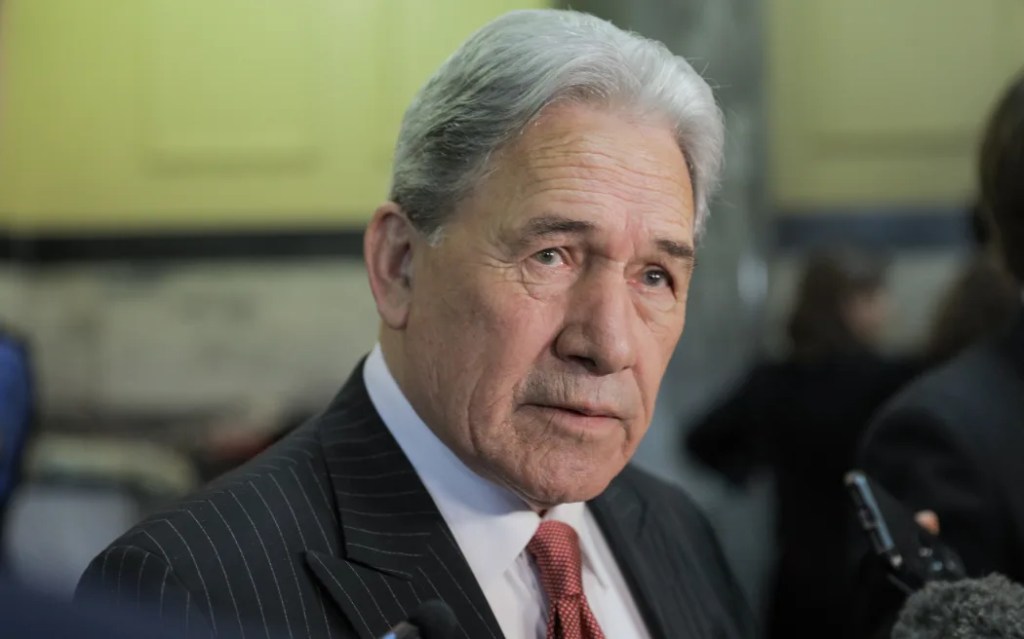
Four days ago, on the 592nd day of Israel’s genocide, Foreign Minister Winston Peters joined 23 countries in objecting to Israel’s escalating violence, and calling for the restoration of humanitarian aid. Peters’ diplomatic step was not accompanied by the usual MFAT media report or published statement, nor has there been any action to substantiate this call.
After 62,000 Palestinian deaths, Peters told RNZ that “we are running out of patience”.
is inflicting conditions of life on Palestinians increasingly incompatible with their continued existence in Gaza as a group… Furthermore, the pattern of strikes on Internally Displaced People’s (IDP) tents and residential buildings, as well as on crowded hospitals, indicates that little, if any, care is being taken to protect the lives of civilians in Gaza, while reports of the use of weapons with wide area effects suggest deliberate, indiscriminate attacks. Meanwhile, the humanitarian situation is beyond description.
Minister Peters, when will your patience actually be spent? For 19 months, while 62,000 Palestinians have died, Aotearoa has done nothing to alter its relationship with Israel or impact the normal flows of trade and treatment. You have not called the ambassador in to hear our objections, let alone put him on a plane or sanction his government. You have not acted as per the world court’s advisory opinion to cease normalising an illegal occupation, nor have you brought the slightest pressure to bear on what the court calls Israel’s plausible genocide.
Peters told RNZ that such “symbolic gestures” are of no help to starving babies. That is fundamentally and historically incorrect. Diplomatic pressure is precisely the brake that has ended Israel’s assaults on the blockaded community of Gaza.
Israel can live without our approval as individuals. However, Israel cannot live in the style to which it is accustomed without European, North American and other diplomatic permission, interactions and normalcy. Israel is built on impunity, and that can be revoked.
In 2015, Israel’s Office of the State Comptroller published its assessment of Israel’s 2014 bombardment of Gaza. Israeli newspapers called the report “scathing” “scalding… blistering”. Among its criticisms: Israel bombed Gaza for fifty days without consistent objectives to focus and limit its violence. Israel’s security cabinet and IDF periodically paused to assess the war’s impacts on Israel’s international standing. Finding that states did not require Israel to stop, the security cabinet opportunistically wrote new objectives and carried on bombing. They did that four times – until they were stopped.
It is wrong to think that only Trump matters to Israel. Israel is deeply integrated into international – particularly European and American – trade, tourism, and culture. There is every reason to believe that Israel remains susceptible to broad international pressure.
States including Aotearoa have always held the power to make this genocidal onslaught end. This week governments cleared their throats and said some words, but that is not enough.
Right now, 81% of Gaza is unilaterally designated as an IDF military zone for operations and / or is under displacement orders. The people of Gaza are being funneled into killing zones.
The danger to Gazan Palestinians is desperate and words do not protect them. We applaud the government’s step, but we must see the actions which convey seriousness.
Now 596 days have passed and we are in the 86th week of genocide, and still we are waiting. Gaza cannot wait.
Starvation of Gaza a continuation of a decades old plan
By Jeremy Rose
Reading an NBC News report a couple of days ago about a Trump administration plan to relocate 1 million Gazans to Libya reminded me of a conversation between the legendary Warsaw Ghetto leader Marek Edelman and fellow fighter and survivor Simcha Rotem that took place more than quarter of a century ago.
In the conversation, first reported in Haaretz in 2023, Rotem said the Jews who walked into the gas chambers without a fight did so only because they were hungry.
Edelman disagreed, but Rotem insisted. “Listen, man. Marek, I’m surprised by your attitude. They only went because they were hungry. Even if they’d known what awaited them they would have walked into the gas chambers. You and I would have done the same.”
Edelman cut him off. “You would never have gone” [to the gas chamber.] Rotem replied, “I’m not so sure. I was never that hungry.” Edelman agreed, saying: “I also wasn’t that hungry,” to which Rotem said, “That’s why you didn’t go.”
The NBC report claims that Israeli officials are aware of the plan and talks have been held with the Libyan leadership about taking in 1 million ethnically cleansed Palestinians. The carrot being offered is the unfreezing of billions of dollars of Libya’s own money seized by the US more than a decade ago.
The Arabic word Sumud – or steadfastness – is synonymous with the Palestinian people. The idea that 1 million Gazans would agree to walk off the 1.4% of historic Palestine that is Gaza is inconceivable.
But then the idea that my great grandmother and other relatives walked into the gas chambers is equally incomprehensible. But we’ve never been that hungry.
The people of Gaza are. No food has entered Gaza for 76 days. Half a million Gazans are facing starvation and the rest of the population (more than 1.5 million people) are suffering from high levels of acute food insecurity, according to the UN.
Last year, Israel’s finance minister Bezalel Smotrich was widely condemned when he suggested starving Gaza might be “justified and moral.”
The lack of outrage and urgency being expressed by world leaders – particularly western leaders – after nearly 11 weeks of Israel actually starving the inhabitants of what retired IDF general Giora Eiland has called a giant concentration camp – is an outrage.
As far as I’m aware there’s been no talk of cutting off diplomatic relations, trade embargos or even cultural boycotts.
Israel – which last time I looked wasn’t in Europe – just placed second in Eurovision. “I’m happy,” an Israeli friend messaged me, “that my old genocidal homeland (Austria) won and not my current genocidal nation.”
A third generation Israeli, she’s one of a tiny minority protesting the war crimes being committed less than 100km from her apartment.
Spanish prime minister Pedro Sanchez and Irish president, Michael Higgins, is an honourable exception to the muted criticism being expressed by western leaders.
Sanchez had declared Israel a genocidal state and said Spain won’t do business with such a nation,
And peaking at a national famine commemoration held over the weekend Higgens said the UN Security Council has failed again and again by not dealing with famines and the current “forced starvation of the people of Gaza.”
He cited UN secretary general António Guterres saying “as aid dries up, the floodgates of horror have re-opened. Gaza is a killing field – and civilians are in an endless death loop.”
Nobel Prize winning economist Amartya Sen argued in his 1981 book Poverty and Famines that famines are man-made and not natural disasters.
Unlike Gaza, the famines he wrote about were caused by either callous disregard by the ruling elites for the populations left to starve or the disastrous results of following the whims of an all-powerful leader like chairman Mao.
He argued that a famine had never occurred in a functioning democracy.
It’s a horrifying fact that a self-described democracy, funded and abetted by the world’s most powerful democracy, has been allowed by the international community to starve two million people with no let-up in its bombing of barely functioning hospitals and killing of more than 2000 Gazans since the ban on food entering the strip was put in place. (Many more will have died due to a lack of medicine, food, and access to clean water.)
After more than two months of denying any food or medicine to enter Gaza Israel is now saying it will allow limited amounts of food in to avoid a full-scale famine.
“Due to the need to expand the fighting, we will introduce a basic amount of food to the residents of Gaza to ensure no famine occurs,” prime minister Benjamin Netanyahu explained.
“A famine might jeopardise the continuation of Operation Gideon’s Chariots aimed at eliminating Hamas.”
If 19-months of indiscriminate bombardment, the razing to the ground of whole cities, the displacement of virtually the entire population, and more than 50,000 recorded deaths (the Lancet estimated the true figure is likely to be four times that) hasn’t destroyed Hamas to Israel’s satisfaction it’s hard to conceive of what will.
But accepting that that is the real aim of the ongoing genocide would be naïve.
In the first cabinet meeting following the Six Day War, long before Hamas came into existence, ridding Gaza of its Palestinian inhabitants was top of the agenda.
“If we can evict 300,000 refugees from Gaza to other places … we can annex Gaza without a problem,” defence minister Moshe Dayan said.
The population of Gaza was 400,000 at the time.
“We should take them to the East Bank [Jordan] by the scruff of their necks and throw them there,” minister Yosef Sapir said.
Fifty-eight years later the possible destinations may have changed but the aim remains the same. And a shamefully indifferent western world combined with a malnourished and desperate population may be paving the way to a mass expulsion.
If the US, Europe and their allies demanded that Israel stop, the killing would end tomorrow.
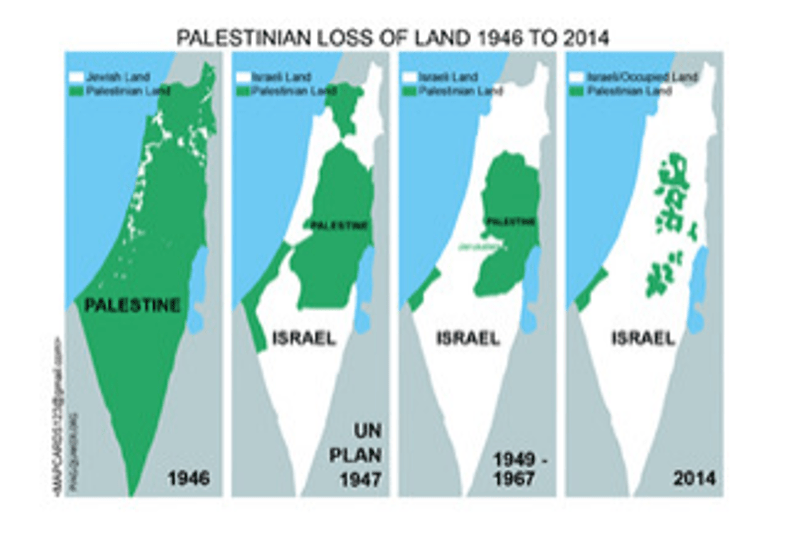
Image in wide circulation – with apologies, we are unable to identify its creator.
Author’s note – As a Palestinian, I write this not to provoke but to expose the dominant myths that have long shaped public understanding of Zionism and the so-called Israeli Palestinian conflict which continues to shield Israel from rightful scrutiny. This article is a call to recognise Zionism for what it is — a settler-colonial movement — and to encourage honest, informed conversations about justice, history, and the urgent need for a truly democratic future in Palestine. My aim is to raise awareness, especially among Western readers, so they can see through the layers of propaganda and challenge the so called two-state solution and join the growing effort — in Palestine and beyond — to speak clearly and truthfully about what has happened, and continues to happen, in that beautiful land.
There are truths that societies often find difficult to confront, and among the most elusive is the recognition of oneself as a coloniser. Throughout history, colonialism has rarely been perceived as such by those who practiced it. It was cloaked in the language of civilizing missions, divine promises, or national rebirths. Yet the patterns repeat: the arrival of settlers, the displacement of indigenous peoples, the claiming of land under foreign notions of entitlement.
Zionism follows this same historical pattern. It is a political movement that sought to establish a Jewish state in Palestine—a land already inhabited. This is not a theoretical or ancient dispute, but an ongoing reality. From its earliest stages to its present-day manifestations, Zionism has functioned as a settler-colonial project, relying on the displacement of Palestinians to realise its vision.
Prior to the arrival of Zionist settlers, Palestine was a diverse land with Muslim, Christian, and Jewish Palestinians living in established communities. The Zionist project, backed by imperial powers, aimed not to integrate into this existing society, but to replace it. This is not a matter of interpretation—it is a matter of documented historical planning and execution.
Zionism’s and Israel’s founding figures, such as Theodor Herzl and David Ben-Gurion, understood that the establishment of a Jewish state in Palestine would not occur through peaceful coexistence with the native population. Instead, it would necessitate the removal of that population. Israeli New Historians — including Benny Morris, Ilan Pappé, and Avi Shlaim — have documented, using Israeli archival sources, that the expulsion of Palestinians was not an unintended consequence of war. Early Zionist leadership foresaw and accepted the necessity of expulsion.
The State of Israel was established through a planned mass ethnic cleansing campaign during which over 750,000 Palestinians were driven from their homes, more than 500 villages and towns were destroyed, and dozens of massacres committed. This catastrophic event is known as the Nakba.
From that day to this day, Israel’s refusal to allow Palestinian refugees to return, in defiance of UN Resolution 194, further confirms Zionism’s intention to destroy the Palestinians as a distinct group of people. Had peace been the goal, Israel would have allowed return, restitution, and reconstruction. Instead, it has only expanded its colonial project.
Today, this settler-colonial reality continues through settlement expansion, military occupation, home demolitions, and land theft. These are not security measures. They are the modern practice of the same project that began over a century ago: to secure maximum land with minimum Palestinians.
This is not antisemitism, and it does not negate the historical suffering that Jews experienced in Europe, which is often used to justify Israel’s crimes. Instead, it is a necessary step toward an honest reckoning with the past and the present, if Palestinians and Israelis are ever to build a shared future together.
The longer the world continues to avoid speaking honestly and bravely about the nature and essence of the actual settler-colonial relations between Israel and the Palestinians, the longer we continue to be participants in sustaining Israel’s criminal apartheid regime – until it reaches its own final solution stage.
The Western powers’ blessing of the Zionist colonisation of Palestine was cynically branded as partition. Today, the so-called two-state solution continues the same deceit, dressing up a brutal colonial project as a peace offer.
When you hear “two-state solution”, you should hear “partition” and recognise it for what it is: a form and a tool of colonisation.
Partition was proposed in South Africa to create separate homelands for Black South Africans. It was argued by some in the United States after the Civil War to preserve the Confederacy. French settles in Algeria pushed for it. So too did colonial powers in Vietnam, carving the country into north and south.
Whether it was through wars of liberation or internal revolution, the lesson was the same: partition is unjust, unsustainable and must be called out and rejected.
In a world that is increasingly recognising and reckoning with the facts and impacts of colonialism – from the Americas to Africa and the Pacific – it is time to extend this recognition to Palestine.
The only just and lasting way forward is a shared country. There should be one democratic state for both peoples with equal rights, freedoms and responsibilities for all who live on that land, from the river to the sea.
One country that would open its gates and take in the descendants of its sons and daughters who were recently made refugees – who, after nearly 80 years, still dwell in refugee camps around their beloved homeland like orphans, denied their inalienable right of return to the motherland.
What now? The blog has been quiet. 2025 has blown the doors off their hinges. Israel has openly, as a matter of stated government policy, starved 2.3 million people for two months while our government has looked quietly on. I have had no words for that, only mounting desperation.
The lives of powerless people outline the reality of surviving genocide. I have worked with Cambodian colleagues who hoarded rotting food in their desks in order to soothe their bodies’ memories of the wracking pain of starvation. Friends who recalled eating grass. Colleagues of stunted growth, colourblind, developmentally impaired . . . Palestinians will be accumulating these lifelong effects now.
Violence is futile, always. It can destroy bodies and things but it cannot address cause, establish co-existence or validate its users. Israel’s violence, too, will do none of those things. How many people will be allowed to die before our government says that out loud? From a population the size of Auckland and Northland, Israel has killed more people than live in Porirua or New Plymouth. New Zealanders in our tens of thousands have demanded intervention in our names.
We shouted for help through bombardment, displacement; the shattering of Gaza’s infrastructure, shelters, universities and hospitals. A century’s work to limit the harms of war has drained away through our fingers like water, as Israel sneered at the very notion of distinguishing civilians from combatants. International courts issued warrants for the arrests of Netanyahu and Galant for crimes of genocide. In vain, we expected our government to review our relations as the courts have directed.
Finally, having devastated every facet of Gazan life while the arms kept flowing in and its diplomatic standing was undisturbed, Israel’s government felt sure enough of its impunity to openly starve the survivors. Israel’s end game is underway.
Israel feels sure of our indifference. And damn it, they have been right. We, Aotearoa, have done officially nothing to disrupt starvation. Not a peep, not a tourist visa withheld or a diplomatic please-explain. That fact has broken my understanding of our governing institutions.
I have tried to work for change within the politics of the institutionally possible. Even through 2024, I continued to speak about the equal rights and dignity of human beings, because I believe it and because I believed that we are governed by people who share the cornerstone value of human life across the differences of our national politics. That cornerstone compels us to intervene when we see genocide.
I was wrong. Now we are governed by people who have not so much as cleared their throats.
So, what now? What comes after f*** you?
Martin Buber, a Jewish anarchist, wrote that protest is a demand that all people should be loved. Buber located his anarchism in the choice of means to the ends. The ends – saving life and providing what people need to live well – do not change.
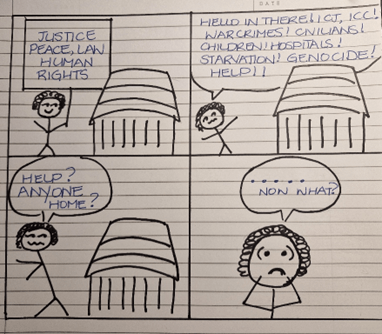
We protest in front of government buildings and I have given up on the people inside those buildings. But institutions are more than buildings. Mostly, they consist of our habituated, unexamined behaviours. When you break the habits and disintermediate the institutions – when you look through the buildings – you come freshly to our choices.
Then a whole cascade of our anti-life choices comes into focus: military spending over peace, foreign policy from the lemming side of history at the expense of our planet and our place in the Blue Pacific, landlords eating children’s school lunches. One-tenth of us are indebted to social welfare institutions, serving the institutions at the expense of their own daily prospects. Write your own list.
Our deadly forfeit on Gaza is of a piece with all these. Act for Gaza as part of all this. But act. That must be the conclusion of this moment. We do not have the luxury of giving up while hunger is mounting by the hour.
When it feels futile, find the people who are not afraid. A neighbour reminded me as we huffed and puffed up a steep walking path this week, “Empathy is never futile. Hope is resistance now.” This neighbour wakes up each morning and writes an email to an MP. MPs may not reply, but they can count.
Turning up is a performance of imagination now.
Today, Palestinian women and children will bring their pots in a desperate hunt for food. Give them your voice: bang a pot in the ears of our indifferent bureaucrats.
Join the funerals of Palestinians who are being bombed, burned, starved this day. Pay your respects by shaming every last yawning member of our government.
Israel’s policy of starvation is before the World Court right now. Stand in the gallery and dare the judges to do right.
Let the doors blow off their hinges. Look freshly at the choices that weave our politics together. Attach this issue to that one. Then we are not powerless. We are merely out of power and preparing to take it back.
Kia kaha, arohanui – stand strong, in abundant love
This letter was written by a Palestinian New Zealander who has good reason to use a pseudonym. Call him Goliath. Please share his message widely: there is so much that we can do, including those of us who might not stand on the front lines. Take the private, cumulative steps that every New Zealander can take. Our choices count, either as passive permission to continue or as effective pressure to end this nightmare.
LEST WE FORGET TO LEARN
I want to talk about something that I believe is incredibly important—not just for those involved, but for all of us: the situation in Gaza, and why it should matter to us here in New Zealand.
As a nation, we pride ourselves on fairness, on standing up for what’s right. We have taken a stand against apartheid, and against nuclear weapons.
We understand that silence in the face of injustice is complicity.
Israel’s genocide in Gaza and its broader military aggression are driving instability that reaches far beyond the Middle East. This is not just a regional issue; it’s a global one.
Military escalation risks involving the USA and its allies directly, just as “our allies” dragged us to war in Afghanistan, in Iraq, Vietnam, and indeed WW1 before that. All this means that New Zealand could face pressure to support military interventions, risking the lives of young Kiwis in conflicts we did not create. LEST WE FORGET TO LEARN.
I know that we have urgent issues here at home that needs our attention, but living in such a way that contributes to sustaining Israel’s apartheid regime does nothing to solve our domestic problems. In other words, these are two separate issues.
Silence is not neutrality; it’s complicity. And it will backfire on us. We do not need to “fix” anything overseas, we just need to stop funding oppression.
Here’s what we can [and should] do with almost zero inconvenience to ourselves:
Boycott – download the No Thanks or Boycat app to make ethical shopping choices.
Divest – check where your Kiwisaver is invested at Mindful Money and move to an ethical fund.
Support local & second-hand businesses – Avoid companies profiting from apartheid.
Learn about BDS – The Palestinian-led movement to hold Israel accountable through economic pressure.
Take political action – Sign petitions, write to MPs, and participate in demonstrations.
Share this letter with as many people as you can.
We cannot continue to ignore the fact that our lifestyle and the choices we make every day—where we shop, where our investments go, our silence—contribute to maintaining a criminal and dangerous status quo.
Thank you for taking the time to read this and for your participation.





 Sh'ma Koleinu - Alternative Jewish Voices (NZ)