Jewish groups call for resignation or removal of Stephen Rainbow as Chief Human Rights Commissioner
In a recent meeting, Dr Rainbow made Islamophobic comments to Philippa Yasbek, spokesperson for Alternative Jewish Voices and Dayenu: Jews Against Occupation.
“Dr Rainbow asserted that the SIS threat assessment shows that Muslims pose a greater threat to the Jewish community in New Zealand than white supremacists. I was shocked that Dr Rainbow is so prejudiced that he misrepresented the SIS report to say the complete opposite of what is written in the document. The SIS report states that it should not be used to single out any ethnic community as a threat. It also says that white supremacists make up the bulk of violent extremists in Aotearoa,” says Philippa Yasbek.
“The Human Rights Commission is meant to promote human rights and racial equality, as well as encourage harmonious relations between diverse groups. Dr Rainbow’s comments in our meeting were Islamophobic and completely contrary to everything that the Human Rights Commission is supposed to stand for. He is clearly unable to perform the role of Chief Human Rights Commissioner. He should immediately resign or be removed by the Government,” says Philippa Yasbek.
The Prime Minister said in Christchurch on 15 March “Islamophobia – like all forms of hatred – has absolutely no place in New Zealand, and it is our duty to challenge it wherever it appears, whether it’s in words, policies or in the silence that allows prejudice to fester.” “I expect the Government to live up to these words. I have written to Paul Goldsmith, the Minister of Justice, asking for an independent investigation into Dr Rainbow’s fitness for the job. This is the first step to remove him from the role,” says Yasbek.
Israel has broken the ceasefire by massacring Gazan civilians in darkness. Israel turned from talks to utter slaughter, with the reported agreement of US president Trump. A surprise Israel-American attack killed more than 400 Palestinians, entirely without warning and without the slightest chance to save themselves and their children.
Israel’s barbaric choices are beyond human tolerance. For more than two weeks, Israel’s government has again cut off Gaza’s supplies of food and fuel. Hunger and thirst again prevail among civilians, despite their most basic right to humanitarian supplies. This is not warfare; it is genocide. Calamity is escalating in the West Bank. More than 40,000 people have been displaced as Israel destroys civilian communities.
Alongside other Aotearoa organisations, we call for peace and we call yet again for our government to represent our outrage by acting in the name of law and the rights of human beings. Act as the highest UN court has already instructed us to act: stop pretending that this is normal. Expel Israel’s ambassador, cease the trade and reciprocal actions that we enjoy with decent states. Israel has removed itself from the community of decent states.
In the disbelieving silence, we ask each other what we can do. For Aotearoa, this assault revives our anger and our fear that nothing we do will be sufficient.
We at AJV urge our friends and neighbours not to yield to despair. Peace is the work of generations, not days. Find your community among people who are not afraid of that commitment. Take your lead from Palestinians and other Indigenous struggles. Learn from their long vision. If you have never waved a Palestinian flag, join one of the dozens of weekly gatherings. Be uplifted by their company in firm solidarity. This genocide will overwhelm anyone who sits alone with the things we are seeing.
Our Jewish community must urgently confront this new era. Hollow claims of “antisemitism” are by now merely the instruments by which Trump dismantles law and pursues his demons. Jewish institutions which defend Netanyahu’s politics by endless slaughter or imagine that Donald Trump is their protector, are worse than blind. Such Jewish institutions have failed the ethical test of our lifetimes. We need new institutions and we will build them.
Our message is to walk beyond horror into action: into the streets, into government’s inboxes, and into community with those who will see this nightmare through to something better.
An open letter to Prime Minister Christopher Luxon
Tēnā koe, Prime Minister, Feb 16, 2025
We are Jewish New Zealanders, members of Alternative Jewish Voices and Dayenu: New Zealand Jews Against Occupation. We understand that your office has scheduled a meeting this week with the NZ Jewish Council (NZJC) and additional ministers. We object in the strongest terms. The NZJC is unelected coterie, forever uncritically aligned with Israel. That is not the Jewish community.
We have documented in depth that the NZJC is not representative. They are not elected. Their constitution outlines a regional structure for indirect democracy, but much of that structure does not seem to exist. They are not accountable to the community. Their president has broadcast her intention to ‘disempower as much as possible’ Jews like Alternative Jewish Voices (AJV) members who ‘raise their voices’.
Several of us attended the Wellington Regional Jewish Council’s last community meeting, in 2021. The meeting roundly disavowed the Jewish Council’s tone and their relentless focus on Israel. Indeed, the NZJC’s constitution does not even mention Israel or Zionism. The Wellington Regional Jewish Council dissolved itself after that meeting, acknowledging that they have no community mandate. They haven’t been heard from since. So much for regional representation.
This is not solely an issue for the Jewish community. For years, we have protested that the Jewish Council’s related Community Security Group shares politically slanted information about New Zealanders with Israel’s embassy. They interpret objections to Israel’s occupation as a security threat to the New Zealand Jewish community, and they share their views of individual Palestinian, Muslim and other New Zealanders with a regime accused of genocide against Palestinians. This creates particular risk for Palestinian New Zealanders, should they ever travel to Israel or the Occupied Palestinian Territories to visit family and whānau.
Let us say this clearly: there is nothing essentially Jewish about Zionism. Zionism is a project of colonisation, erasure, apartheid, ethnic cleansing—finally, of genocide. Institutions that wrap their nationalism in our Jewishness are shielding the brutality that we witness daily. In this country, the NZJC has been a leading voice in the campaign to confuse Jewish with Zionist, enabling decades of oppression in our names.
The NZJC does not serve, represent or account to the Jewish community. How many Jewish New Zealanders would choose a representative who, like NZJC president Juliet Moses, retweets defenses of Elon Musk’s Nazi salute?
The NZJC is an extremist voice. Their politics are harmful, and their actions jeopardise the good standing of Jews in Aotearoa. We protest in the strongest terms that Israel’s advocates are being given Prime Ministerial access.
It’s not hard to guess what the NZJC will be asking for: some special “antisemitism regime” that uses our Jewish identity to shield Israel from the directives of the International Court of Justice. They will be asking to divorce the Jewish community from our shared mahi of antiracism and our human rights framework. They will be seeking some exceptional status, suppressing principled protest for Palestinian rights and the criminal accountability of Israeli leaders. That conversation should not take place without representation from the Muslim and Palestinian communities. They are the New Zealanders whose voices are being silenced, and frankly they are the communities who have lost the most to racism in recent years.
Prime Minister, any meeting with the NZJC ought to be recorded in the ministerial diaries as a session with Israel’s ambassadors. And damn it, they will be doing it in our name. We are also the New Zealand Jewish community, and we are so tired of being used this way.
We would like to join your meeting with the NZJC, bringing Jewish diversity into the room. If you will not open this meeting to the real breadth of the Jewish community, then we wish to schedule a second meeting which includes Muslim and Palestinian representation. We work closely with the Muslim and Palestinian communities in Aotearoa, modelling the change that we would like to see in the Middle East.
Hear us out before you act.
Alternative Jewish Voices and Dayenu: New Zealand Jews Against Occupation
Anyone who cares about human rights should be able to see these decisions for the travesty they are
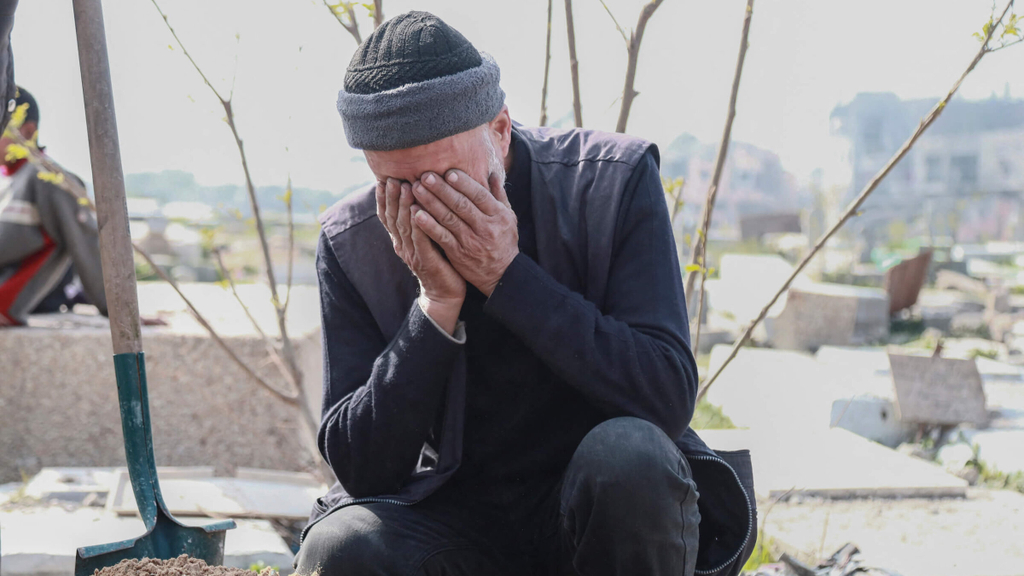
An elderly man covers his face while crying beside a grave in the Fallujah cemetery in the northern Gaza Strip on Feb. 3 Photo by Abood Abusalama / Middle East Images via AFP/Getty Images
After Israel last week enacted its ban on UNRWA, the United Nations agency that serves Palestinian refugees, from operating in Israeli-controlled territory, President Donald Trump on Tuesday halted all U.S. funds for the agency. I consulted for UNRWA’s Gaza director for two and a half years, including during the 2014 bombardment and the following year of what passes in Gaza for reconstruction. I have seen the work that these actions will disrupt; work that is essential to any real recovery from 15 months of furious violence.
The Knesset’s ban and Trump’s withdrawal cap a long and exceptionally rancorous campaign against both UNRWA and Israel’s obligation, in the context of its military occupation, to provide and facilitate humanitarian assistance to Gaza. Jerusalem’s deputy mayor, Aryeh King, called UNRWA “the enemy in our holy city.” Noga Arbell, formerly a Foreign Ministry official, said flatly in the Knesset that “It will be impossible to win the war if we do not destroy UNRWA.”
The vitriol was on display long before Israel alleged that fewer than 0.01% of UNRWA employees had taken part in attacking Israel on Oct. 7, 2023. UNRWA terminated the employees in question, and Israel has not provided evidence to support any wider charges against the agency — although such sweeping claims have continued to circulate.
While the politics swirl, Trump and Netanyahu’s moves mean, simply, that more civilians in Gaza will die because fewer of their survival needs will be met. The ban also directly contravenes Israel’s obligations in international law.
The International Court of Justice affirmed last summer that Israel is illegally occupying the West Bank and Gaza. In January, 2024, it ordered Israel to improve humanitarian access to Gaza amid the war. Yet 26 NGOs reported last week that “Israel’s authorities failed on all counts to improve humanitarian access over the last year” to Palestinians fleeing the Israeli onslaught.
In 1949, the UN established UNRWA with a mandate to serve Palestinians as members of one dispersed nation, until a durable political solution could be found. That mandate recognizes that Palestinians’ suffering has a political cause, and awaits a national political solution. Recent moves are far from the first time that UNRWA’s detractors have tried to erase that mandate.
UNRWA also records intergenerational refugee rights, which detractors say helps to perpetuate violent resistance against Israel in Gaza and the West Bank. Politically, the millions of people who have protested for Palestinian rights across the globe mock any notion that UNRWA is the cement holding their movement together. And the frequent suggestion that Palestinians’ intergenerational rights are exceptional is factually incorrect: Worldwide, the rights of refugees always transfer to their children.
These arguments distract from what UNRWA needs to do. More than 2 million Palestinians in Gaza need to reestablish a standard of basic livability after the unprecedented destruction of the war. UNRWA is essential to meeting their most fundamental rights.
Even more responsibility for Palestinians’ rights will devolve to Israel in UNRWA’s absence. There is no reason to expect that Israel will take that obligation seriously. Some Israeli leaders, envisioning Gaza’s future, have presented proposals for prospective Israeli settlements and beachfront condos. For-profit security contractors are already at work.
And Trump, leader of Israel’s most powerful ally on the world stage, has in his first weeks back in office repeatedly called for Palestinians to be relocated from Gaza to other Arab countries — despite forced relocation being, under every definition, a war crime.
These actions affirm Israel’s disregard for Palestinians’ rights, and for its own clearly outlined obligations. In Israel’s hands, there will be no meaningful aid for Palestinians in Gaza — only attempts to turn the strip into an asset for Israel.
Gazans’ need is enormous. Amid the war’s violence, life expectancy in Gaza has been cut nearly in half, according to one Lancet study. The UN’s development program estimates that Gaza’s development has been set back by 75 years. Investigators with the research group Forensic Architecture have charted in Gaza the “near-total destruction of civilian life.”
UNRWA is indispensable to any genuine response. Statements of scale — UNRWA delivers more than half of all Gaza’s aid — fail to explain the agency’s real importance. UNRWA is a blockade specialist with decades of deep neighbourhood knowledge.
For a year following the 2014 war, I saw just how essential that specialized knowledge can be. In my reconstruction role, I spent time compiling the needs of bakers, tailors, and self-employed families whose chickens and rabbits had died of fright from the noise of the bombings. Around me, colleagues measured windows and doors to weatherproof more shelters. UNRWA consolidated exceptionally diverse needs for shelter, water, sanitation, food, fuel, cash, education, medication and health services. It produced quantity surveys for buildings to provide those services, all while navigating a longstanding blockade so intricate that it has been known to make it impossible to import the lead in pencils.
UNRWA was designed to pull this together in one coherent appeal, rather than presenting donors with a hundred competing requests.
Within weeks of the cessation of bombing in 2014, civilians in Gaza began to protest at UNRWA’s gates. They felt that the scale of need in Gaza was already receding in importance in the global eye.
Where else could they go to make that statement? Gaza has no Embassy Row. Israel prevents or controls the entry of international journalists, and most Gazan civilians have never been outside the blockaded strip. Then as now, Palestinians in Gaza sent messages to donor states through UNRWA, and UNRWA delivered its assistance in the name of donor countries.
UNRWA is the face of the world’s obligation to Palestinians. Every pallet of aid says that the world has not forgotten. Having survived an unimaginably destructive war, it is intolerable that the civilians of Gaza might now see the General Assembly let UNRWA’s mandate be torn up.
And although Israel’s ban will be deadliest in Gaza, its implications are much wider. If Israel is permitted to push UNRWA from occupied East Jerusalem, doing so will help cement Israel’s illegal annexation of the area and its religious sites. Just how much provocation will the region tolerate?
Why is Israel’s head of infantry doctrineaddressing a Jewish community leadership gathering?
Alternative Jewish Voices asks its community to step backfrom uncritical militarism
Why is Israel’s head of infantry doctrine addressing a Union for Progressive Judaism (UPJ) leadership gathering? With genocide charges pending in international court, why is the UPJ’s 2025 fundraising campaign being led by an IDF major general?
The Union for Progressive Judaism (UPJ) is the Australian-based umbrella for New Zealand and Australian synagogues in the Progressive stream of Jewish religion. Over the past 15 months, the UPJ has folded an uncritical militarism into its vision of the Israel which it supports.
Alternative Jewish Voices (AJV), a collective of anti-Zionist New Zealand Jews, is voicing their alarm.
In January 2025, the UPJ advertised a leadership forum for emerging Jewish community leaders. Among the featured speakers was Colonel Yaron Simsolo, the Israel Defense Forces (IDF) head of infantry doctrine, pictured in his uniform. After some internal resistance, the event was re-branded in warm yellows as a “Shabbat gathering – a weekend with the UPJ”. Colonel Yaron’s image was removed, although he remains part of the event. The current UPJ newsletter also announces that an IDF major general will spearhead its 2025 fundraising appeal for Israel.
Infantry doctrine guides frontline troops. It is an inextricable part of the IDF’s strategy and guidance on matters including ammunition, targeting and the permissible levels of civilian death and destruction. Military doctrine thus displays the IDF’s respect or disregard for the laws of war and civilian protections.
For years, longitudinal studies have quantified Israel’s increasingly deadly selections of ammunition, its use of explosive weapons ever closer to Palestinian civilians with foreseeable increases in civilian casualties, and its explicit doctrines of disproportionate violence against civilian areas. These studies chart the deadly doctrinal path to the decimation of Gaza—which the International Court of Justice calls “plausible genocide”.
A deeper layer of scrutiny, as in this survey of operations from 1993 – 2014 points to the existence of “a second war doctrine — overt, but not officially written or institutionalized. The result is recurrent tension and dissonance owing to prevailing expectations within the IDF and in the public arena, based on official documents and the divergence from formal doctrinal documents.”
The IDF’s actions are now before the courts. In July, the International Court of Justice instructed all states not to normalise or advance Israel’s illegal actions. Israel’s civilian leaders of the IDF are charged with genocide.
Marilyn Garson, co-founder of Alternative Jewish Voices, says, “For the UPJ to hold up an IDF doctrine writer some kind of leadership role model is just plain ostrich-headed. People are already baffled and disillusioned that Jewish institutions seem so indifferent to Gaza’s suffering. It is beyond imagining that young Jewish New Zealanders will be lectured by a shaper of this doctrine, while Muslim New Zealanders are grieving for scores of thousands of their whānau—and while Gazans unearth their relatives’ remains. What are they thinking?
“Alternative Jewish Voices works hard to distinguish IDF accountability from the rights of Jewish New Zealanders. The UPJ’s actions blur the distinctions we are asking others to respect. This event is not merely insensitive. It also privileges violence above other ways of seeing our place in the world. Our Jewish community institutions absolutely must imagine a better future than that.”
Alternative Jewish Voices is a collective of anti-Zionist Jews. It works on three issues: Jewish pluralism, antiracism including antisemitism, and support for Palestinians in their pursuit of freedom and justice.
On January 27, Alternative Jewish Voicesmember Rick Sahar hosted a Genocides Remembrance gathering. Tangata whenua, Armenian, Irish, Jewish and others; we spoke of our losses and the power of sharing in survival. Palestine is at the heart of every bit of comfort and solidarity that we – together – can offer.
Jewish commemoration now needs to open itself to all this, as Jewish memory confronts Jewish participation.
Kia ora koutou. I want to acknowledge mana whenua. I am an immigrant descended from refugees. I am grateful for my welcome and for the place of Tangata te Tiriti in Aotearoa.
I want to speak to two sides of being Jewish on this day of commemoration. Like many of you, we are imprinted with genocide. I appreciate your company in that. When we remember the category of genocide, rather than our losses alone, then we acknowledge all of our intergenerational trauma. We take on the task of seeing more than our fears in the eyes of others.
My four grandparents would be called refugees today. They fled from Eastern Europe and Russia. They were welcomed in North America. They established new lives and I grew up admiring their agency. My whānau had mostly left Europe before the Holocaust. I was born 16 years after. I grew up in its shadow. The Jewish religion also took a beating in the time of my childhood. How can anyone believe when a third of your people have just been killed in the heart of Europe? In those baffled, grieving years, Zionism took hold as a secular way to be Jewish.
I, and many Jews who grew up then, learned indelibly that the non-Jewish people around us had sat silently while we were murdered. We learned that there was no safety. I got beyond those fears by living for two decades among endangered communities. I am convinced that we are each others’ best hope.
We can remember in either of two ways. Let me contrast two parliamentary events. On November 29, 2023, I represented AJV alongside Palestinians and tangata whenua to mark the international day of solidarity with the Palestinian people. That evening drew together three communities imprinted with genocide and suspicion. We committed to bringing a better future about—together.
In that same spirit we, here, will give each other a parting gift this evening. We will leave here reminded that vulnerability and loss and comfort and hope are aspects of our shared human condition.
By contrast, tonight a parliamentary event is remembering only the Jewish losses of the Holocaust. No shared future in sight, and no responsibility. That’s the other, exceptional path.
There’s a great big elephant in that parliamentary reception room, of course. We are watching genocide again. This time it is being carried out by people who are Jewish and who coopt the Jewish religion and identity for their ideology.
AJV spends a lot of energy distinguishing between Jewish and Israel, Judaism and Zionism, anti-Zionism and antisemitism. Jewish New Zealanders are not responsible for a government for which we do not vote. But here’s the elephant: we, Jewish New Zealanders, must grapple with the fact of Jewish soldiers committing genocide and inflicting hideous, gleeful destruction on Palestinians. This time, the institutions of our community are among those who turn away and sit silently. Even as we ask you to maintain those distinctions, we need to account to ourselves for the intersection of Jewish memory and participation right now. The Jewish community will be held to this account for generations.
This time, we are implicated. To be implicated is not guilt. It is involvement. In my view, most of us have something to learn from the category of implication. We, Jewish New Zealanders, naturally avoid this accountability because it takes in family, friends and community. I want to tell you a story from the Cambodian genocide, which helps me to reckon with being an implicated Jew.
In the 1970s, in four years, the Khmer Rouge slaughtered and starved somewhere between a fifth and a quarter of their own people. Scholars called it auto-genocide because there was no ethnic distinction between killers and victims. Media called the Khmer Rouge an inexplicable, alien evil. I studied the Cambodian genocide with adolescent fixation. I knew there was something I needed to learn from it. Maybe I was trying to understand the Holocaust in my own way.
In university, no professor would let me take up the Khmer Rouge for graduate work. Instead I travelled to Cambodia a number of times and became fluent in Khmer. I first lived in Cambodia in the 1990s. I directed an organisation of former child soldiers and people with disabilities—all child survivors of four years of genocide and starvation. I cannot count the hours I spent learning from my colleagues. I formed a sophisticated political analysis of the Khmer Rouge genocide.
After three years, a man very close to me deliberately told me a story that marked him as Khmer Rouge. I was stunned: my friend! We talked for hours about his choice to join the Khmer Rouge as a teenager, and about the things he did. I believe he told me in order to complicate my political analysis with flesh and blood. He taught me that genocide is not the act of a safely-removed ‘them’. Genocide is an act of human beings. We will only grasp that if are willing to know it as an act of familiar people, not aliens. Sometimes, we even find people we love there.
Well, now our Jewish community is implicated. People familiar, close to us, are enablers. We are offered the benefits of a system which trains teenage fighters, and produces leaders who harbour genocidal visions. We are the product of four generations of conditioning to tolerate demonisation, to do violence and expect impunity.
More broadly, many people who have been silent this year enjoy some stake. Many of us are implicated in matters of stolen land and colonisation, in the harm done to other communities represented in this room. Many of us are not ready to see the future in the eyes of those who are dispossessed or securitised or imprisoned.
My Cambodian friend wanted me to embrace the discomfort of being implicated. Implication is not the disabling trauma that removes one from action. It is the recognition that we participate in genocide unless we participate in ending it. We find ourselves, our grief and our hope fully as we struggle to integrate all that. Only then can we say, “Tell me. I believe you. I hear you without defensiveness and I will stay here with you until we make something better.”
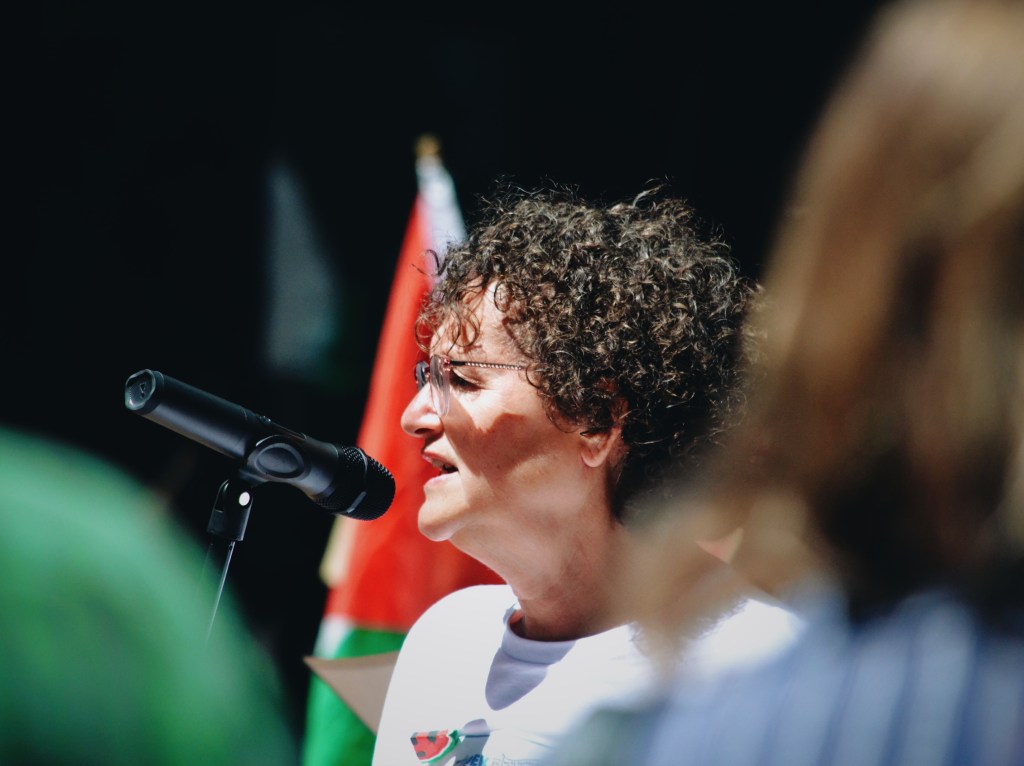
Rally at MFAT’s office, Jan 22. Image Teirangi Klever
(Below are Marilyn’s remarks to the rally outside MFAT today, January 22. Please put them to good use! There’s still time to write to Foreign Minister Winston Peters. Use your own arguments or cite any of the points below. Write to W.Peters@ministers.govt.nz today. Again tomorrow. And then again the next day.)
The Israeli government is just days away from dismantling Gaza’s humanitarian system and controlling reconstruction—if it can ban UNRWA. We are here to tell Winston Peters and MFAT to act before that happens.
What is UNRWA in Gaza? They call it para-statal. It has government-like responsibility for Palestine refugees, who are 2/3 of Gaza’s population. UNRWA registers each refugee’s birth, and their rights. UNRWA provides education, health, housing, social welfare, rubbish collection—state responsibilities until there is a Palestinian state able to provide for its citizens. UNRWA does that in our name.
In times of emergency, UNRWA provides for everyone it can reach, refugee or not.
What makes UNRWA indispensable in emergencies? UNRWA is Gaza’s largest employer, owning by far the most extensive network of trucks, warehouses, shelters and food distribution centres. But UNRWA is not essential because it owns trucks. Israel says those can be given to NGOs to do the work. No, UNRWA owns the trucks because UNRWA has been built on the knowledge that anchors Gaza’s humanitarian operations. UNRWA is made to get goods through a blockade which is designed to keep goods out. UNRWA’s distribution points are the places where food reaches neighbourhoods.
Israel is claiming that donors can somehow contract, hire, procure, deliver, navigate that deadly blockade and distribute food to every neighbourhood in a manmade famine, without communications or buildings or neighbourhood standing. That is a formula for ongoing genocide; nothing less. States like ours must refuse to let more people die avoidably.
Israel also wants to erase UNRWA’s mandate. UN states assigned UNRWA to serve Palestinians as members of a single nation, and to persist until their rights are fulfilled. Now, Palestinians know, you and I know that Palestine refugees are members of one nation. UNRWA is the United Nations’ demonstration of the world’s commitment to a real political solution. Donors to UNRWA are recognising political cause and political solutions.
NGOs can’t do that. They will assist Palestinians as de-politicised individuals needing humanitarian goods. NGOs sign time-limited contracts to provide X to location Y.
On December 9 Israel introduced new regulations for NGOs, requiring them to comply with Israel’s defense and policy interests. Israel will refuse or de-register organisations which, for example, deny that Israel is democratic or call for boycotts. They will deregister any organisation whose staff, local Palestinian partners or board members have used that language within the past seven years!
This regulation is already in place. If you feel critical of NGO language, Israel’s limitations are part of the explanation. Israel is trying to regulate the end of advocacy and human rights work in occupied Palestine. Our government did not object. Investigators for the International Criminal Court—do you think they’re getting into Gaza?
Israel is bound by law to facilitate humanitarian aid to the people of occupied Gaza. It is not up to Israel to control, to buy and sell access, survival, shelter or advocacy for Palestinians. States sign agreements when they join the United Nations. Will Aotearoa sit quietly while Israel shreds those agreements?
Image: Teirangi Klever
Ceasefires in Gaza have never been more than suspensions of violence. Within a few weeks of the suspension of bombing in 2014, Gazan Palestinians were protesting at UNRWA’s gates. They protested the donor states’ slow response to the enormous task of reconstruction
Where else should they go to speak to us? We have no embassy in Gaza. UNRWA is the face of states’ obligations to Gaza behind an illegal blockade. Gazan Palestinians live at the sharpest edge of Palestinian suffering, and UNRWA is proof that our government has not forgotten. UNRWA’s services and lifesaving supplies are delivered in our name.
Governments had the power and failed to use it to stop 470 days of genocide. It is unthinkable that we, our governments, will let Israel erase the proof of our obligations now, after 15 months of this apocalyptic nightmare.
If UNRWA is banned: food, water, fuel, medicines; all the immediate essentials of survival will not arrive as they could arrive to relieve a shocked, starving, grieving, homeless, cold community. It’s that simple.
If this ceasefire takes hold and lays bare the extent of Israel’s devastation, Gaza can think about living and rebuilding while they pursue their political and human rights.
UNRWA is essential to reconstruction. It’s the middle of winter. 90% of Gaza’s homes are ruined and 90% of its people need warm shelter. Half of Gaza’s trees and agricultural land are wrecked. 2/3 of its water resevoirs are gone. Universities, hospitals—gone. 95% of its schools have been blown up and children have had their eductions disrupted. 40m tons of debris need to be sifted for the bodies of the missing and for explosives. UNRWA anchors each of those tasks.
Reportedly Israel will permit a private Egyption company to bring in reconstruction materials. Remember the exit visas they privatised—$5000 US to get through the Rafah gates. What will they charge for concrete, and who will get it first? That is Israel’s vision, if we sit back and let Israel contract out and control reconstruction. UNRWA prioritises refugee needs; Egyptian companies do not.
Israel will also take over UNRWA’s headquarters and facilities in occupied East Jerusalem. Already, mobs have set fire to the perimeter of the buildings repeatedly, while people were inside. Reportedly, Israeli authorities will seize the buildings, hand them over to settlers, and instantly establish one more illegal settlement in occupied East Jerusalem. Palestinian students will be transferred from UNRWA to Israeli schools, in defiance of the rights of an occupied people.
The ICJ has ruled that the occupation is illegal and we must bring it to an end. Instead, Israel will unilaterally push the UN out of occupied East Jerusalem. Israel’s illegal annexation of East Jerusalem will become one more fact on the ground. And East Jerusalem contains Al Aqsa Mosque. Israel’s intended actions have massive implications.
UNRWA is our face in Gaza. We must not withdraw, we must not let Israel dictate Gaza’s survival and its prospects. After 76 years of illegal occupation, after 17 years of illegal blockade, and 470 days of genocidal violence, after all the words our politicians have said, we need action this week.
Winston Peters, MFAT, you failed to act on genocide. You must not fail in our names again.
Perhaps this ceasefire will take hold. We hope so. The cessation of firing is an urgent, insufficient step. Gaza’s grief and suffering are overwhelming and Israel’s forces must stop compounding it. They must facilitate immediate, sufficient quantities of food, water, medicines, fuel, materials for shelter and warmth; all the essentials of life that have been withheld through 470 days that the ICJ has called ‘plausible genocide’. Let all those held hostage go home: Israelis, Palestinians marched away by an invading army, and all those held in administrative detention or convicted in Israel’s kangaroo occupation-courts.
Israel has brought about the ‘near total destruction of civilian life in Gaza.’ Genocidal intent has become so normalised that an Israeli cabinet minister can demand that the killing continue until Gaza is left a ‘vegetable patch’. Gazans need quiet, protection, and they need the supplies to live right now.
Families and the nation of Palestine must be in unimaginable pain. We wish them every comfort and the time to breathe. We as friends and supporters also need to breathe in the possibility that this first step will lead toward political solution: reconstruction, statehood, justice.
Accountability is integral to that possibility. The ICJ’s arrest warrants must be served on Israel’s leaders. Investigators must be brought into Gaza to properly document all of the crimes. We have watched genocide for 470 days and now we need to see accountability.
We write these things one week before International Holocaust Remembrance Day. Many of our parents and grandparents’ generations fled pogroms in Eastern Europe, were slaughtered or escaped from genocide in Europe. We constantly challenge Zionist institutions to stop dishonouring that history by using it to justify genocide and impunity. Many of us had roots in Russian or Ukrainian villages that no longer exist, German or Polish cities whose Jewish communities were murdered en masse.
A week from now, parliament will acknowledge our losses—and only our losses—in the company of Israel-supporting Jewish institutions. The commemoration will not relate that genocide to the present; that burnt-out village to the rubble fields that were Gaza’s cities just one year ago.
We protest the compartmentalisation of history, and the representation of our Jewish community solely by Israel-supporting institutions. For years we, Alternative Jewish Voices, have been objecting to their use of Jewish ‘sensitivities’ as a pretext to silence Palestinian and Muslim participation in our media and public space. This year they have used Jewish historical trauma to silence calls that sought to save Palestinian lives and grant Palestinians their full human and political rights.
We too are Jewish New Zealanders. The memory and the house of government are also ours. We call for the commemoration of genocides. The Holocaust was an event while genocide is a category. We are living in another moment of genocide and we call for its acknowledgement, so that we might all mourn and finally transcend the patterns of ethnic violence which underlie genocide.
We must remember fully, not selectively. The world did nothing while European Jews and others were murdered. Diplomatic guilt (and no small measure of anti-Jewish racism) helped to create the state of Israel, disregarding Palestine’s existing, indigenous people. That set in motion the Nakba or Catastrophe of the Palestinian people—and the Nakba is culminating in genocide before our eyes. Israel’s exceptional impunity is not separate from the horror of the Holocaust. We, who have genocide imprinted on us ought to recognise genocide when we see it.
This genocide is a crime that happens to be committed by some Jewish Israelis. Israel and its advocates have worked for years to wrap an Israeli flag around Jewish identity. We categorically reject that flag. Jewish does not equal Israel, and Judaism does not equal Zionism. A crime committed by the government of Israel is just that: a crime. Judge it by the law, by morality and decency and the dignity of all human beings.
New Zealand’s Jewish community did not vote for the fascists who govern Israel and we are not responsible for their actions. That said, we each choose to support, enable, or with our silence we may passively permit those actions—or else we stand up and say out loud that they are hideously, shamefully wrong.
We have found our institutional Jewish community’s silence this year acutely painful. We were raised being told to remember that the world was silent during the Holocaust. Now our institutions have been silent while others have been killed, and Jewish identity has been deployed to shield Israel in the commission of genocidal crimes.
Our government and others failed to stop 470 days of genocide. By joining with a Holocaust Centre which is unable to condemn all genocide, in order to commemorate some pain without reference to the pain in front of their eyes, they are perpetuating their failure.
We will therefore host our own Genocides Remembrance event. Watch this space for details.
We are the co-founders of Alternative Jewish Voices, and members of the Aotearoa Jewish community. We both happen to be observant Jews. For us, social justice is an essential part of our understanding and practice of Judaism.
Marilyn Garson also consulted for UNRWA in Gaza for 2 ½ years. As a member of UNRWA’s emergency shelter management team through the war of 2014, she has personal knowledge of UNRWA’s essential humanitarian and political role in Palestine.
We write to draw your attention to this media release from Global Jews for Palestine, a collective of Jewish justice organisations in 17 countries. We have also appended the text to this email. As you will read, campaigns are taking place around the world to ask as we are asking you, ‘What are you doing in our name to preserve UNRWA’s operations and mandate right now?’
If Israel’s Knesset proceeds to ban UNRWA from its lifesaving work in the Occupied Palestinian Territories on January 30, more Palestinians will die avoidably. Surely you know that UNRWA’s operations are indispensable, built on decades of knowledge and credibility at street level. No other organisation could step in to contract, hire, procure, deliver and distribute the essentials of life behind a blockade wall, under fire, as UNRWA is now doing.
UNRWA does not operate at Israel’s grace. As you well know, it is a UN agency with a unique mandate to serve Palestinians as members of a single nation until a political solution is found to their displacement. To parcel out UNRWA’s kinetic tasks among dozens or hundreds of NGOs across its six geographical fields would undermine Palestine’s rightful collective, national claim. NGOs would treat Palestinians merely as a collection of individuals in humanitarian distress.
We are confident that you realise the implications of Israel’s legislation to ban UNRWA. Then, sir, what are you doing in our names to ensure that UNRWA’s operations and its mandate stay in place until they can be handed on to a sovereign, effective Palestinian government?
The foreign ministers of seven of our allies have expressed their ‘grave concern’ at Israel’s threatened ban. As the International Court of Justice has advised, New Zealand must not normalise or aid a situation which is illegal and so unbearably inhumane.
We urge you on behalf of New Zealand to speak up, and to attach consequences to any ban. Should Israel’s government flaunt its obligations by banning UNRWA and criminalising its service delivery, we urge you to sanction Israel and suspend diplomatic relations until Israel conforms to the law.
If no one intervenes, Israel will ban UNRWA in three weeks. We ask for your reply, detailing the steps that New Zealand will take to stand up for our principles.
We are supported in this correspondence by our colleagues at Justice for Palestine.
Thank you for your consideration (but we will thank you far more for your action),
Fred Albert and Marilyn Garson
Co-founders, Alternative Jewish Voices of Aotearoa
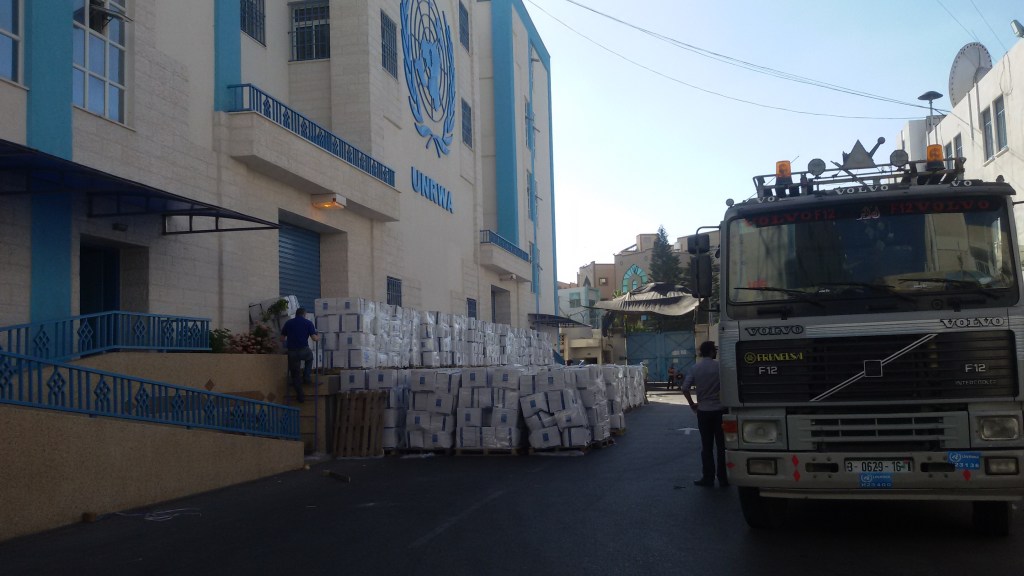
UNRWAfood deliveries, 2014 (photo: Marilyn Garson)
I consulted to the office of UNRWA’s Gaza director for 2 ½ years. I arrived a skeptic, but I left convinced that UNRWA is indispensable for now.
Israel’s advocates have long tried to blur civilian Gaza into militant Hamas, as a way of discounting Palestinians’ civilian protections. This campaign extends to UNRWA itself, portraying UNRWA as a Hamas vehicle in order to call for its closure. Returning to Aotearoa at the end of 2015, I was taken aback by the depth of fury that the Israel Institute in particular reserved for UNRWA. So I have written intermittently about UNRWA since then.
Israel’s parliament has passed legislation that will ban UNRWA’s operations in Gaza and the West Bank on January 30. It will also close the headquarters which supports UNRWA’s operations in Jordan, Lebanon and Syria. UNRWA is mandated by the UN General Assembly, not by Israel. Its closure would violate the agreements Israel signed when it became a member of the United Nations. Israel’s action would also set a deadly precedent for other states to deny civilians the essentials of life. Simply put, if Israel bans UNRWA, “more people will die.” States have widely condemned Israel’s legislation as an immediate disaster and a calamitous violation of the UN Charter, the laws of war, Israel’s humanitarian obligations, and orders of the international courts.
Israel’s government is counting on the apathy of states like ours. Israel’s legislation will take effect unless states raise the cost of its implementation, such that Israel steps back. This month, a global campaign calls for civil societies’ intervention.
Israel’s legislation is an attack in three dimensions. It targets the life, unity and spirit of a community in resistance.
First and most urgently, UNRWA is indispensable to Gaza’s humanitarian assistance. This is not simply because UNRWA owns the largest number of trucks and is the largest employer in Gaza. More than that, UNRWA is the repository of expert knowledge. UNRWA anchors Gaza’s supply chain because it has been built to procure and bring goods through an atrocious blockade which inflicts collective punishment by keeping goods out. From the crossings through warehouses to neighbourhood distribution points, UNRWA’s capacity rests on skilled people from each of Gaza’s neighbourhoods.
Israel’s advocates say dismissively that UNRWA’s trucks can be given to others who have some disaster management experience. They say that it will be a routine matter to contract, hire, procure, deliver, navigate the blockade, warehouse and distribute lifesaving supplies without records or local knowledge. Behind a blockade, the likes of which exists nowhere else on this planet. Under fire, among people who have survived 15 months of unbearable suffering. Israel’s advocates say it will be routine to do all this in conditions of infrastructure, social and environmental collapse; while enduring an assault that the UN’s highest court calls ‘plausibly genocidal’. In 2018 I wrote,
“Gaza has not had a natural disaster… It is a zone of manmade, escalating sacrifice. To cast that as an administrative matter for routine, instant rescue is – and this is the very nicest thing I can write – murderously misleading.”
Image: Omar Ishaq
Israel’s attack on UNRWA is also essentially political. UNRWA is mandated to serve Palestine refugees as members of a single national community, displaced to a number of locations. UNRWA will do that until a durable, just political solution is in place. If Israel can pull UNRWA apart while other states yawn, UNRWA’s kinetic functions will be fragmented into thousands of NGO budget lines. There will be six-month contracts to supply sacks of flour to a given refugee camp, and NGOs will want to hit their quantitative marks in the hope of extending their contracts.
I once asked a group of Gazan IT graduates how they would feel about collecting food within such a system. They were aghast, and tried to put the obvious into words. Gazans are not simply poor. They have been intentionally, politically deprived for four generations. The neighbours who distribute and receive food in Gaza share that history and await a political solution together. To be Gazan is to be held in place. Gazans are the living evidence, and together they persevere. Food distribution enacts all that at neighbourhood scale. To simply line up before strangers without reference to cause or meaning or purpose would feel—the university graduates searched for words—diminished, even a little shameful.
You see, UNRWA is also the proof that donor states have not forgotten. UNRWA’s logo is a two-way bond. Less than two weeks after the cessation of bombing in 2014, people began to gather at UNRWA’s gates to protest donors’ slow response to the enormity of reconstruction. Where else should they go to be heard? UNRWA is the face of UN states’ obligations to Gaza, and its withdrawal would constitute a terrible betrayal at any time. It is unthinkable that Gaza would see us toss our obligations away after these 15 apocalyptic months.
Wouldn’t NGOs try to replicate that mandate?
I worked two years for a well-regarded NGO whose American donor required that documentation exclude words like blockade, occupation and war. Just like that, the hardship of Gazan Palestinians had neither cause nor solution, while Israel had no obligations. Humanitarianism is not about cause. It addresses needs in the present tense.
When I arrived at UNRWA, I asked a colleague which euphemisms I would be required to use. He regarded me as if I’d come straight out of kindergarten and spoke very deliberately, “Around here, we call a blockade a blockade.”
This is part of the reason why donors have kept UNRWA around. UNRWA is evidence of Palestine’s longstanding, unresolved injustice. As UNRWA’s January 30 denouement looms, the UN has made it clear that “the United Nations does not plan to replace the agency in the Palestinian territories, and the Knesset must reverse its decision to ban it.”
The UN is a set of institutions, a collection of member states and a framework of international agreements. The institutional UN will not cooperate while Israel trashes that framework, leaving in its place a compliant remnant of aid for people who are being starved as a war strategy. Now we need to convince our own member-state government to back that up with action.
UNRWA needs not simply preserving but progress, and there is only one direction in which to progress. There’s not enough left in Gaza to imagine reverting to the status quo ante. That is why Philippe Lazzarini, Commissioner-General of UNRWA has said, “UNRWA can be replaced only through a functioning Palestinian state which would address the plight of Palestine refugees.”
Remember that: UNRWA’s mandate can only go to a sovereign state.
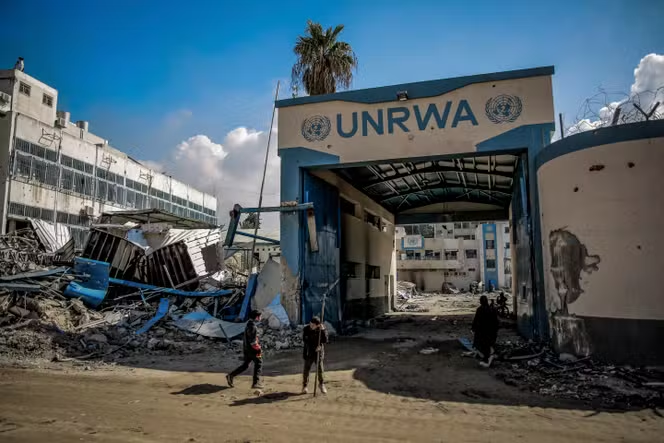
Is it too late? States have done nothing while Israel’s forces damaged or destroyed 70% of UNRWA’s buildings; 95% of them while they were being used as shelters. States have sat and watched while 237 UNRWA staff have been killed – the greatest loss in the history of the United Nations. What does it matter now? It matters because UNRWA continues to provide shelter in the buildings that remain. It still matters because there will be a ceasefire one day. Gazan Palestinians will need every ounce of autonomy and advocacy to decide what happens next. UNRWA will continue to matter for some time yet.
Therefore, in the coming weeks, please join AJV and Justice for Palestine as we push our government to do three things.
Stand up for UNRWA’s humanitarian operations and its mandate.
Attach consequences to Israel’s illegal ban. If Israel bans UNRWA, we should suspend diplomatic ties until Israel complies with its legal and humanitarian obligations. Such consequences are entirely within our capacity.
Immediately recognise the State of Palestine. UNRWA’s mandate can only be handed to an effective Palestinian state, capable of assuming responsibility for its citizens. New Zealand has not even imagined the existence of such a state.
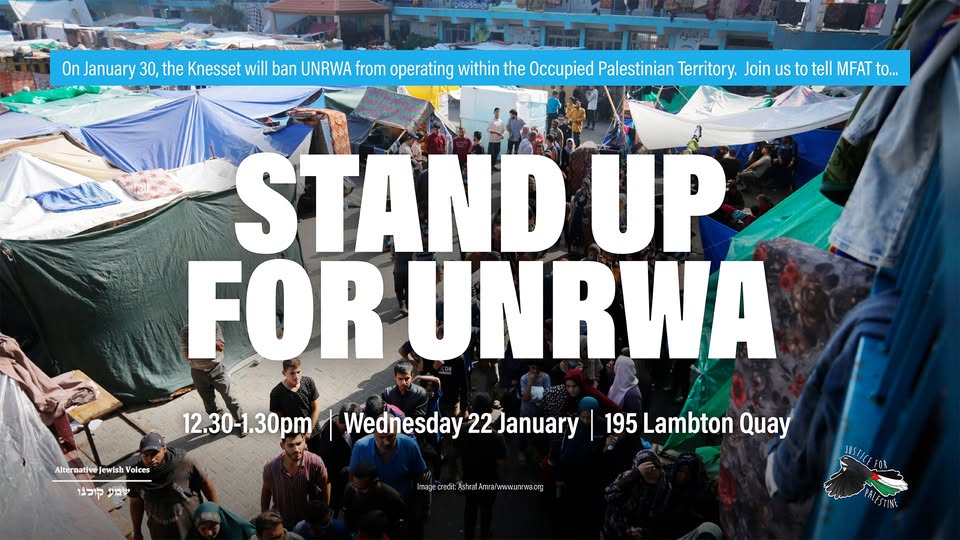
Write to Foreign Minister Winston Peters today. And tomorrow. Join Justice for Palestine and Alternative Jewish Voices in front of MFAT, 195 Lambton Quay in Wellington, 12:30 on January 22. We will tell them again!





 Sh'ma Koleinu - Alternative Jewish Voices (NZ)