
What’s so special about UNRWA?

Rally at MFAT’s office, Jan 22. Image Teirangi Klever

(Below are Marilyn’s remarks to the rally outside MFAT today, January 22. Please put them to good use! There’s still time to write to Foreign Minister Winston Peters. Use your own arguments or cite any of the points below. Write to W.Peters@ministers.govt.nz today. Again tomorrow. And then again the next day.)

The Israeli government is just days away from dismantling Gaza’s humanitarian system and controlling reconstruction—if it can ban UNRWA. We are here to tell Winston Peters and MFAT to act before that happens.

What is UNRWA in Gaza? They call it para-statal. It has government-like responsibility for Palestine refugees, who are 2/3 of Gaza’s population. UNRWA registers each refugee’s birth, and their rights. UNRWA provides education, health, housing, social welfare, rubbish collection—state  responsibilities until there is a Palestinian state able to provide for its citizens. UNRWA does that in our name.

In times of emergency, UNRWA provides for everyone it can reach, refugee or not.

What makes UNRWA indispensable in emergencies? UNRWA is Gaza’s largest employer, owning by far the most extensive network of trucks, warehouses, shelters and food distribution centres. But UNRWA is not essential because it owns trucks. Israel says those can be given to NGOs to do the work. No, UNRWA owns the trucks because UNRWA has been built on the knowledge that anchors Gaza’s humanitarian operations. UNRWA is made to get goods through a blockade which is designed to keep goods out. UNRWA’s distribution points are the places where food reaches neighbourhoods.

Israel is claiming that donors can somehow contract, hire, procure, deliver, navigate that deadly blockade and distribute food to every neighbourhood in a manmade famine, without communications or buildings or neighbourhood standing. That is a formula for ongoing genocide; nothing less. States like ours must refuse to let more people die avoidably.

Israel also wants to erase UNRWA’s mandate. UN states assigned UNRWA to serve Palestinians as members of a single nation, and to persist until their rights are fulfilled. Now, Palestinians know, you and I know that Palestine refugees are members of one nation. UNRWA is the United Nations’ demonstration of the world’s commitment to a real political solution. Donors to UNRWA are recognising political cause and political solutions.

NGOs can’t do that. They will assist Palestinians as de-politicised individuals needing humanitarian goods. NGOs sign time-limited contracts to provide X to location Y.

On December 9 Israel introduced new regulations for NGOs, requiring them to comply with Israel’s defense and policy interests. Israel will refuse or de-register organisations which, for example, deny that Israel is democratic or call for boycotts. They will deregister any organisation whose staff, local Palestinian partners or board members have used that language within the past seven years!

This regulation is already in place. If you feel critical of NGO language, Israel’s limitations are part of the explanation. Israel is trying to regulate the end of advocacy and human rights work in occupied Palestine. Our government did not object. Investigators for the International Criminal Court—do you think they’re getting into Gaza?

Israel is bound by law to facilitate humanitarian aid to the people of occupied Gaza. It is not up to Israel to control, to buy and sell access, survival, shelter or advocacy for Palestinians. States sign agreements when they join the United Nations. Will Aotearoa sit quietly while Israel shreds those agreements?
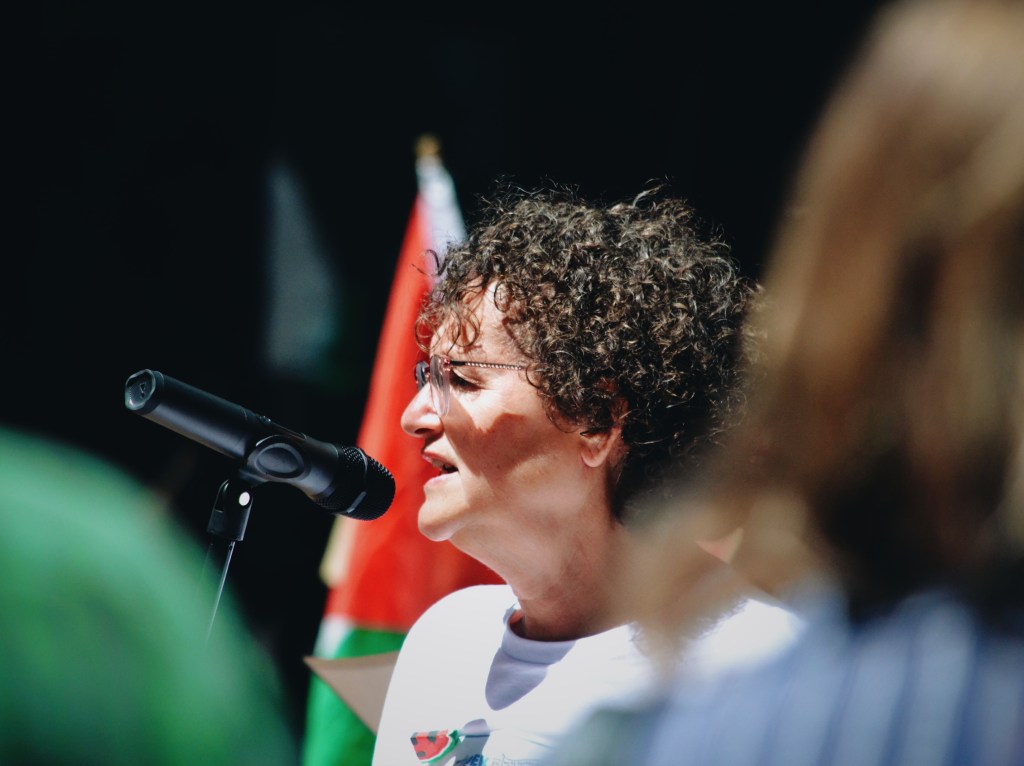
Image: Teirangi Klever


Ceasefires in Gaza have never been more than suspensions of violence. Within a few weeks of the suspension of bombing in 2014, Gazan Palestinians were protesting at UNRWA’s gates. They protested the donor states’ slow response to the enormous task of reconstruction

Where else should they go to speak to us? We have no embassy in Gaza. UNRWA is the face of states’ obligations to Gaza behind an illegal blockade. Gazan Palestinians live at the sharpest edge of Palestinian suffering, and UNRWA is proof that our government has not forgotten. UNRWA’s services and lifesaving supplies are delivered in our name.

Governments had the power and failed to use it to stop 470 days of genocide. It is unthinkable that we, our governments, will let Israel erase the proof of our obligations now, after 15 months of this apocalyptic nightmare.

If UNRWA is banned: food, water, fuel, medicines; all the immediate essentials of survival will not arrive as they could arrive to relieve a shocked, starving, grieving, homeless, cold community. It’s that simple.

If this ceasefire takes hold and lays bare the extent of Israel’s devastation, Gaza can think about living and rebuilding while they pursue their political and human rights.

UNRWA is essential to reconstruction. It’s the middle of winter. 90% of Gaza’s homes are ruined and 90% of its people need warm shelter. Half of Gaza’s trees and agricultural land are wrecked. 2/3 of its water resevoirs are gone. Universities, hospitals—gone. 95% of its schools have been blown up and children have had their eductions disrupted. 40m tons of debris need to be sifted for the bodies of the missing and for explosives. UNRWA anchors each of those tasks.

Reportedly Israel will permit a private Egyption company to bring in reconstruction materials. Remember the exit visas they privatised—$5000 US to get through the Rafah gates. What will they charge for concrete, and who will get it first? That is Israel’s vision, if we sit back and let Israel contract out and control reconstruction. UNRWA prioritises refugee needs; Egyptian companies do not.

Israel will also take over UNRWA’s headquarters and facilities in occupied East Jerusalem. Already, mobs have set fire to the perimeter of the buildings repeatedly, while people were inside. Reportedly, Israeli authorities will seize the buildings, hand them over to settlers, and instantly establish one more illegal settlement in occupied East Jerusalem. Palestinian students will be transferred from UNRWA to Israeli schools, in defiance of the rights of an occupied people.

The ICJ has ruled that the occupation is illegal and we must bring it to an end. Instead, Israel will unilaterally push the UN out of occupied East Jerusalem. Israel’s illegal annexation of East Jerusalem will become one more fact on the ground. And East Jerusalem contains Al Aqsa Mosque. Israel’s intended actions have massive implications.

UNRWA is our face in Gaza. We must not withdraw, we must not let Israel dictate Gaza’s survival and its prospects. After 76 years of illegal occupation, after 17 years of illegal blockade, and 470 days of genocidal violence, after all the words our politicians have said, we need action this week.

Winston Peters, MFAT, you failed to act on genocide. You must not fail in our names again.

Marilyn Garson,

for Alternative Jewish Voices of Aotearoa

ceasefire and selective commemoration

Perhaps this ceasefire will take hold. We hope so. The cessation of firing is an urgent, insufficient step. Gaza’s grief and suffering are overwhelming and Israel’s forces must stop compounding it. They must facilitate immediate, sufficient quantities of food, water, medicines, fuel, materials for shelter and warmth; all the essentials of life that have been withheld through 470 days that the ICJ has called ‘plausible genocide’. Let all those held hostage go home: Israelis, Palestinians marched away by an invading army, and all those held in administrative detention or convicted in Israel’s kangaroo occupation-courts.

Israel has brought about the ‘near total destruction of civilian life in Gaza.’ Genocidal intent has become so normalised that an Israeli cabinet minister can demand that the killing continue until Gaza is left a ‘vegetable patch’. Gazans need quiet, protection, and they need the supplies to live right now.

Families and the nation of Palestine must be in unimaginable pain. We wish them every comfort and the time to breathe. We as friends and supporters also need to breathe in the possibility that this first step will lead toward political solution: reconstruction, statehood, justice.

Accountability is integral to that possibility. The ICJ’s arrest warrants must be served on Israel’s leaders. Investigators must be brought into Gaza to properly document all of the crimes. We have watched genocide for 470 days and now we need to see accountability.

We write these things one week before International Holocaust Remembrance Day. Many of our parents and grandparents’ generations fled pogroms in Eastern Europe, were slaughtered or escaped from genocide in Europe. We constantly challenge Zionist institutions to stop dishonouring that history by using it to justify genocide and impunity. Many of us had roots in Russian or Ukrainian villages that no longer exist, German or Polish cities whose Jewish communities were murdered en masse.

A week from now, parliament will acknowledge our losses—and only our losses—in the company of Israel-supporting Jewish institutions. The commemoration will not relate that genocide to the present; that burnt-out village to the rubble fields that were Gaza’s cities just one year ago.

We protest the compartmentalisation of history, and the representation of our Jewish community solely by Israel-supporting institutions. For years we, Alternative Jewish Voices, have been objecting to their use of Jewish ‘sensitivities’ as a pretext to silence Palestinian and Muslim participation in our media and public space. This year they have used Jewish historical trauma to silence calls that sought to save Palestinian lives and grant Palestinians their full human and political rights.

We too are Jewish New Zealanders. The memory and the house of government are also ours. We call for the commemoration of genocides. The Holocaust was an event while genocide is a category. We are living in another moment of genocide and we call for its acknowledgement, so that we might all mourn and finally transcend the patterns of ethnic violence which underlie genocide.

We must remember fully, not selectively. The world did nothing while European Jews and others were murdered. Diplomatic guilt (and no small measure of anti-Jewish racism) helped to create the state of Israel, disregarding Palestine’s existing, indigenous people. That set in motion the Nakba or Catastrophe of the Palestinian people—and the Nakba is culminating in genocide before our eyes. Israel’s exceptional impunity is not separate from the horror of the Holocaust. We, who have genocide imprinted on us ought to recognise genocide when we see it.

This genocide is a crime that happens to be committed by some Jewish Israelis. Israel and its advocates have worked for years to wrap an Israeli flag around Jewish identity. We categorically reject that flag. Jewish does not equal Israel, and Judaism does not equal Zionism. A crime committed by the government of Israel is just that: a crime. Judge it by the law, by morality and decency and the dignity of all human beings.

New Zealand’s Jewish community did not vote for the fascists who govern Israel and we are not responsible for their actions. That said, we each choose to support, enable, or with our silence we may passively permit those actions—or else we stand up and say out loud that they are hideously, shamefully wrong.

We have found our institutional Jewish community’s silence this year acutely painful. We were raised being told to remember that the world was silent during the Holocaust. Now our institutions have been silent while others have been killed, and Jewish identity has been deployed to shield Israel in the commission of genocidal crimes.

Our government and others failed to stop 470 days of genocide. By joining with a Holocaust Centre which is unable to condemn all genocide, in order to commemorate some pain without reference to the pain in front of their eyes, they are perpetuating their failure.

We will therefore host our own Genocides Remembrance event. Watch this space for details.

Alternative Jewish Voices of Aotearoa
Tēnā koe, Minister Peters, will you stand up?

To: Hon. Foreign Minister Winston Peters

Tēnā koe Minister,                                                                                   January 10, 2025

We are the co-founders of Alternative Jewish Voices, and members of the Aotearoa Jewish community. We both happen to be observant Jews. For us, social justice is an essential part of our understanding and practice of Judaism.

Marilyn Garson also consulted for UNRWA in Gaza for 2 ½ years. As a member of UNRWA’s emergency shelter management team through the war of 2014, she has personal knowledge of UNRWA’s essential humanitarian and political role in Palestine.

We write to draw your attention to this media release from Global Jews for Palestine, a collective of Jewish justice organisations in 17 countries. We have also appended the text to this email. As you will read, campaigns are taking place around the world to ask as we are asking you, ‘What are you doing in our name to preserve UNRWA’s operations and mandate right now?’

If Israel’s Knesset proceeds to ban UNRWA from its lifesaving work in the Occupied Palestinian Territories on January 30, more Palestinians will die avoidably. Surely you know that UNRWA’s operations are indispensable, built on decades of knowledge and credibility at street level. No other organisation could step in to contract, hire, procure, deliver and distribute the essentials of life behind a blockade wall, under fire, as UNRWA is now doing.

UNRWA does not operate at Israel’s grace. As you well know, it is a UN agency with a unique mandate to serve Palestinians as members of a single nation until a political solution is found to their displacement. To parcel out UNRWA’s kinetic tasks among dozens or hundreds of NGOs across its six geographical fields would undermine Palestine’s rightful collective, national claim. NGOs would treat Palestinians merely as a collection of individuals in humanitarian distress.

We are confident that you realise the implications of Israel’s legislation to ban UNRWA. Then, sir, what are you doing in our names to ensure that UNRWA’s operations and its mandate stay in place until they can be handed on to a sovereign, effective Palestinian government?

The foreign ministers of seven of our allies have expressed their ‘grave concern’ at Israel’s threatened ban. As the International Court of Justice has advised, New Zealand must not normalise or aid a situation which is illegal and so unbearably inhumane.

We urge you on behalf of New Zealand to speak up, and to attach consequences to any ban. Should Israel’s government flaunt its obligations by banning UNRWA and criminalising its service delivery, we urge you to sanction Israel and suspend diplomatic relations until Israel conforms to the law.

If no one intervenes, Israel will ban UNRWA in three weeks. We ask for your reply, detailing the steps that New Zealand will take to stand up for our principles.

We are supported in this correspondence by our colleagues at Justice for Palestine.

Thank you for your consideration (but we will thank you far more for your action),

Fred Albert and Marilyn Garson

Co-founders, Alternative Jewish Voices of Aotearoa
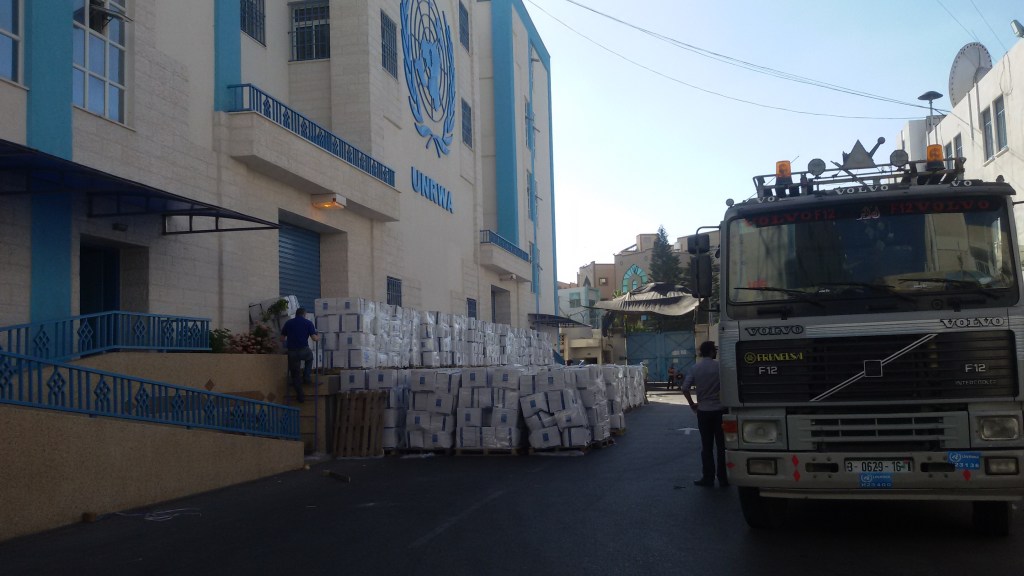
UNRWA in three dimensions

UNRWA food deliveries, 2014 (photo: Marilyn Garson)

I consulted to the office of UNRWA’s Gaza director for 2 ½ years. I arrived a skeptic, but I left convinced that UNRWA is indispensable for now.

Israel’s advocates have long tried to blur civilian Gaza into militant Hamas, as a way of discounting Palestinians’ civilian protections. This campaign extends to UNRWA itself, portraying UNRWA as a Hamas vehicle in order to call for its closure. Returning to Aotearoa at the end of 2015, I was taken aback by the depth of fury that the Israel Institute in particular reserved for UNRWA. So I have written intermittently about UNRWA since then.

Israel’s parliament has passed legislation that will ban UNRWA’s operations in Gaza and the West Bank on January 30. It will also close the headquarters which supports UNRWA’s operations in Jordan, Lebanon and Syria. UNRWA is mandated by the UN General Assembly, not by Israel. Its closure would violate the agreements Israel signed when it became a member of the United Nations. Israel’s action would also set a deadly precedent for other states to deny civilians the essentials of life. Simply put, if Israel bans UNRWA, “more people will die.” States have widely condemned Israel’s legislation as an immediate disaster and a calamitous violation of the UN Charter, the laws of war, Israel’s humanitarian obligations, and orders of the international courts.

Israel’s government is counting on the apathy of states like ours. Israel’s legislation will take effect unless states raise the cost of its implementation, such that Israel steps back. This month, a global campaign calls for civil societies’ intervention.

Israel’s legislation is an attack in three dimensions. It targets the life, unity and spirit of a community in resistance.

First and most urgently, UNRWA is indispensable to Gaza’s humanitarian assistance. This is not simply because UNRWA owns the largest number of trucks and is the largest employer in Gaza. More than that, UNRWA is the repository of expert knowledge. UNRWA anchors Gaza’s supply chain because it has been built to procure and bring goods through an atrocious blockade which inflicts collective punishment by keeping goods out. From the crossings through warehouses to neighbourhood distribution points, UNRWA’s capacity rests on skilled people from each of Gaza’s neighbourhoods.

Israel’s advocates say dismissively that UNRWA’s trucks can be given to others who have some disaster management experience. They say that it will be a routine matter to contract, hire, procure, deliver, navigate the blockade, warehouse and distribute lifesaving supplies without records or local knowledge. Behind a blockade, the likes of which exists nowhere else on this planet. Under fire, among people who have survived 15 months of unbearable suffering. Israel’s advocates say it will be routine to do all this in conditions of infrastructure, social and environmental collapse; while enduring an assault that the UN’s highest court calls ‘plausibly genocidal’. In 2018 I wrote,

“Gaza has not had a natural disaster… It is a zone of manmade, escalating sacrifice. To cast that as an administrative matter for routine, instant rescue is – and this is the very nicest thing I can write – murderously misleading.”

Image: Omar Ishaq

Israel’s attack on UNRWA is also essentially political. UNRWA is mandated to serve Palestine refugees as members of a single national community, displaced to a number of locations. UNRWA will do that until a durable, just political solution is in place. If Israel can pull UNRWA apart while other states yawn, UNRWA’s kinetic functions will be fragmented into thousands of NGO budget lines. There will be six-month contracts to supply sacks of flour to a given refugee camp, and NGOs will want to hit their quantitative marks in the hope of extending their contracts.

I once asked a group of Gazan IT graduates how they would feel about collecting food within such a system. They were aghast, and tried to put the obvious into words. Gazans are not simply poor. They have been intentionally, politically deprived for four generations. The neighbours who distribute and receive food in Gaza share that history and await a political solution together. To be Gazan is to be held in place. Gazans are the living evidence, and together they persevere. Food distribution enacts all that at neighbourhood scale. To simply line up before strangers without reference to cause or meaning or purpose would feel—the university graduates searched for words—diminished, even a little shameful.

You see, UNRWA is also the proof that donor states have not forgotten. UNRWA’s logo is a two-way bond. Less than two weeks after the cessation of bombing in 2014, people began to gather at UNRWA’s gates to protest donors’ slow response to the enormity of reconstruction. Where else should they go to be heard? UNRWA is the face of UN states’ obligations to Gaza, and its withdrawal would constitute a terrible betrayal at any time. It is unthinkable that Gaza would see us toss our obligations away after these 15 apocalyptic months.

Wouldn’t NGOs try to replicate that mandate?

I worked two years for a well-regarded NGO whose American donor required that documentation exclude words like blockade, occupation and war. Just like that, the hardship of Gazan Palestinians had neither cause nor solution, while Israel had no obligations. Humanitarianism is not about cause. It addresses needs in the present tense.

When I arrived at UNRWA, I asked a colleague which euphemisms I would be required to use. He regarded me as if I’d come straight out of kindergarten and spoke very deliberately, “Around here, we call a blockade a blockade.”

This is part of the reason why donors have kept UNRWA around. UNRWA is evidence of Palestine’s longstanding, unresolved injustice. As UNRWA’s January 30 denouement looms, the UN has made it clear that “the United Nations does not plan to replace the agency in the Palestinian territories, and the Knesset must reverse its decision to ban it.”

The UN is a set of institutions, a collection of member states and a framework of international agreements. The institutional UN will not cooperate while Israel trashes that framework, leaving in its place a compliant remnant of aid for people who are being starved as a war strategy. Now we need to convince our own member-state government to back that up with action.

UNRWA needs not simply preserving but progress, and there is only one direction in which to progress. There’s not enough left in Gaza to imagine reverting to the status quo ante. That is why Philippe Lazzarini, Commissioner-General of UNRWA has said, “UNRWA can be replaced only through a functioning Palestinian state which would address the plight of Palestine refugees.”

Remember that: UNRWA’s mandate can only go to a sovereign state.

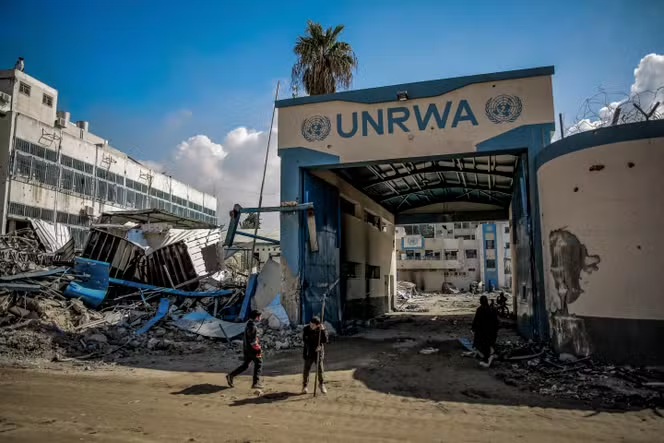
Is it too late? States have done nothing while Israel’s forces damaged or destroyed 70% of UNRWA’s buildings; 95% of them while they were being used as shelters. States have sat and watched while 237 UNRWA staff have been killed – the greatest loss in the history of the United Nations. What does it matter now? It matters because UNRWA continues to provide shelter in the buildings that remain. It still matters because there will be a ceasefire one day. Gazan Palestinians will need every ounce of autonomy and advocacy to decide what happens next. UNRWA will continue to matter for some time yet.

Therefore, in the coming weeks, please join AJV and Justice for Palestine as we push our government to do three things.

  1. Stand up for UNRWA’s humanitarian operations and its mandate.
  2. Attach consequences to Israel’s illegal ban. If Israel bans UNRWA, we should suspend diplomatic ties until Israel complies with its legal and humanitarian obligations. Such consequences are entirely within our capacity.
  3. Immediately recognise the State of Palestine. UNRWA’s mandate can only be handed to an effective Palestinian state, capable of assuming responsibility for its citizens. New Zealand has not even imagined the existence of such a state.

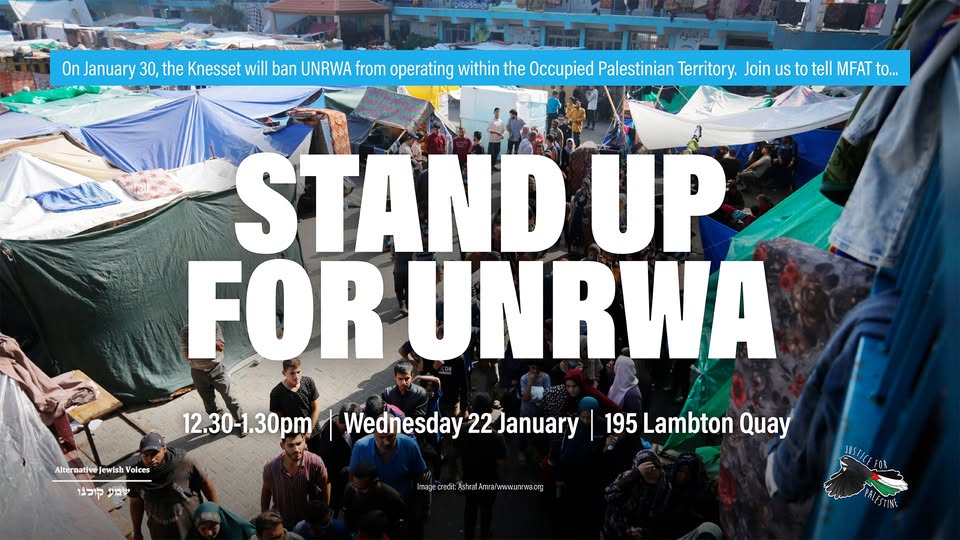
Write to Foreign Minister Winston Peters today. And tomorrow. Join Justice for Palestine and Alternative Jewish Voices in front of MFAT, 195 Lambton Quay in Wellington, 12:30 on January 22. We will tell them again!

Marilyn Garson, for Alternative Jewish Voices

Call from Jewish Groups Across the Globe: Tell Your Political Representatives Now, UNRWA is Urgent

Jan 5th, 2025

On January 30, two new Israeli laws will effectively ban UNRWA’s (the UN Relief and Works Agency for Palestine Refugees) lifesaving operations in Gaza and the West Bank. Although the threat to UNRWA has slipped from the headlines, it is urgent right now and for the longer term.

Immediately, as the Foreign Secretaries of seven countries have expressed in a joint statement, UNRWA is essential to Israel’s “responsibility to facilitate full, rapid, safe and unhindered humanitarian assistance in all its forms as well as the provision of sorely needed basic services to the civilian population.” If UNRWA cannot operate, Gaza’s catastrophe will be made exponentially worse. 

Less visibly, Israel’s legislative attack on UNRWA also aims to undermine the integrity and continuity of the Palestine refugee community. UNRWA is the only agency mandated to serve Palestine refugees as a single national community, dispersed to multiple locations. UNRWA creates and holds records essential to refugees’ ability to claim their rights. 

That unifying recognition would be lost if humanitarian assistance were fragmented into hundreds of local NGO budget lines. NGOs’ humanitarian response would de-politicise the problem and its solution. Food is desperately needed, but Palestinians have a right to more than food: they have a right to be free and self-determining. UNRWA’s mandate is to serve Palestinians until a political solution is found.

That is why Philippe Lazzarini, Commissioner-General of UNRWA has said, “UNRWA can be replaced only through a functioning Palestinian state which would address the plight of Palestine refugees.” In diplomacy and donorship, our states must relate to Palestine as a fellow national actor, not merely to Palestinians as a collection of humanitarian recipients.

The long assault on UNRWA will come to a head this month. The UN is (properly) not backing down, stating on January 4 that “the United Nations does not plan to replace the agency in the Palestinian territories, and the Knesset must reverse its decision to ban it.”

UNRWA perseveres despite the greatest loss of staff members and physical infrastructure in the history of the United Nations: 237 staff. We urge everyone to make UNRWA a priority this month. We urge groups and individuals to write to their political representatives with two messages. 

1.    Pressure Israel to live up to its legal commitments by facilitating UNRWA’s work. 

2.    Palestine’s political demands will not be met by humanitarian NGOs. Diplomatically and as donors, call on governments to preserve UNRWA’s mandate until a genuine political solution is in place.

Statement from Global Jews for Palestine

***

About Global Jews for Palestine: We are Jews from many countries, who are members of local, national and international networks and organizations. We are multi-ethnic and multigenerational and our members embrace a broad range of viewpoints on Jewish religious and ethical traditions.  We are connected by our involvement in the struggle for Palestinian rights, and by our determination to work for justice. We oppose Zionism and all forms of racism and colonialism. 

__________

Additional information for drafting letters to political representatives:

UNRWA Sitrep and other reports:

Since October 7th 2023, UNRWA health teams have provided millions of consultations vaccinated 560,000 children against polio, provided food assistance to almost 2 million people and provided shelter to hundreds of thousands of displaced people.

  • 388,000 families have received flour at least twice.
  • 1.46 million have received UNRWA food parcels
  • 97 mobile medical teams have covered medical points
  • 196,245 displaced people have received community social work support including psychological first aid and psychological support.
  • 129,475 displaced people have received internal community social network support.
  • 7.753 people with disabilities or injuries have received assistive devices and rehabilitation
  • The allegations of large numbers of Hamas operatives being UNWRA workers have come with little evidence to the International community

 UNRWA: Claims Versus Facts | UNRWA

More ideas to support UNRWA, from Jewish Voice for Labour


Contact: Marilyn Garson, Donna Nevel—Global Jews for Palestine

globaljewishcollective@gmail.com

Response to the Holocaust Centre’s dusty old rhetoric

What kind of Holocaust Centre cannot stand with others to stop all the slaughter? Why can its director not join us in condemning all the hatred that licenses ethnic violence?

The NZ Holocaust Centre has chosen to dedicate itself to the particular – to one community’s losses – rather than joining others to stop all genocidal crimes. Such an institution forfeits its relevance. It becomes (in the sterile, dustiest sense of the word) merely a museum. The present-tense mandate to stop genocidal crimes in progress, to rescue those still alive and judge those accused of the genocide, falls to civil society. And we accept.

The Holocaust Centre director is unable or unwilling to distinguish ‘Jewish’ from Israel, or protest from antisemitism. These are dusty museum pieces of rhetoric; evidence of (to borrow the director’s word) lazy thinking.

It is not antisemitic to object to crimes that happen to be committed by Jews. If I get a parking ticket, that is an offense committed by a Jew. It does not make the traffic warden antisemitic.

There is racism, and then there is protest speech which upholds the full and unequivocal rights of Palestinians among all people. The organisations which lead protest in Aotearoa have stated and restated that antisemitism is not welcome. In addition to being harmful in itself, anti-Jewish racism misdirects action and leaves the actual underpinnings of Israel’s illegal occupation and plausible genocide intact.

Per the standard Zionist formulation, the only reason to protest Israel’s genocidal violence is an anti-Jewish pathology. Nonsense: there is plenty of reason to be angry and the Holocaust Centre should be standing with us in our outrage; standing up against both racism and genocide.

To the Holocaust Centre,

We who protest do not hold you responsible for Israel’s actions. We distinguish Jewish from Israel. We hold you responsible for your silence in the face of the heinous crimes your institution exists to memorialise. You forfeit the high ground of memory when you are indifferent to the wasting of other lives.

We demand that our government must live up to Aotearoa’s international commitments, and act to protect the people who are being slaughtered by the government and armed forces of Israel—crimes against humanity. Why don’t you join us in that call?

We worry about racism. We see it here, and we see its naked, deadly consequence daily in Palestine. Can you not see the need for education regarding that racism?

Antisemitism, anti-Muslim and anti-Palestinian hate; can you not join us in condemning all of the racism? That is how we will roll it back—together. We are each others’ best protection, but no single group will be safe in isolation from the others.

Fred Albert and Marilyn Garson (co-founders, Alternative Jewish Voices)

Solidarity: “total identification from the soul”

Written for the Ha’aretz (paywalled) December magazine. We agreed that I would also post it here, with minor revisions. The sound of Aotearoa’s Palestine solidarity carries far – Marilyn Garson

Image: Teirangi Klever

We can hate some of their actions and see them as very wrong, but we recognise that most of them thought they were coming to a land without a people when they came—and they found that people were already living here. They were fed a colonising narrative.

Palestine? No. Dr. Catherine Love (descended from Te Atiawa, Taranaki and Ngāti Ruanui) is instead discussing the colonial experience of Māori, the Indigenous people of Aotearoa / New Zealand.

Love is grandmotherly in the way of elders who have stood on many front lines. Around 2014, UNICEF hired her to assess the wellbeing of Palestinian children. “Every time, every Palestinian individual we spoke with; it connected at a really visceral level. As I learned more about Palestine, I could see the colonisation process. I could see the parallels with what had happened to our ancestors, and is still happening to us in a different way. It was total identification from the soul… [T]he media are biased and present the Israeli-American narratives as if they’re true. But we are also familiar with that as Māori: dehumanising representations of ourselves.”

Te Otāne Huata (Ngāti Kahungunu) is animated and certain at 34. He studied history in a curriculum that was “very much an Israel-leaning or -supporting perspective.” It failed to explain why Palestinians should pay “for the sins of the Nazis.” When he saw Israel’s 2014 bombardment of Gaza, Te Otāne probed that narrative more deeply. He concluded, “I’m actually being taught that my superheroes are the villains.”

Te Otāne lives in the town of Hastings (population 52,000), which is scarcely larger than his Instagram following of 45,500. Yet he finds it essential to stand and wave the Palestinian flag at 1:30 every Sunday afternoon, in front of the Hastings town clock. “Regardless of whether we get 1000 people or whether we get twenty people, we will continue to stand in solidarity. When you throw those intentions into the universe, you are literally changing the fabric of the universe itself… Tino rangatiratanga means ultimate authority, sovereignty over your land and your waters. Those concepts are definitely applicable to other Indigenous communities. It’s about collective liberation… People like to say, ‘Worry about your own back yard.’ When we’re standing in solidarity with Palestine, we are worried about our own back yard.”

Te Otāne Huata (Image: Putaanga Waitoa)

At weekly flag waving gatherings in villages and towns up and down the country, the symbols of Māori sovereignty mingle with those of Palestine. The campaign for Palestinian rights is widely understood as an anticolonial movement. By bringing Māori experience to bear on Palestine, Aotearoa’s campaign has acquired a distinct voice.

It took shape on October 23, 2023, as around 800 people leaned into gale-force winds and dodged flying placards on the Pōneke / Wellington waterfront. They had assembled to hear Māori, Jewish and Muslim speakers make spiritual commitments to work together under the banner: Justice the Seed, Peace the Flower.

Nadia Abu-Shanab, a veteran organiser with the human rights group Justice for Palestine, recalls their intentions. “It’s worth understanding the way that people have already organised here for generations. Māori have deployed… strategic political strategies and insights on how you move through things and how you change things.”

Knowing that a new era had begun, Justice for Palestine chose “to have mana whenua open this space: the Māori who have the authority because this is their ancestral local area… We were able to open the space on the land in a way that respected the history of the land with integrity… [Our vigil] demonstrated how we wanted to move forward: together in solidarity between the Indigenous people of this land, Jews, Palestinians and all peoples. That came through. I feel like it distinguished my experience of the year from the experience that many other people have narrated to me from different places.”

As the Jewish speaker that day and on other days since, I have also felt our gatherings channel outrage into something more aspirational. Pōneke / Wellington is a capital city of 215,000 in a remote country of 5 million. Our vision has greater impact than our volume.

Māori bring more than just the long-sightedness of Indigenous resistance to Palestine. Te Tiriti o Waitangi / the Treaty of Waitangi, Aotearoa’s constitutive document, offers an actionable vision of co-existence.

For Abu-Shanab, Te Tiriti extends “an invitation… to consider how two peoples might live together on a land where one people is Indigenous, and other people arrive. We can belong here together. Equality isn’t in the smashing of those differences. It isn’t in a domination of one people over another, but nor is it that we don’t have the right to live here. That is a bit of an invitation for the world… The idea of Indigenous rights doesn’t preclude other people being able to live on that land. It requires a responsibility from people who arrive, to honour the self-determination of the people who already live there.”

Abu-Shanab navigates freely from here to there and back again. Indigenous to Palestine, she dismisses Israel’s “supremacist justifications; [its] claim of the Jewish need for safety while Palestinians do not need safety or self-determination.” In Aotearoa, she advocates from privilege. “All it requires is that we honour Māori self-determination, and then we have a really honourable and dignified way to live here.”

Dr Cath Love (Image: Teirangi Klever)

Tau iwi / non-Māori New Zealanders who know that our society and our rights derive from this invitation, are known as Tangata Te Tiriti / people of the treaty. Our status reminds us that collective liberation is not safely remote. It involves us. The framework of tikanga Māori / values approximating a system of law, then shapes a method of acting.

Dr Love enumerates the elements on her fingers to give each one full play. “Our tikanga—the root word, tika, refers to what is right, correct, true and just—are the way that we organise all of our behaviour… That sets the tikanga for us to be peaceful and inclusive.” Each time Love opens Palestine rallies in Pōneke-Wellington, she grounds the gathering in these expectations.

The current New Zealand government jeopardises the vision of Te Tiriti. On November 14, the coalition’s small neoliberal partner tabled a bill which aims to unilaterally alter Te Tiriti’s meaning in law. The youngest parliamentarian, Hana-Rāwhiti Maipi-Clarke, tore up the bill and replied with a haka / challenge.

The haka and the thunder of feet in the parliamentary gallery were galvanising. Indigenous Aotearoa laid down a boundary that has been witnessed more than half a billion times.

The Hīkoi mō Te Tiriti / March for the Treaty was already underway to reassert Māori rights. For nine days, Māori and Tangata Te Tiriti walked from the far north and south of the country toward parliament. The Auckland Harbour Bridge shook as they passed over it. No one knows how many people took part locally, walking or volunteering to house and feed the walkers en route.

Hīkoi, still arriving at parliament (Image: Te Ao Māori News)

As the hīkoi approached the capital, Te Otāne Huata urged organisers to include a Palestinian speaker in the ultimate gathering. “Symbolically it was… the greatest movement that we’ve ever seen in Te Ao Māori [the Māori worldview], offering a place to our Indigenous brothers and sisters of Palestine; a position where they can say the truth.”

Nadia Abu-Shanab recalls the humility of addresssing the 50,000 people who surrounded parliament. Palestine had been invited into a “foundational, generation-changing, historic moment—probably the biggest mass mobilisation our country has ever seen—and a day that was framed by the principle of Kotahitanga, of unity and togetherness and working together… It was a collective moment. People were open-hearted. They were feeling the sense of confidence and strength that you feel when you’re together.”

She recites a Māori chant that dates to the land wars of the 1860s: We are engaged in a struggle without end, forever and ever and ever. She and others re-work the words to say, “We are here to live forever and ever and ever. We’re not just here to fight, we’re here to live. That resonates, because we and Māori are really good at this. We’re not just fighting against something, we are actually fighting for something. We’re fighting for life, for dignity and for better ways of living in relationship with the lands where we live.”

Image: Teirangi Klever

The Jewish community of Aotearoa divides over Palestine like every Jewish community. Alternative Jewish Voices (AJV, an anti-Zionist collective) calls for a liberatory Aotearoa Jewish identity that reckons with our roles in Aotearoa’s colonial story. Notwithstanding historical suffering, we Jews are not victims in Aotearoa. We do not tend to be food-insecure or over-policed. We are not denied employment or the freedom to practice our religion. It is not we who wake each day wondering who of our relatives between the river and the sea have survived the night.

AJV works in partnership with Justice for Palestine and with the Federation of the Islamic Associations of New Zealand. Each time we meet with decision-makers together, we defy the assumption that Jews exist in a zero-sum relationship with Palestinians or Muslims. Over the years, shared experience becomes a glue. Samira Zaitoun, a tireless co-convenor of Justice for Palestine, said at a recent book launch, “When you’ve taken enough steps together, you realise that you just have to go through this thing together.”

The Zionist-Jewish community has rallied and published with Christian Zionists and neoliberal lobby groups for several years. For example, a recent media release condemning ICC warrants for Benjamin Netanyahu and Yoav Gallant was jointly issued by 7 Christian Zionist groups, 1 majority-Christian and neoliberal group, and 2 Jewish Zionist groups.

When Māori rights intersect with Palestine, it complicates those tidy Jewish community divisions in hopeful ways. Part of the wisdom of small communities lies in leaving doors ajar. So it was on the day of the hīkoi. Its breadth brought some Jewish supporters of Māori sovereignty into an unexpected encounter with Palestine.

‘Elaine’ and ‘Dorothy’ are tau iwi / non-Māori, Jewish Wellingtonians who regard Israel as a Jewish homeland. They groan at the Zionist label because, Dorothy explains, “I’m also a person who feels deeply that colonisation is a powerful harm… I feel deeply for the Palestinian people who were resident on that piece of land… Zionism feels like a swear word. It feels like, as soon as I say the word, I’m endorsing” Israel’s actions.

On the day of the hīkoi, Dorothy understood the unity of “groups who’ve had the experience of colonisation and having their rights and land taken away… Being there together as tau iwi and Māori, not being divided was more important to me” than being surrounded by people who share her views about Israel.

Earlier this year, Elaine expressed her contempt for Israel’s actions by attending an event calling for Palestinian rights. “It was really hard for me to stand there, but I’m too aware of the indoctrination that I grew up with to let that make me leave… If I felt unwelcome, it came from me, not from anybody else.

“It didn’t even occur to me that I wouldn’t” join the hīkoi at parliament, Elaine continues. She wanted to add her body to the count of Māori rights proponents, and she defends the Māori embrace of Palestinian rights. “Nothing shocks me about the intersectionality of it… It makes sense to me that the two groups who are being oppressed… identify with each other… I actually said that to someone who was saying [Palestinians] shouldn’t have been there. I said, it’s not for us [to determine]… We were there to support Māori.”

While she stands outside the anti-Zionist intersection, Elaine makes a point of challenging the inconsistencies she hears within her networks. “A lot of people who say that they’re leftwing are pretty rightwing when it comes to [Palestine], because it’s literally the first time they’ve had to stand by those beliefs. That’s me as well. Does it make me uncomfortable? Yes. Does that bother me? No.”

The Hīkoi mō Te Tiriti culminated on a Tuesday. On Wednesday the media speculated about the new political landscape. On Sunday at 1:30, Te Otāne Huata waved the Palestinian flag in front of the Hastings town clock.

Image: Teirangi Klever

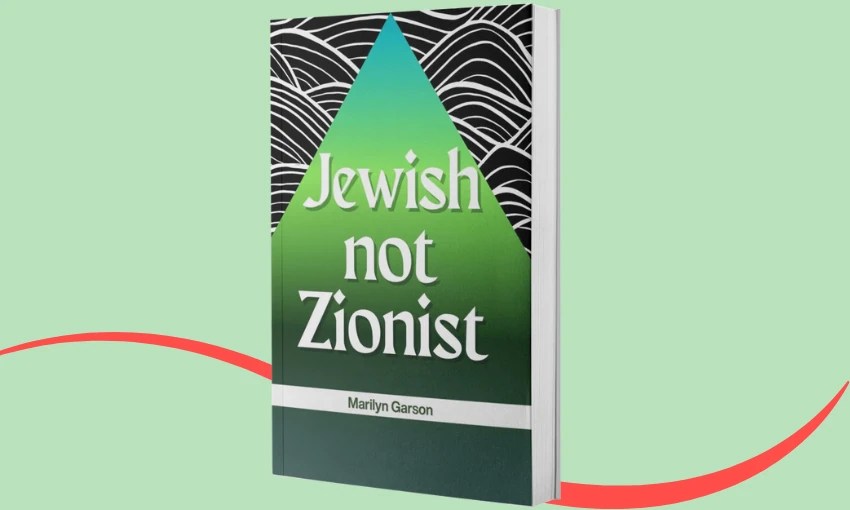
Marilyn Garson is the author of Jewish, not Zionist, the story of a liberatory Aotearoa Jewish identity, and Still Lives – a Memoir of Gaza. She is the co-founder of Alternative Jewish Voices of Aotearoa, and a member of Global Jews for Palestine.

Dear ASB, All we want for Chanukah is . . .

18 December 2024

Vittoria Shortt, Chief Executive

Adam Boyd, EGM Personal Banking

Dear Vittoria and Adam,

We are two members of the Jewish community, co-leaders of an independent Jewish worship space and co-founders of Alternative Jewish Voices. Fred met with Adam and others from ASB in November. We write regarding the request that ASB divest KiwiSaver funds from Motorola Solutions Inc, a campaign we fully support.

We expect that you will be receiving messages from NZ Zionist groups. We want to shed some light on the voices and ideas that are assumed to reflect our community. Then, you’ll be relieved to be reminded that divestment is not about the Jewish community at all. It is a way of upholding the laws which protect civilians of every ethnicity. 

Two questions will help you to contextualise any messages you’ve been receiving: how Jewish is Zionism? And, is non-violent economic choice antisemitic?

Zionism is Jewish nationalism, embodied in the state of Israel. Zionism is an ideology, a political project rather than a religion; and Jewish anti-Zionism (ie Jewish opposition to that nationalist project) is exactly as old as Zionism. In no way is the modern project of Zionism a synonym or a substitute for millenia of rich, complex, pluralist Jewish life and aspirations. Similarly, NZ’s Zionist-Jewish institutions are not the totality of our community’s secular / cultural / religious / political breadth.

By far, most Zionists are Christian. 65 NZ Christian clergy publish together as COMS-Israel; 13 times the total number of rabbis in the country. Much Zionist communication in NZ is wrongly attributed Jewish community. For example, a statement opposing the ICC’s arrest warrants for Benjamin Netanyanhu and Yoav Gallant was issued by 7 Christian, 1 majority-Christian and 2 Jewish groups.

Zionists are fond of claiming to speak for a huge majority of Jews. Actual research shows Zionism’s declining hold, particularly on young Jews. In a recent poll commissioned by three Zionist-Jewish Canadian organisations, only 50.9% of Jews self-declared as Zionist.

Therefore, you must not confuse ‘Zionism’ with ‘the Jewish community of New Zealand’.

Perhaps you have been warned that divesting from Motorola would make you ‘anti-Zionist antisemitic’. We must untie this knot, which deters a great deal of principled action. 

Antisemitism is the hatred of Jews, Judaism or Jewishness. To conflate criticism of Zionism or Israel with antisemitism is both wrong and harmful to any open, democratic political participation. Opposition to Zionism is not New Zealand’s definition of antisemitism.

The Human Rights Commission affirms that speech and action which uphold human rights is essential, protected speech. Our request to divest from Motorola is an attempt to uphold the rights of Palestinians, and we urge you not to confuse standing up for the rights of Palestinians with any hatred of Jews.

Is divestment an antisemitic act per se? Our website features statements confirming that divestment (an element of Boycott, Divestment and Sanctions or BDS) is not antisemitic, including by Harvard Law School and Oxford philosophy lecturers. As Jews, we would vociferously oppose any campaign that was ethnically based or religiously motivated.

Divestment is not about—and will not harm—our Jewish community. Motorola is not in any sense a Jewish entity. It’s a publicly listed, international company which chooses to engage with an illegal occupation. 

With these clarifications, we urge you to reconsider your investment. This is a matter of principle and international law. In July of this year, the International Court of Justice directed states not to aid, invest in or normalise an illegal occupation. We are asking you to respect that. 

One more consideration. Principled, non-violent, economic choice can drive change in the real world. To ward off its effectiveness, a stiff counter-campaign seeks to influence the risk assessments ASB relies on. We encourage you to read the following reports, which illustrate the politics that are being brought to bear on risk assessments including those of Sustainalytics, which is used by ASB. 

Conveniently, Sustainalytics’ current risk rating of Motorola has been bleached of any reference to the West Bank, Gaza, Palestine, Occupation, etc. 

For us, this is not about risk management. It’s about valuing life. Watch the news from Gaza this evening, and ask yourself where ASB’s values-led advertising belongs. Should ASB support civilian protections in this world, or are you content for your customers to associate ASB’s logo with the (profitable) devastation being inflicted upon civilians? 

International humanitarian law is a way of taking the side of civilians. We ask you to adhere to it.

Warm regards,

Fred Albert and Marilyn Garson

Co-founders, Alternative Jewish Voices of Aotearoa
Solidarity Day 2024: justice is a verb

image pngtree

To our Palestinian whānau on this day of solidarity we say, justice is a verb.

Most of our grandparents would be called refugees today, but we chose to immigrate to Aotearoa. On Tuesday 19th, we re-committed to Toitū Te Tiriti because that is the country we came to.

On Friday November 29, we re-commit to act in solidarity with the people of Palestine. As Jews we share responsibility to bring a free, just, safe and self-determining Palestine into being.

The International Criminal Court has issued arrest warrants for the war criminals Netanyahu and Gallant. The International Court of Justice has told us to bring Israel’s illegal occupation to an end as rapidly as possible. The things we knew to be right are now the elements of a court-ordered workplan.

Cease firing. The (illegal) occupier Israel must ~

  • urgently provide and distribute all the essentials of life to Gazan Palestinians including food, water, medicines, fuel.
  • dismantle the (illegal) settlements. Remove the (illegal) settlers.
  • pay reparations for the property it has stolen and damaged.
  • return the refugees to their homes.

Israel’s crimes create obligations for Aotearoa. We must stop normalising genocide and starvation. We must end all economic and diplomatic interactions which aid and enable this illegal status quo.

Arrest the war criminals – at long last. Let the world hear Gazans speak as witnesses and survivors.

In the past fortnight Aotearoa has done the most hopeful, solemn spring planting. Now we commit to grow these seeds. Toitū te Tiriti. Support the court. Ceasefire NOW. Palestine must be free and self-determining.

Justice is a verb. We are here to act for justice with you.

Alternative Jewish Voices of Aotearoa / New Zealand, 29/11/2024 and thereafter

A new Aotearoa Jewish identity: justice as our common cause

The Spinoff 211024: a new book argues for a religious space without nationalism.

Marilyn Garson’s guest column in The Spinoff:

Marilyn Garson, author of Jewish, Not Zionist, outlines how Aotearoa’s Jewish community can live a full Jewish life without Israel. 

Israel’s advocates have tried for years to cram Jewishness into Zionism. It’s time to unpack these terms: we are Jewish, an ethno-religious group. Israel is a state. Zionism is a nationalism, and a large majority of Zionists are Christian. How large? A group of 65 Christian clergy publish as the Coalition of Ministers Supporting Israel in New Zealand. That’s nearly 11 times the number of Jewish synagogues, and 13 times the number of rabbis in the country.


Aotearoa’s media has generally told just two Jewish stories.
Either we are asked to speak as pro- or anti-Zionists; or else
antisemitism is used to justify exceptional licence for Israel. The
licence granted by that narrative now appears to be endless.


Those two well-rehearsed scripts are equally limiting. They
wrongly present broad issues of justice and racism as separate Jewish
matters, centred on Israel. The first reduces Palestine and Palestinians
to being the voiceless objects of Israel’s actions. The second severs
anti-Jewish racism from others’ experience and from our common
anti-racist mahi. 


Those narratives leave no space for a fearless, outward-looking
Jewish identity; one that is not centred on Israel at all. Can we not
live a full Jewish life right here in Aotearoa?


Stories of a revitalised diasporic Jewishness come from New
York, London, Berlin and other major northern cities. Justice-oriented
Jews walk out of the Zionist-Jewish institutions that denigrate their
principles. They explore their Jewish identities in new communities of
values. Flourishing Jewish organisations
bring ritual into public space, to wrest the symbols of Judaism back from settlers and soldiers. 


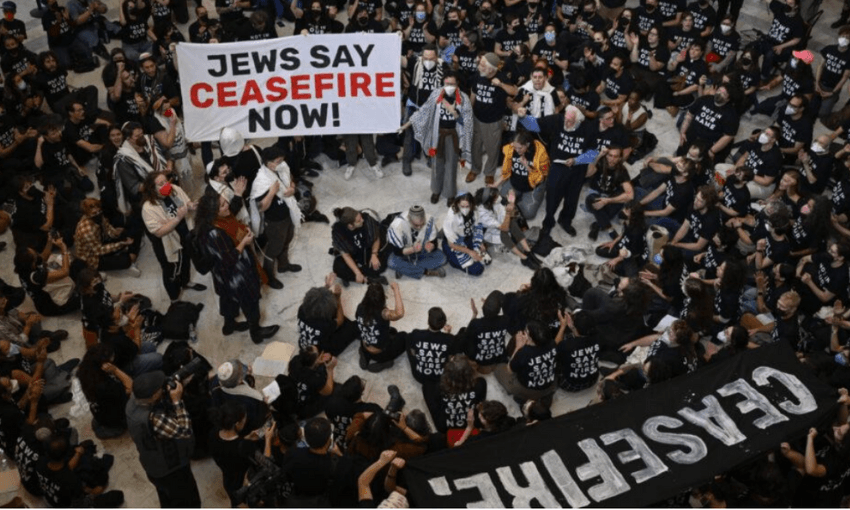
Jewish protest surrounding rabbis (wearing prayer shawls) in the Congressional rotunda (Photo: Jewish Voice for Peace)

That’s New York. What happens here? North of the Dunedin Jewish Congregation,
what happens when a Jewish person asks, “What will I believe?
Everything I have been told? Or the world in front of my eyes? If I am
not Zionist, who am I?”


Until very recently, we asked that question at the expense of
our communal lives. The effort of forming a Jewish identity that is
politically alive and principled – and, for some of us, spiritual – was
solitary work. Now we are building organisations to belong to. We have
made a religious space not distorted by nationalism. 


I wrote Jewish, not Zionist to tell one story of Aotearoa’s liberatory Jewish community. Far from feeling threatened by the rights of Palestinians, we regard justice as our common cause. We are tangata Tiriti, committing also to the long
work of justice at home. 


If not through Zionism, Aotearoa’s media presents the Jewish community through the lens of antisemitism. Repeatedly, reports of protest are diverted by claims of antisemitism. The focus of protest is obscured by personal accusations. It is an act of political misdirection to confuse principled protest with racial hatred. It implies that there is no other motive for upholding the
rights of Palestinians.


Furthermore, when the media fails to present the Jewish
community more fully, they reduce Jewish identity to victimhood. That is
a distortion. We – Jewish New Zealanders – are not Aotearoa’s victims.
Here, now, we are not underserved, over-imprisoned, or denied education.
We do not tend to be food-insecure and few of us lack shelter. Many of
us lead privileged lives. And we are not the people whose whānau are
experiencing what the UN’s highest court has called “plausible
genocide”. 


We are not victims but we are targets of antisemitism. Distinct from its political use, real anti-Jewish hatred is alive and well. From the far right and malevolent disinformation networks, hardcore antisemitic voices are vigorously seeking to capitalise on widespread anger at Israel.

They want to spread the lie that Jewishness is the cause of genocide in
Gaza and injustice in Aotearoa – not nationalism or colonialism or
imperial power-seeking, but Jews. 


Overwhelmingly, these networks are also Islamophobic: Jews and Muslims are in this together. Aotearoa’s anti-Zionist Jews work alongside our natural antiracist allies to uphold the rights of Palestinians, Muslims, tangata whenua and Jews. Human and political rights are everyone’s rights, or they are nothing.


Even as we struggle with our outrage at Israel’s slaughter of
civilians and the betrayals of law and politics, we reject the excuse of
racism. We see exploitative structures of power and economy, not
ethnicity. We protest against the crimes of genocide, apartheid,
collective punishment and starvation – not against Jews, Jewishness or
Judaism. Not against Palestinians, Arabs, Muslims or those who are
assumed to be Muslim. 

At this moment, being Jewish in public can feel like standing on a very
narrow bridge. As Rebbe Nachman of Bratslav wrote, when you stand on a
very narrow bridge, the most important thing is not to be afraid. In
that spirit, I have written one story to invite the whole anthology of
our liberatory, spiritually and politically alive Aotearoa Jewishness.


Please tear up the old scripts and make some space.


Jewish, not Zionist by Marilyn Garson ($30, Left of the Equator Press) will be launched at Unity Books Wellington on October 22 and at Trades Hall, Auckland on October 27.